|




















The
Adventures of Sherlock Holmes
|
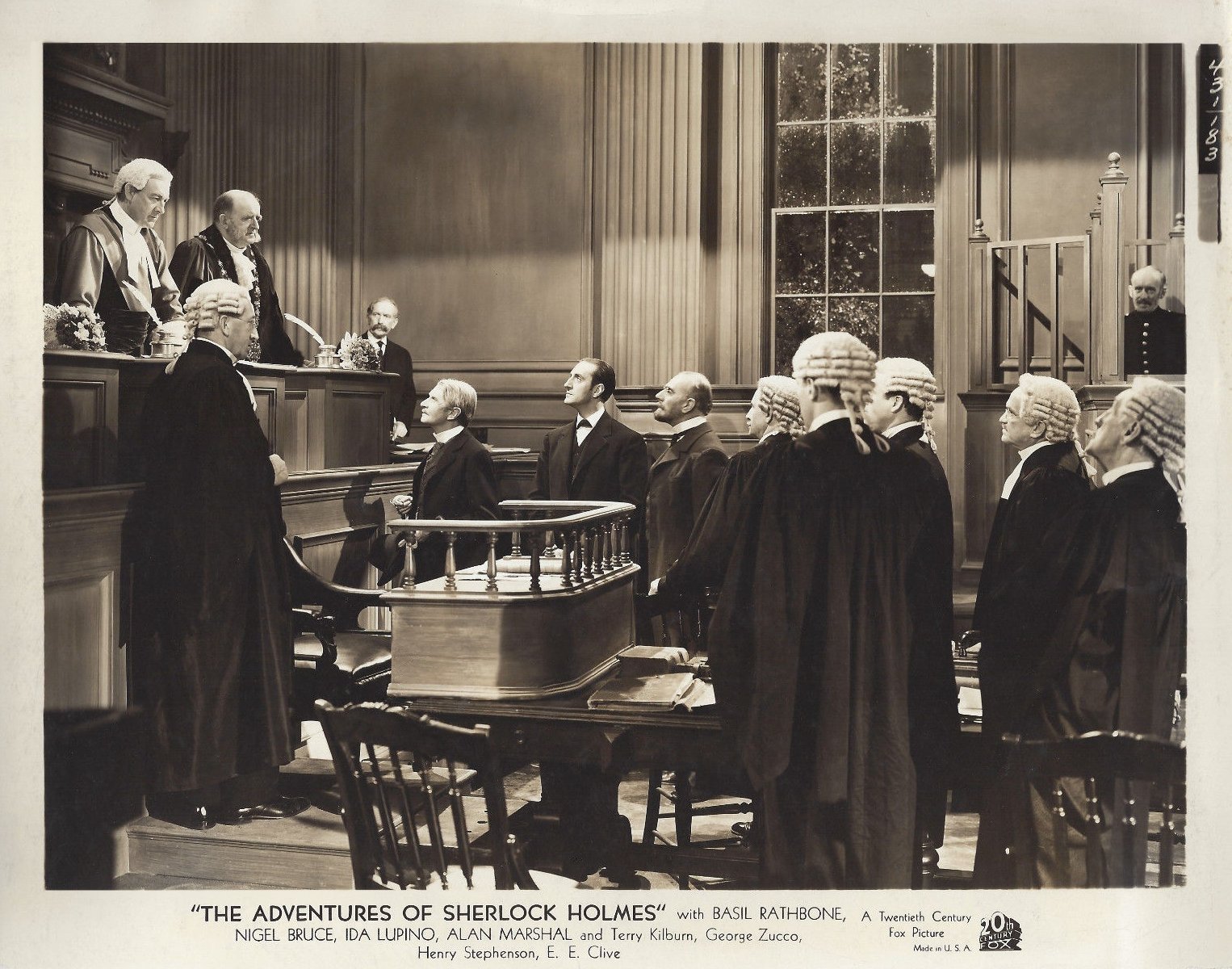 Moriarty is acquitted. |
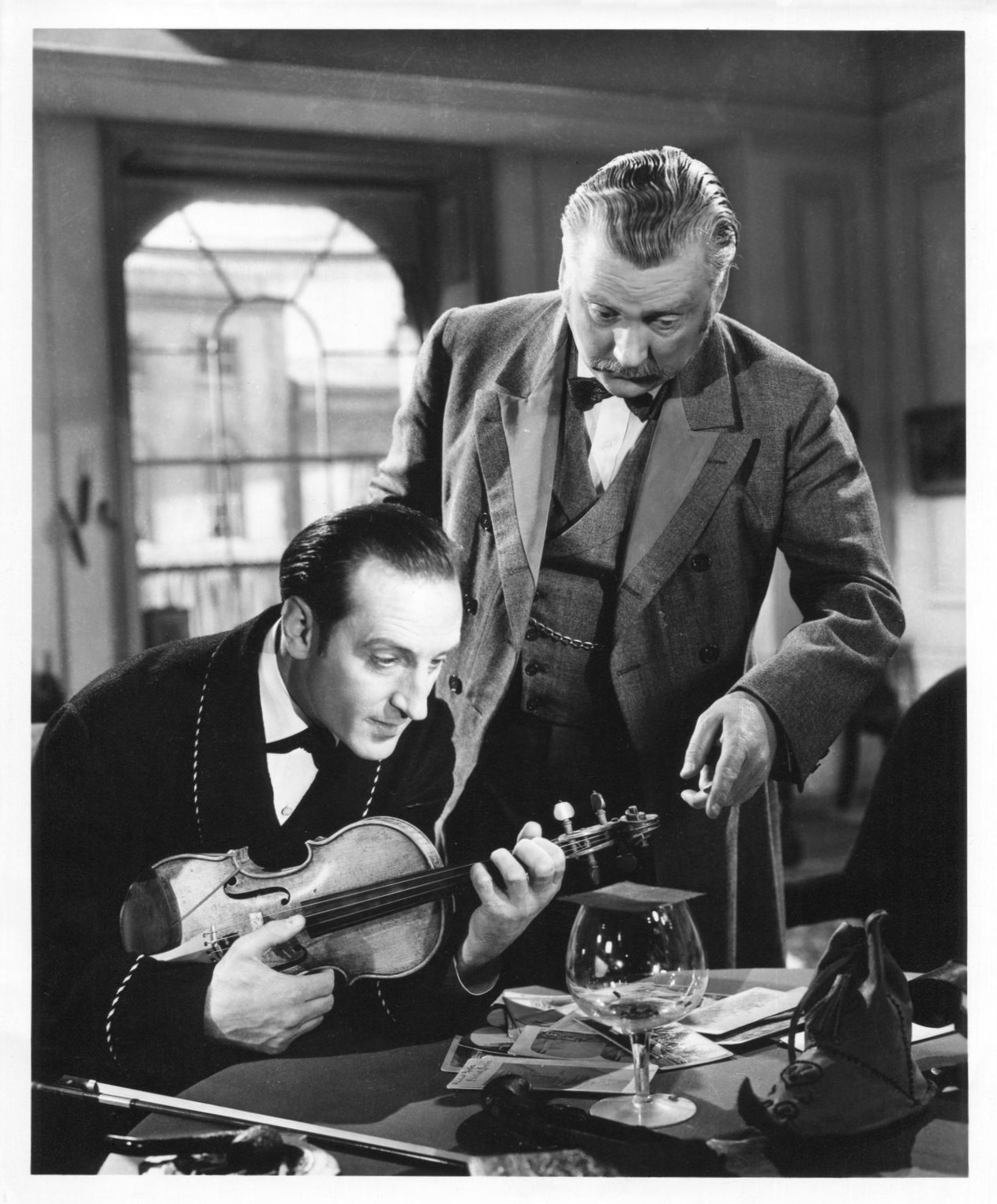 Holmes tries to annoy the flies. |
Meanwhile, at Mrs. Jameson's garden party Holmes, disguised as a "music hall chap," does a song and dance routine while keeping an eye on Miss Brandon. As far as I know, this is the only film in which we hear Basil Rathbone sing. It isn't great singing, but good enough for the character, and a great disguise for Holmes. Later, Holmes hears Miss Brandon's screams coming from the garden. He rushes to her, arriving just in time to see a man about to hurl a Patagonian bolas (a weapon made of long strands of rawhide with leather-coated lead balls on the ends). Holmes knocks Miss Brandon to the ground as the deadly bolas flies by and decapitates a nearby statue. When Holmes learns from the would-be killer that Moriarty is behind this, he figures out what Moriarty is really up to, and he and Watson rush off to the Tower of London in time to thwart Moriarty's theft of the crown jewels. A hand-to-hand battle between Holmes and Moriarty ensues atop the Tower, ending with Moriarty falling to his apparent death below. (Moriarty never really dies. He returns in Sherlock Holmes and the Secret Weapon and again in The Woman in Green.)
In the final scene, while Holmes and Watson are dining in a restaurant and reading of Ann Brandon's marriage to Jerrold Hunter, Holmes begins to pluck at a fiddle to find the note that will annoy the flies and make them leave. Watson demonstrates to Holmes the better way to eliminate flies—WHACK! with a newspaper.
This ending was not in the original script for the film. The first ending features a scene in Inspector Bristol's office, in which Mateo (the murderous Indian with the bolas) explains why he tried to kill Miss Brandon. He claims that Miss Brandon's father killed his father years ago, and stole the mine that made the Brandon family rich. Mateo swore vengeance against Brandon and his family. (One wonders what Moriarty had to do with this.) While this scene does tie up some loose ends, director Alfred Werker felt the lengthy explanatory scene was too anticlimactic and replaced it in the final edit with the shorter restaurant scene.
|
Adventures of Sherlock Holmes Brisk, bright, atmospheric detective tale, deftly made and played, in which Holmes matches wits with the arch-criminal Moriarty who has warned he will commit the crime of the century. Sherlock Holmes has come to the screen many times during the past twenty years, but never in a neater, more compact and more enjoyable picture than this, which may be and many fans will hope will be the start of a long series. Professor Moriarty, the one adversary most worthy of his steel Holmes ever faced, is on trial for murder. Holmes dashes in to break the Professor's alibi with evidence that he had tampered with the master clock at Greenwich — too late. An acquittal has been pronounced and under British law no man can be placed in jeopardy of his life twice on the same charge. The Professor warns Holmes that he intends to commit the super crime of modern times and departs in triumph. Then begins the duel of wits. Two threatened crimes are dramatically brought to Holmes' attention. The Custodian of the Crown Jewels has received a not that the fabulous Star of Delphi is to be stolen. And the beautiful Ann Brandon dashes in with a plea for help. Her brother has received a death threat precisely like that which preceded the killing of her father years before. The brother is murdered — and Ann herself is designated as the next victim. The Professor's diabolical scheme is working, for Holmes dispatches Watson to guard the Star of Delphi while he himself investigates the murder riddle. But the Professor has not reckoned with Holmes' speed in action. Ann is saved and the murder mystery solved in time for Holmes to scent the connection with the jewel scheme and to arrive at the Tower of London and battle the Professor to a finish — of the film, but not necessarily of the Professor. For arch criminals have a habit of coming back even from what looks like certain death for further adventures in later films. Basil Rathbone is, of course, the perfect choice for Holmes as The Hound of the Baskervilles proved not long ago. Nigel Bruce is again a grand Watson, handicapped by some absurd lines in the script, but still the blundering, marveling, touchingly faithful man who lives in Conan Doyle's pages. George Zucco is the Professor to the last whisker and sinister whisper and E. E. Clive as Inspector Bristol is a good substitute for the Lestrade of the original tales. Ida Lupino slips smoothly into the story as Ann Brandon, equally able in moments of brief romance with Alan Marshal and in the scenes of terror when the killer is on her trail. The pace is crisp, the whole effect clean-cut and compact. It's not a big picture stepped up with a Richard Greene to draw in the matinee idolizers. It's a straightforward Sherlock Holmes adventure in the true tradition. —Movies and the People Who Make Them, 1939 |
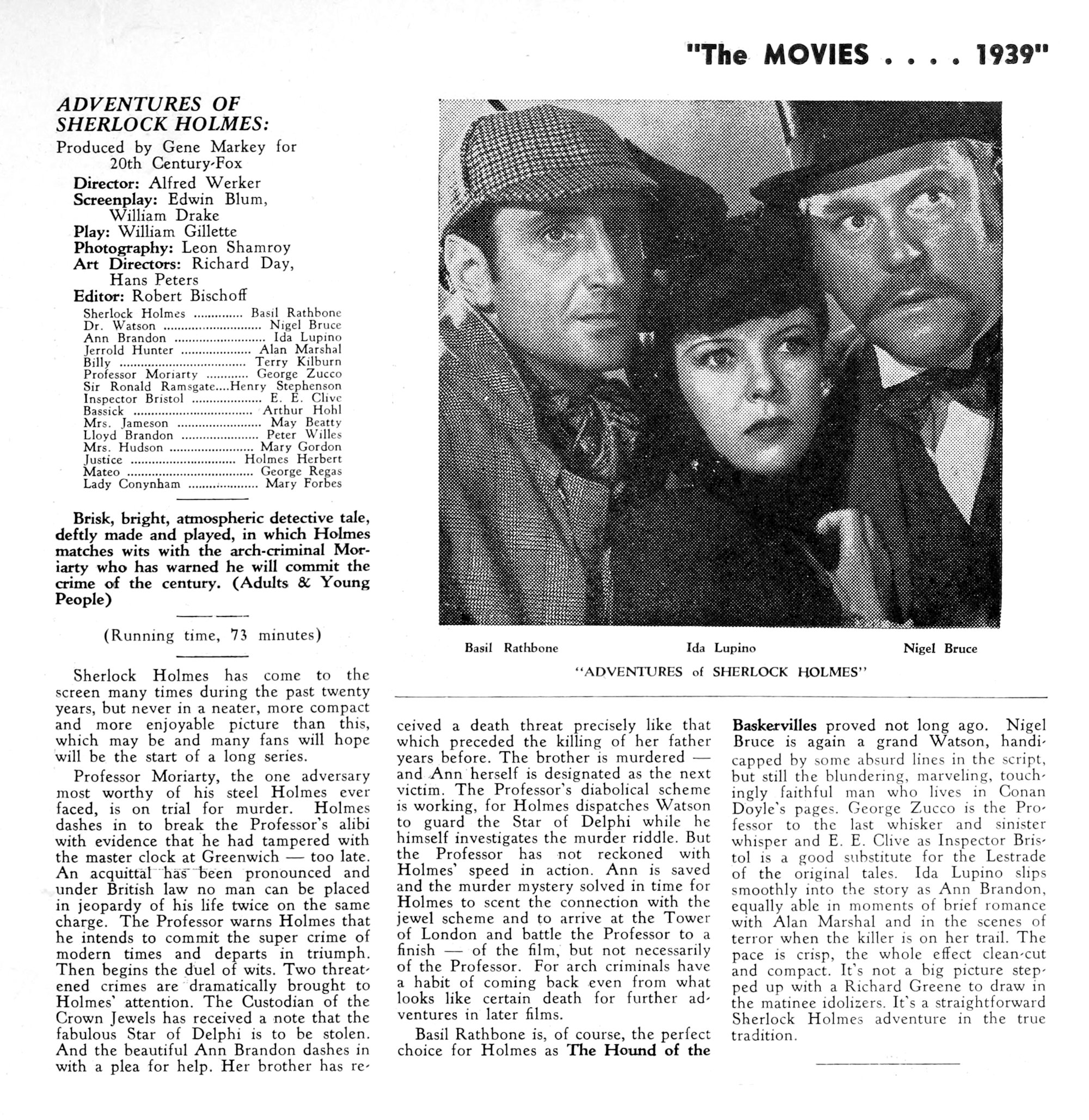
The success of The Hound of the Baskervilles as brought to the screen by 20th Century-Fox induced the studio to plan a series of Sherlock Holmes pictures, with Basil Rathbone in the role of the famous detective and Nigel Bruce as Dr. Watson. The Adventures of Sherlock Holmes, taken from the William Gillette play, is the second in the series. In a surprising move after the success of The Adventures of Sherlock Holmes, 20th Century-Fox decided not to produce more Holmes films. According to Scarlet Street editor Richard Valley, the Conan Doyle estate was displeased with The Adventures of Sherlock Holmes, and as a result, demanded that the studio adapt the original tales instead of using non-Canonical tales. 20th Century-Fox was unwilling to agree to these demands; thus the plan for a series of Holmes films was shelved. (See Scarlet Street, No. 13, Winter 1994, p. 33.)
About two years later Universal Studios acquired the film rights to the Sherlock Holmes stories, and Universal placed Basil Rathbone, Nigel Bruce and Mary Gordon (Mrs. Hudson) under contract for four years.
The Adventures of Sherlock Holmes began filming on June 3, 1939, immediately upon completion of The Hound of the Baskervilles.
According to Rathbone's contract with 20th Century Fox (signed October 25, 1938), he was paid $5000 per week to play Sherlock Holmes in The Hound of the Baskervilles and The Adventures of Sherlock Holmes.
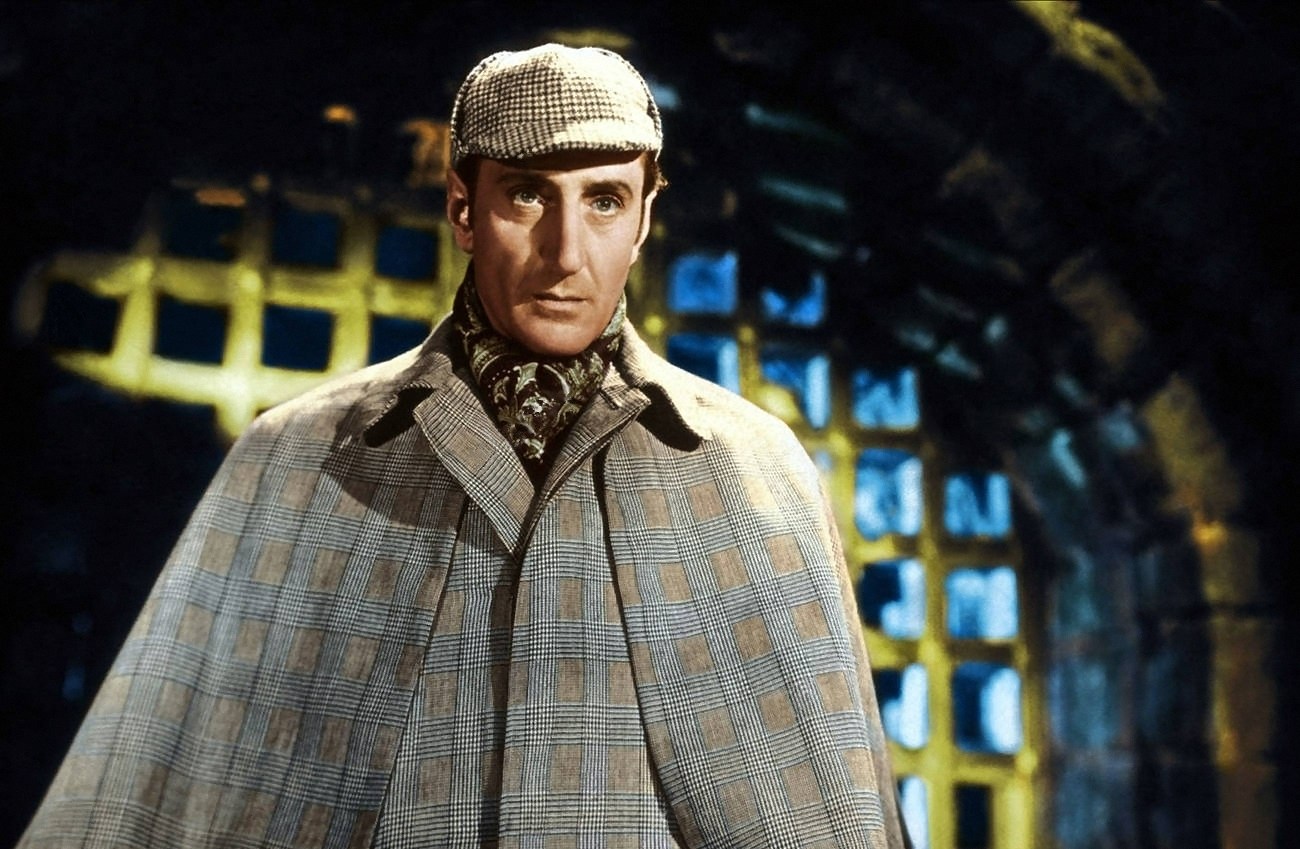
Basil Rathbone is again superlative in the role of Sherlock Holmes, infusing the detective with the color, mystery and genius which have made the character a byword all over the world.
Nigel Bruce likewise is outstanding in the same character he portrayed in The Hound of the Baskervilles—the grumpy, lovable and sometimes blundering confidant of the master criminologist.
George Zucco also appeared as Richard Stanley in Sherlock Holmes in Washington. In 1920 Zucco joined the New Shakespeare Company in Stratford upon Avon—the same acting company that Basil Rathbone had been in earlier. By 1920 Rathbone was no longer with the company.
Holmes Herbert, who played the Justice of the Court in the opening scene, appeared in several other Sherlock Holmes films: Sherlock Holmes and the Secret Weapon, The Pearl of Death, Sherlock Holmes in Washington, The House of Fear, and Dressed to Kill.
Arthur Hohl (Bassick) was also in The Scarlet Claw (Emile Journet) and The Spider Woman (Adam Gilflower).
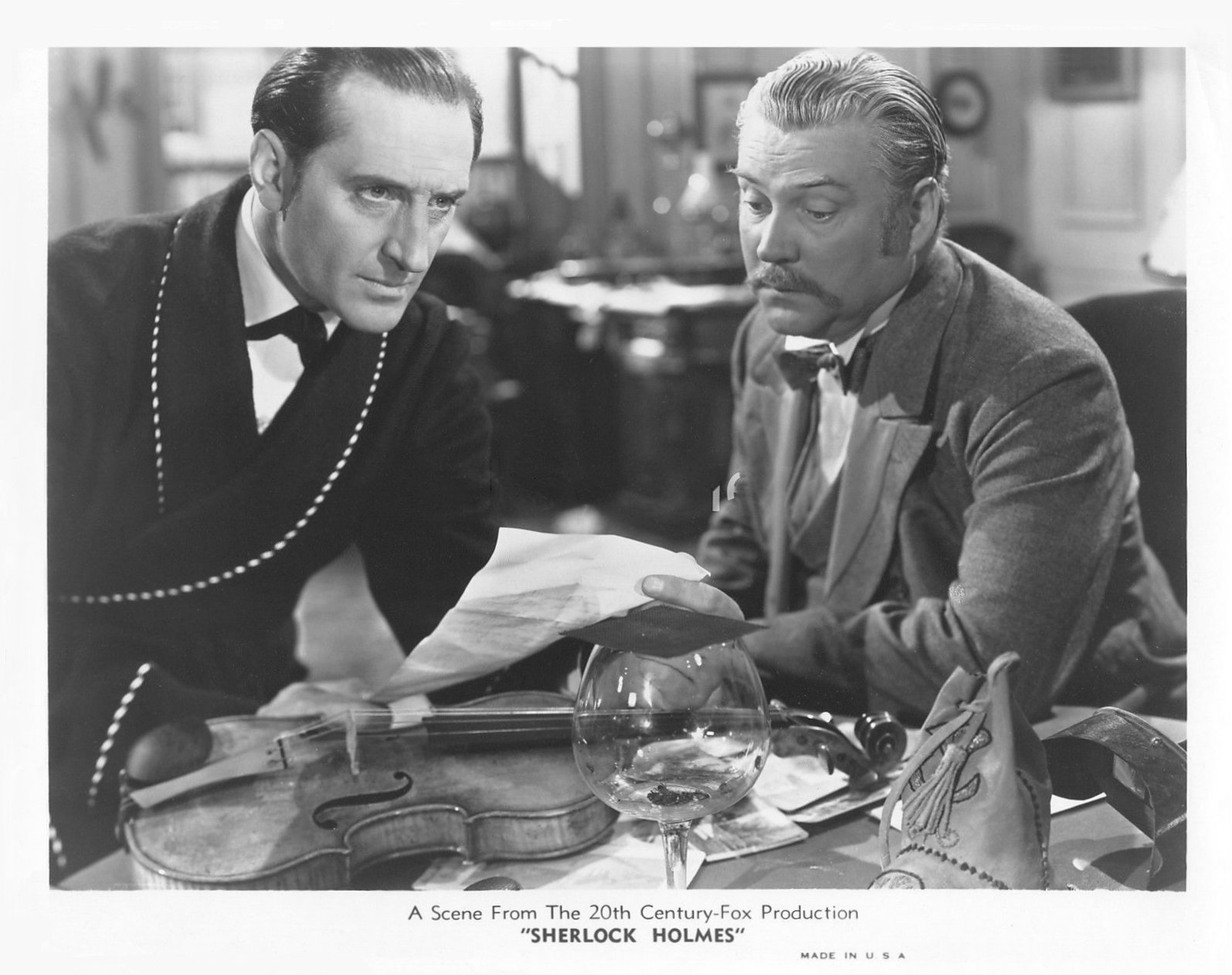 A letter has come in the post. |
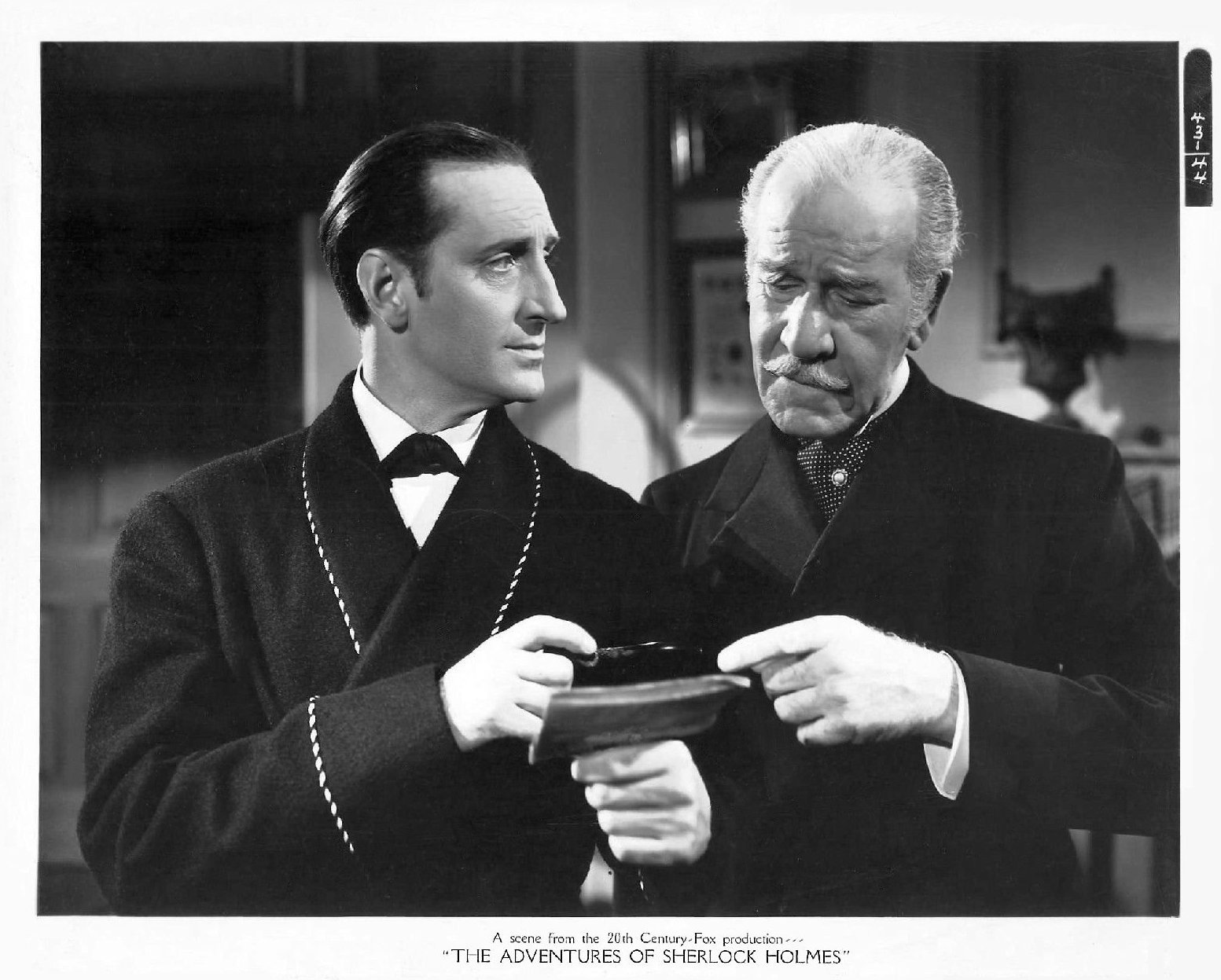 Sir Ronald Ramsgate consults Holmes about the Star of Delhi. |
The Exhibitor (June 21, 1939) and Variety (July 26, 1939) both list Lionel Atwill as one of the cast, right after Terry Kilburn, who played Billy. George Zucco's name is further down the cast list, indicating that he had a smaller part. It seems likely that Lionel Atwill was the studio's first choice to play Professor Moriarty. For some unknown reason, he couldn't do it (probably a schedule conflict), and George Zucco was then given the part.
This was one of Ida Lupino's early films, and her performance was superb. She went on to earn fame not only as an accomplished actress, but also as a director, producer and screenwriter. According to a Scarlet Street interview (issue #13, p. 48), Lupino had fun during the filming of The Adventures of Sherlock Holmes and liked to call her co-star "Basil Bathrug."
In another Scarlet Street interview, Terry Kilburn said, "[Basil Rathbone] was a great gentleman and an extremely pleasant person. Everybody liked him very much. Of course, in those days, he was more famous for playing villains, and he couldn't have been more different. He was a gentle and really very charming man, and he was indeed very, very well liked by everybody." (See Scarlet Street, No. 13, p. 53.)
|
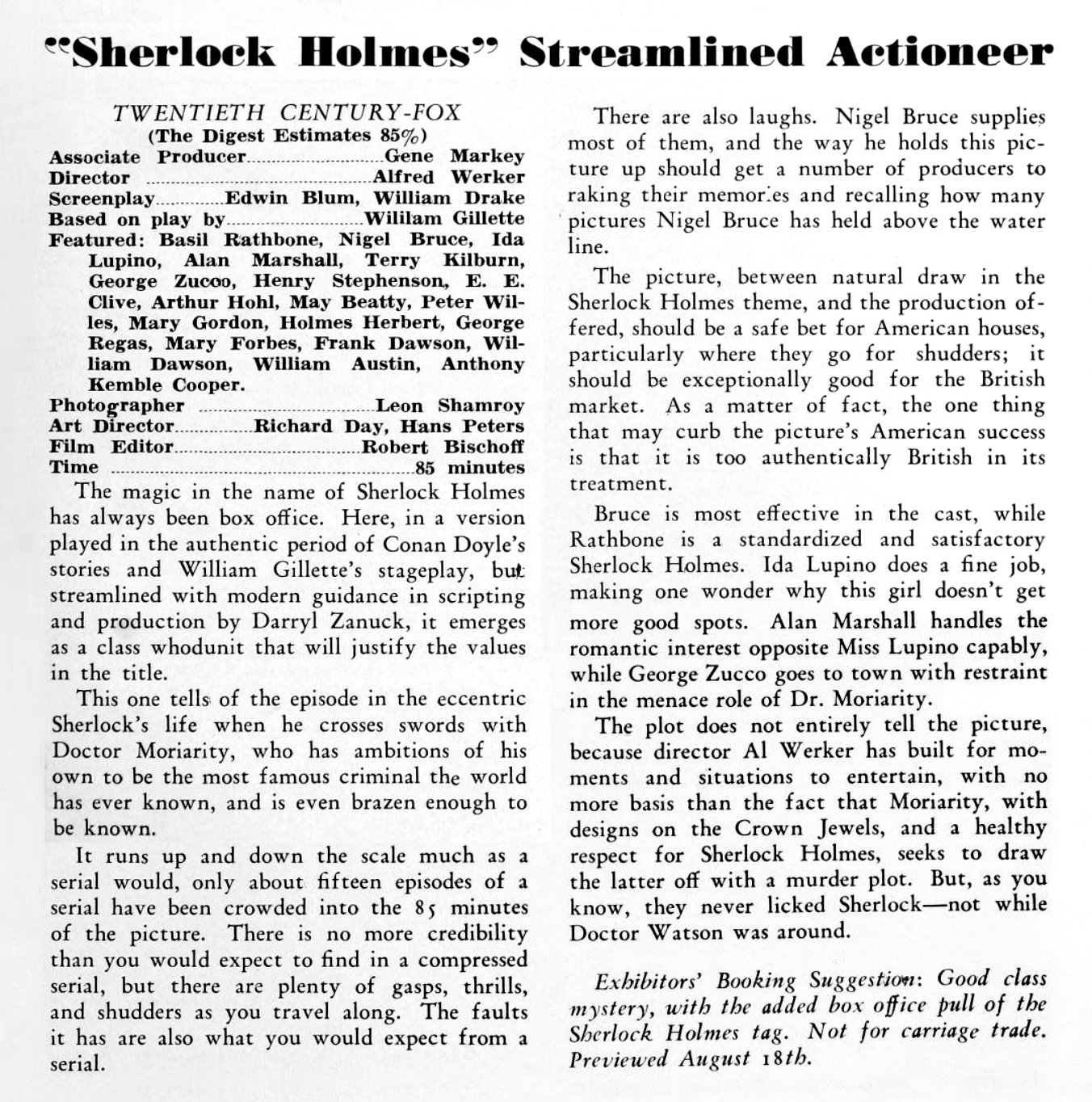
"Sherlock Holmes" Streamlined Actioneer The magic in the name of Sherlock Holmes has always been box office. Here, in a version played in the authentic period of Conan Doyle's stories and William Gillette's stageplay, but streamlined with modern guidance in scripting and production by Darryl Zanuck, it emerges as a class whodunit that will justify the values in the title. This one tells of the episode in the eccentric Sherlock's life when he crosses swords with Doctor Moriarty, who has ambition of his own to be the most famous criminal the world has ever known, and is even brazen enough to be known. It runs up and down the scale much as a serial would, only about fifteen episodes of a serial have been crowded into the 85 minutes of the picture. There is no more credibility than you would expect to find in a compressed serial, but there are plenty of gasps, thrills, and shudders as you travel along. The faults it has are also what you would expect from a serial. There are also laughs. Nigel Bruce supplies most of them, and the way he holds this picture up should get a number of producers to raking their memories and recalling how many pictures Nigel Bruce has held above the water line. The picture, between natural draw in the Sherlock Holmes theme, and the production offered, should be a safe bet for American houses, particularly where they go for shudders; it should be exceptionally good for the British market. As a matter of fact, the one thing that may curb the picture's American success is that it is too authentically British in its treatment. Bruce is most effective in the cast, while Rathbone is a standardized and satisfactory Sherlock Holmes. Ida Lupino does a fine job, making one wonder why this girl doesn't get more good spots. Alan Marshall handles the romantic interest opposite Miss Lupino capably, while George Zucco goes to town with restraint in the menace role of Dr. Moriarty. The plot does not entirely tell the picture, because director Al Werker has built for moments and situations to entertain, with no more basis than the fact that Moriarty, with designs on the Crown Jewels, and a healthy respect for Sherlock Holmes, seeks to draw the latter off with a murder plot. But, as you know, they never licked Sherlock—not while Doctor Watson was around. —Box Office Digest, August 24, 1939 |
.
| Nigel Bruce wrote the following in his memoirs: | |
|
|
|
(posted on the Scarlet Street forums) |
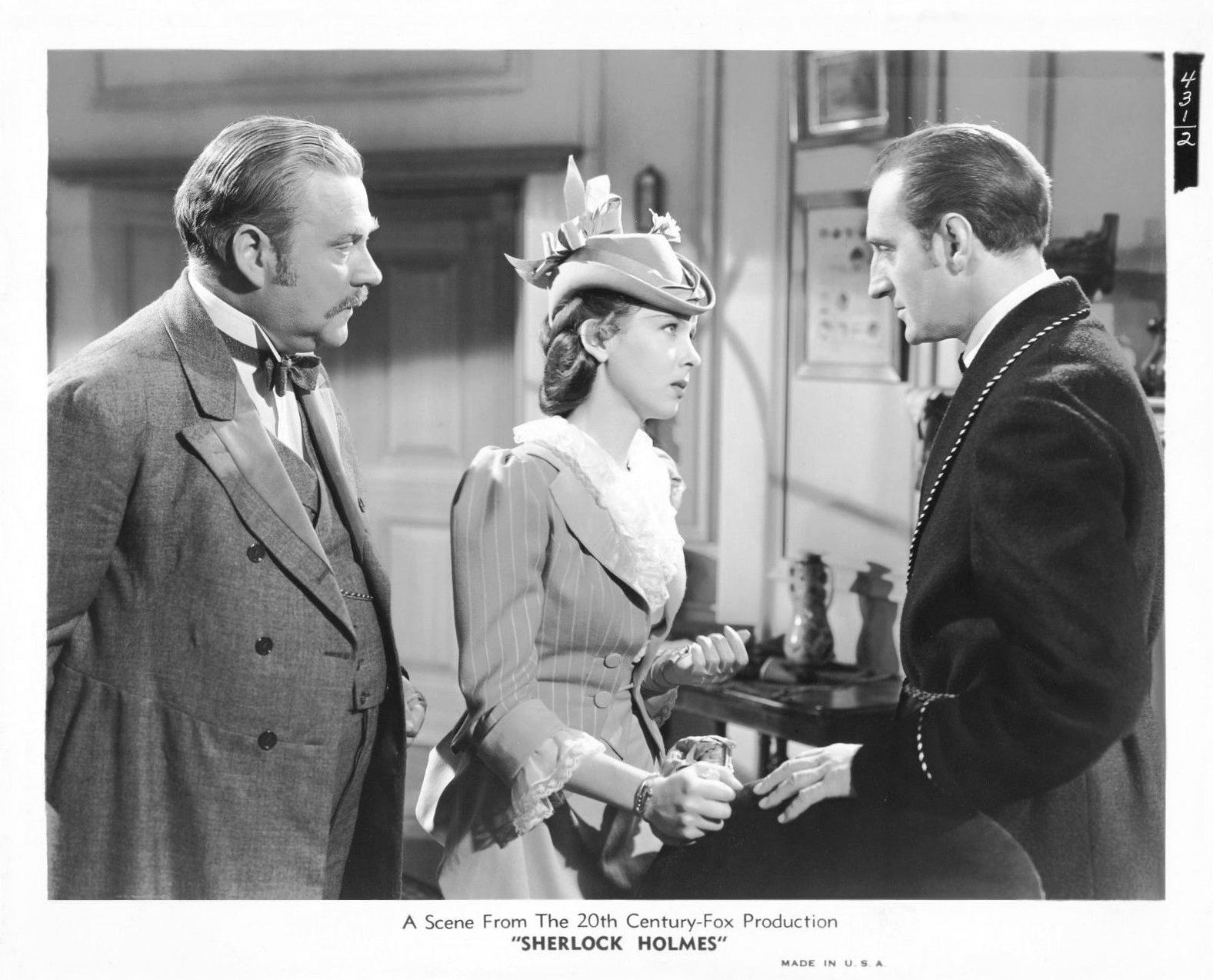 Miss Brandon consults Holmes about a garden party. |
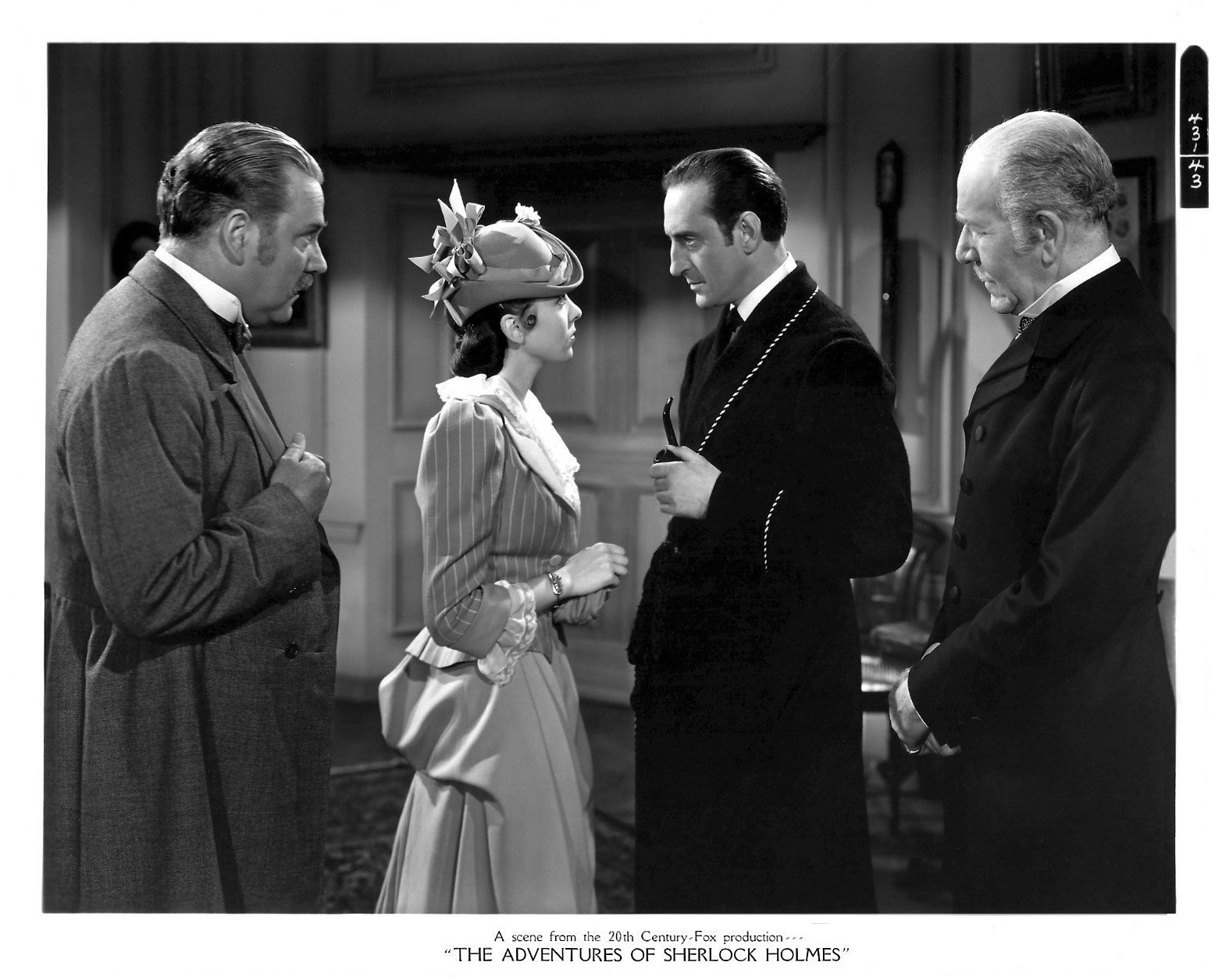 Nigel Bruce, Ida Lupino, Basil Rathbone, and Henry Stephenson |
About Nigel Bruce, Basil Rathbone wrote: "There is no question in my mind that Nigel Bruce was the ideal Dr. Watson, not only of his time but possibly of and for all time. There was an endearing quality to his performance that to a very large extent, I believe, humanized the relationship between Dr. Watson and Mr. Holmes." (In and out of Character, p. 181)
"Rathbone and Bruce were fine as the Baker Street residents." —Michael B. Druxman, Basil Rathbone: His Life and His Films
"The Adventures of Sherlock Holmes is in so many ways a superior film that to criticize it seems carping. Yet Moriarty's grand scheme is so complicated and unwieldy that it is embarrassing to see it almost work." —Chris Steinbrunner and Norman Michaels, The Films of Sherlock Holmes
|
RATHBONE AS SHERLOCK Who hasn't heard of Professor Moriarty, the arch-criminal of Sherlock Holmes fame? Well, he meets his match in the shape of Basil Rathbone, who at long last becomes a hero, if Sherlock Holmes can be called a hero, and appears in the film of that name at the Paramount next week. No one has ever disputed Basil Rathbone's remarkable histrionic ability, and I must say it is given full scope in this exceedingly clever story of the famous detective. Moriarty, who is played by George Zucco, having been acquitted of a murder charge, leaves the country a free man, but as he does so he warns Holmes that eh intends to accomplish the greatest crime the world has known for centuries. A note is later received by Sir Ronald Ramsgate, custodian of the Crown Jewels, warning him that the Star of Delhi, a gem of fabulous value, will be stolen, and he consults Holmes. About the same time, a young lady named Anne Brandon, played by Ida Lupino, tells Holmes that her brother has received a death threat, precisely the same as the one which preceded her father's murder 10 years earlier. Later the brother is murdered. This is a picture of thrills and chills, but it is also marked by splendid acting, well worthy of Rathbone's ability. Also in the cast are Nigel Bruce and Alan Marshal, the former playing the part of the famous Dr. Watson. This is a film you must not miss, and one I can heartily recommend. —Cedric Fraser, Liverpool Evening Express, April 20, 1940 |
"Amusing, exciting, and faithful to the traditions established by Sir Arthur Conan Doyle." —Elsie Finn, Philadelphia Record, August 26, 1939
"Basil Rathbone outshines his previous performance in Hound of the Baskervilles. With this second picture, it looks as if the series will prove to be well established. It is clever and the suspense holds up effectively throughout the picture." —The Los Angeles Times, August 24, 1939
"Basil Rathbone and Nigel Bruce, repeating in their respective Holmes-Watson roles, are excellent in type and delivery." —Box Office, August 26, 1939
Basil Rathbone singing "I Do Like to Be Beside the Seaside"
See more pictures and reviews on Page Two.
See Posters, Lobby Cards and Promo Photos on page 3.
.
|
|
The Adventures of Sherlock Holmes is available
|
Images on this page, Page Two and Page Three are from the film The Adventures of Sherlock Holmes, copyright 20th Century Fox.
