|




















A
Tale of Two Cities
|
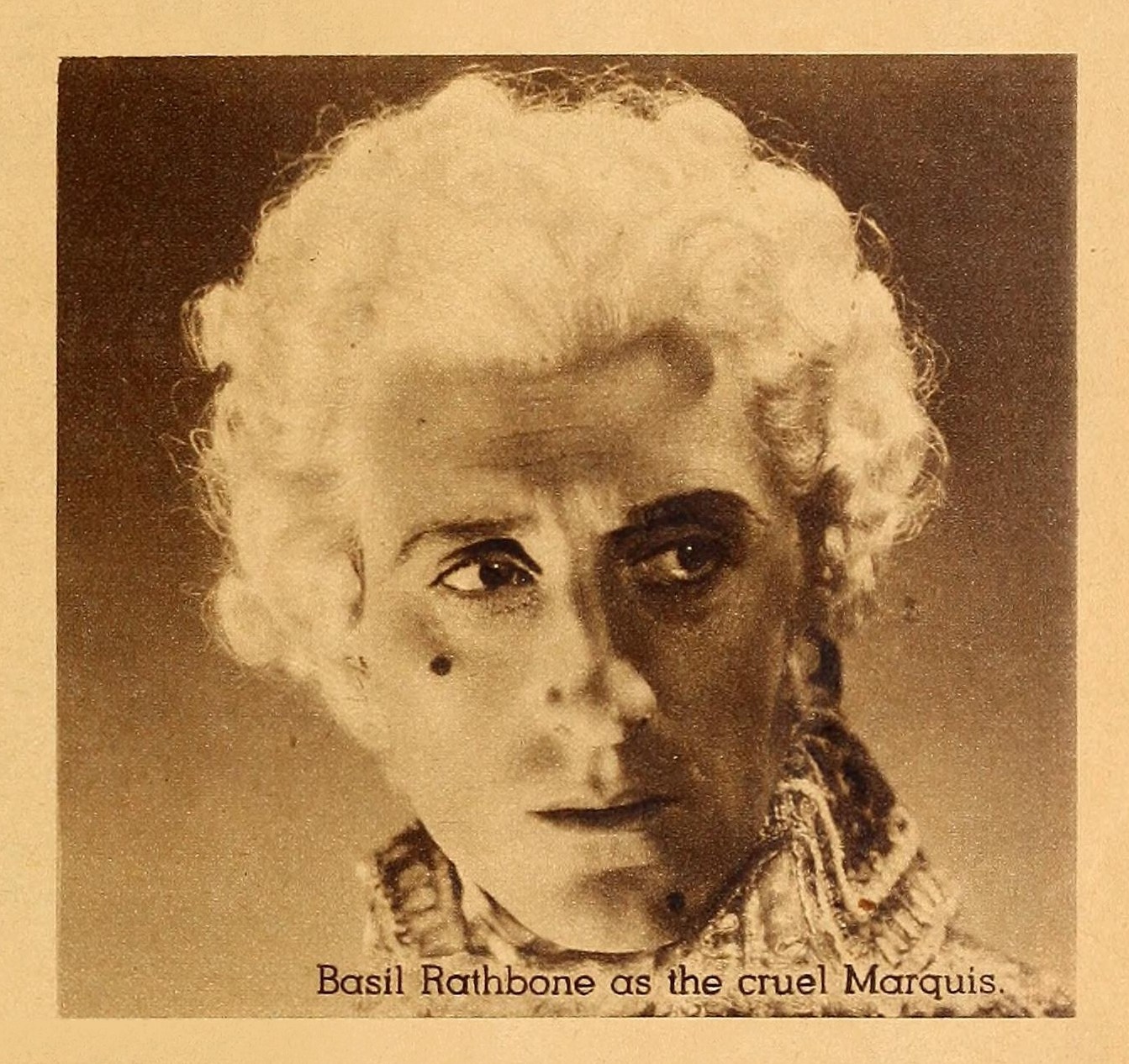
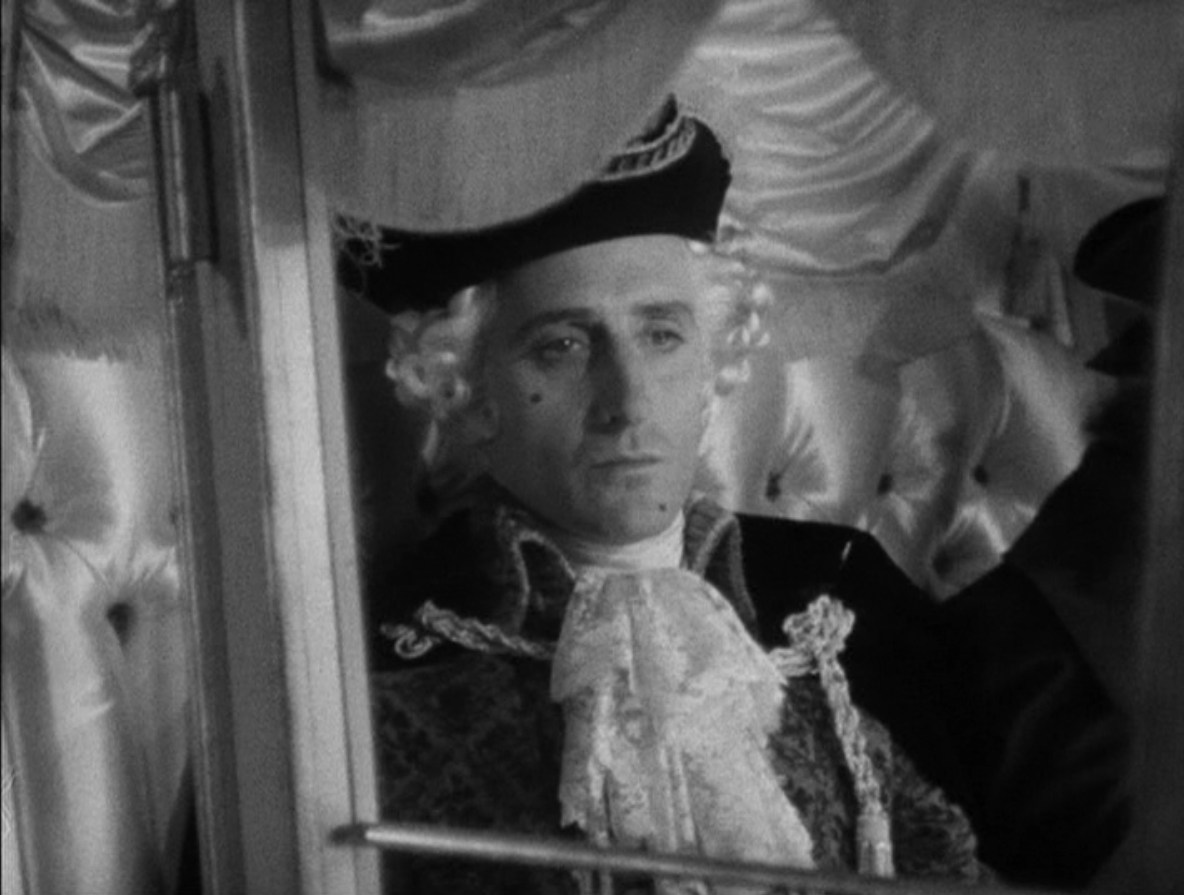 The Marquis rides in his carriage. |
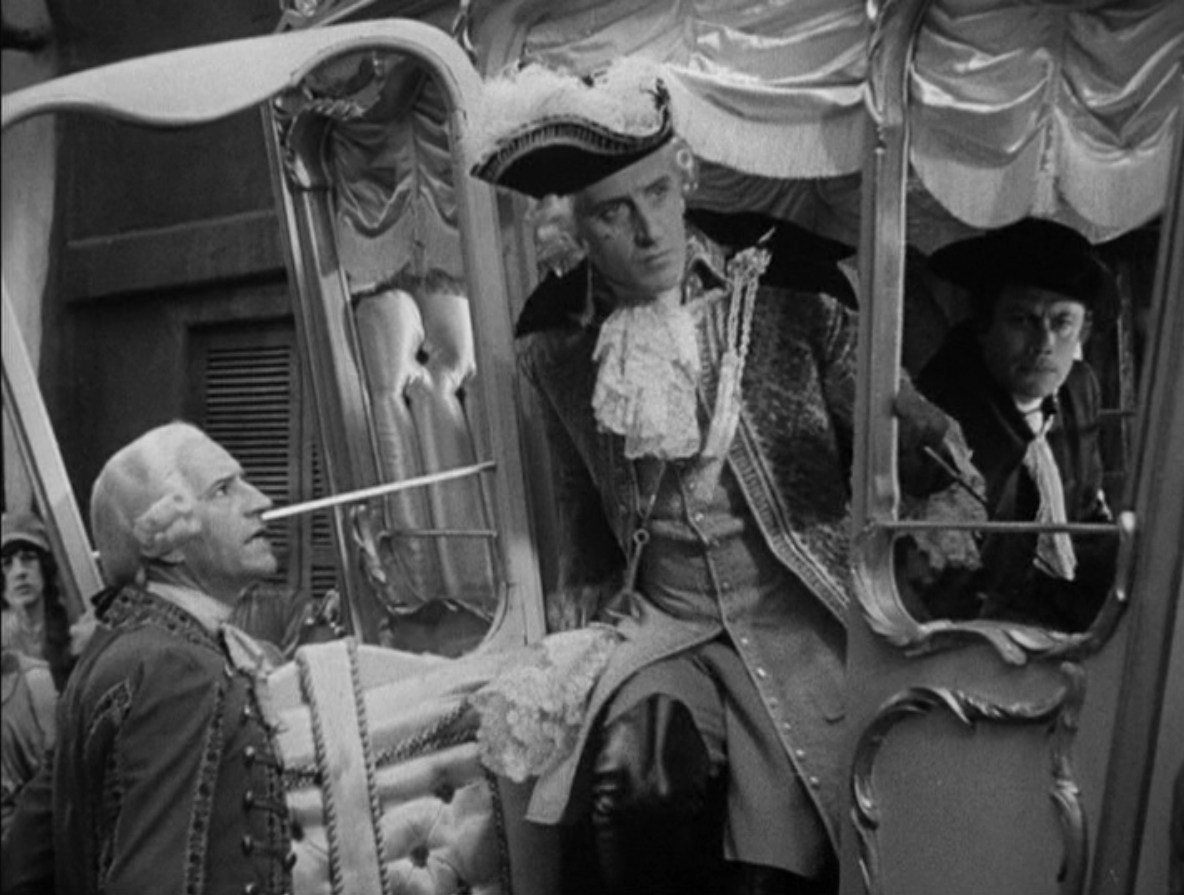 "The child is dead, Excellency." |
Charles Darnay, a nephew of the Marquis, renounces his heritage due to the cruelties of the French ruling aristocracy. After telling his uncle, "Our name is detested more than any name in France," Darnay emigrates to England, where he is promptly arrested and tried for treason. The trial introduces us to Sydney Carton, a London barrister who closely resembles Darnay. Carton, played by Ronald Colman, is a dissolute, cynical drunkard, but a brilliant lawyer; he succeeds in getting his client acquitted.
Both Sidney Carton and Charles Darnay fall in love with Lucie Manette, the daughter of Dr. Manette. Lucie marries Darnay, but she is unaware that his uncle (the Marquis St Evremonde) was responsible for her father's imprisonment.
When the Revolution came, so fierce was the popular hatred for the name of Evremonde that all who bore it were murdered, the innocent with the guilty. Young Darnay is tricked into returning to Paris and promptly condemned. Sydney Carton, unwilling to see his beloved Lucie in pain, redeems his wasted life by smuggling Darnay out of prison and then taking his place on the scaffold.
A TALE OF TWO CITIES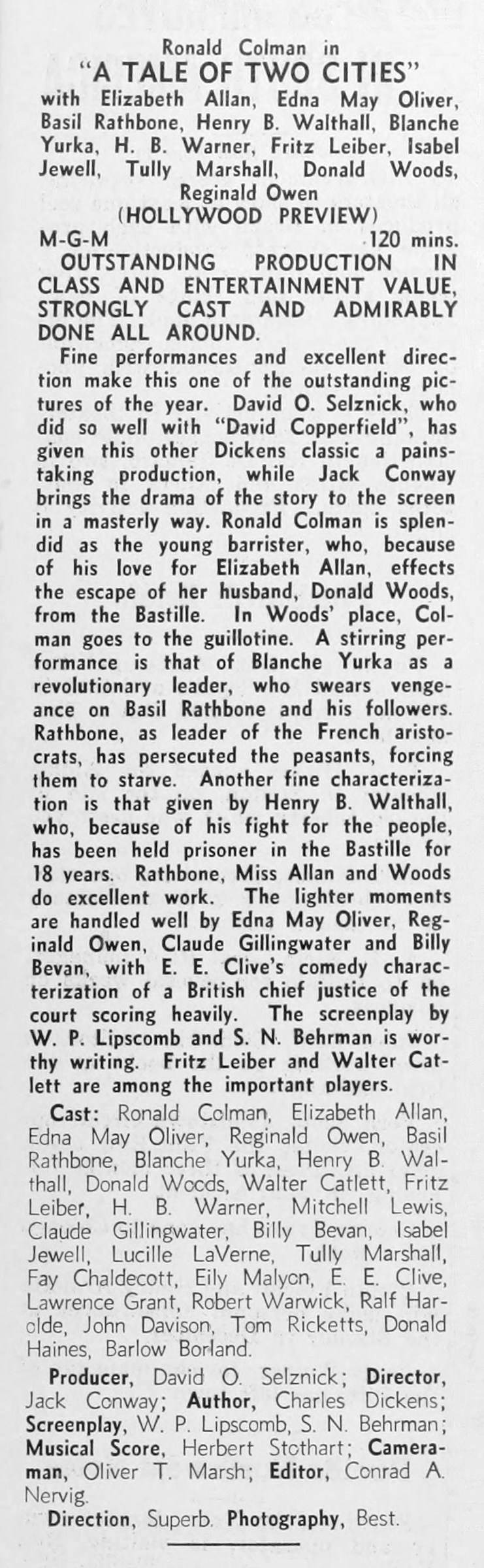 OUTSTANDING PRODUCTION IN CLASS AND ENTERTAINMENT VALUE, STRONGLY CAST AND ADMIRABLY DONE ALL AROUND. Fine performances and excellent direction make this one of the outstanding pictures of the year. David O. Selznick, who did so well with "David Copperfield," has given this other Dickens classic a painstaking production, while Jack Conway brings the drama of the story to the screen in a masterly way. Ronald Colman is splendid as the young barrister, who, because of his love for Elizabeth Allan, effects the escape of her husband, Donald Woods, from the Bastille. In Woods' place, Colman goes to the guillotine. A stirring performance is that of Blanche Yurka as a revolutionary leader, who swears vengeance on Basil Rathbone and his followers. Rathbone, as leader of the French aristocrats, has persecuted the peasants, forcing them to starve. Another fine characterization is that given by Henry B. Walthall, who, because of his fight for the people, has been held prisoner in the Bastille for 18 years. Rathbone, Miss Allan and Woods do excellent work. The lighter moments are handled well by Edna May Oliver, Reginald Owen, Claude Gillingwater and Billy Bevan, with E. E. Clive's comedy characterization of a British chief justice of the court scoring heavily. The screenplay by W. P. Lipscomb and S. N. Behrman is worthy writing. Fritz Leiber and Walter Catlett are among the important players. Direction, Superb Photography, Best. —The Film Daily, November 30, 1935 |
Four films based on Dickens novels were being prepared in 1934: David Copperfield (MGM); A Tale of Two Cities (Warner Bros.); Great Expectations (Universal); and The Pickwick Papers (Warner Bros.). The New Movie magazine (February 1934) announced that Warner Baxter would be seen as Sidney Carton in A Tale of Two Cities. A short time later, the news was that Leslie Howard would play Sidney Carton (Hollywood Filmograph, March 10, 1934).
Warner Brothers dropped the plans for both A Tale of Two Cities and The Pickwick Papers. In September 1934, The Film Daily announced that A Tale of Two Cities would be produced by Fox and directed by Frank Lloyd. By November 15, The Film Daily announced that A Tale of Two Cities would be made by MGM.
Early in 1935, Motion Picture Daily reported that Basil Rathbone was anxious to play the role of Sidney Carton in A Tale of Two Cities (Motion Picture Daily, February 20, 1935). Although he wasn't offered the role of Sidney Carton, Basil Rathbone joined the cast of A Tale of Two Cities in May 1935.
Ronald Colman was borrowed from 20th Century Fox to play Sidney Carton. The original plan was to have Colman play both Sidney Carton and Charles Darnay. David Selznick changed that plan in April (Silver Screen, October 1935). Like Basil Rathbone, Ronald Colman also was anxious to play the role of Sidney Carton. He told reporters, "Carton is a character one can believe in. ... I've dreamed of playing that role ever since I became an actor" (Movie Classic, November 1935). Ronald Colman's performance was named the best of the year by the Screen Actor's guild.
Shooting started June 4, 1935, and ended August 19, 1935. The film was released on Christmas Day.
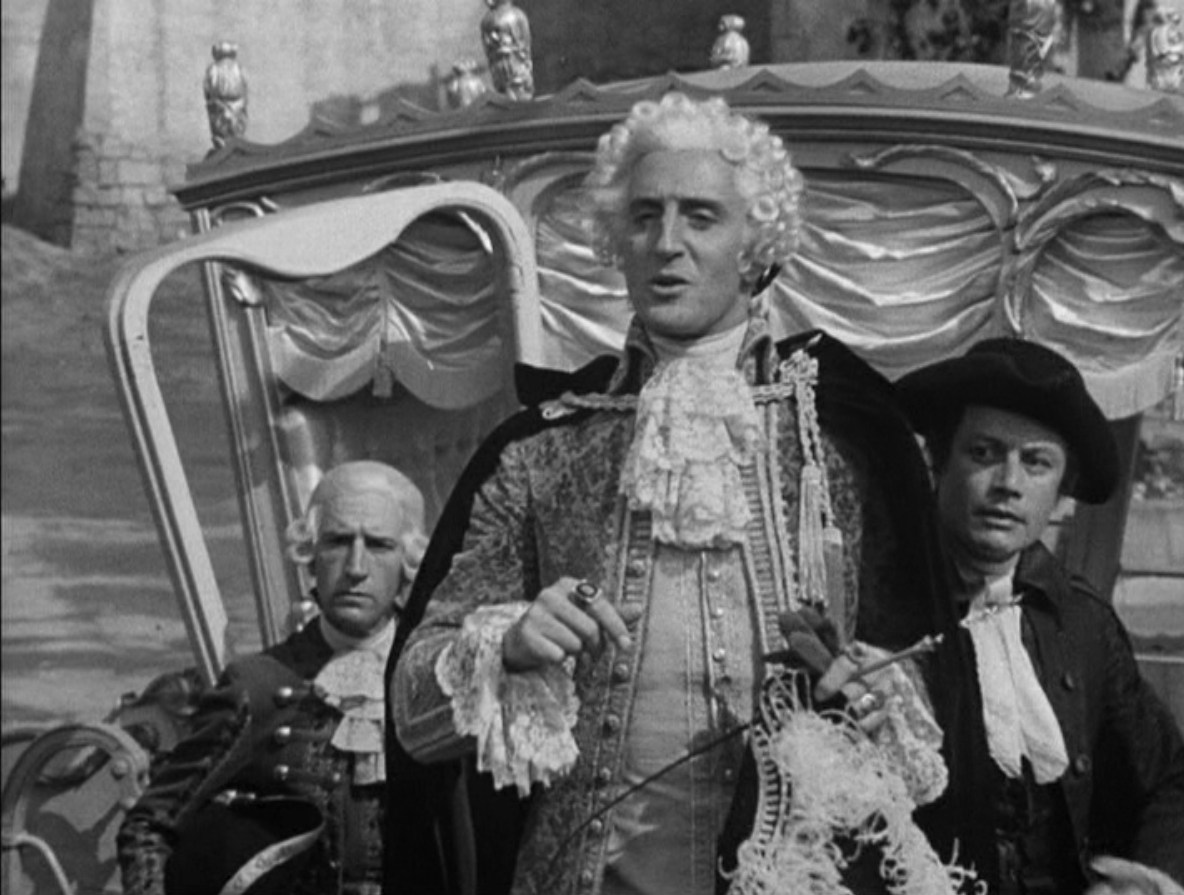 "It is extraordinary to me that you people cannot take care of yourselves and your children." |
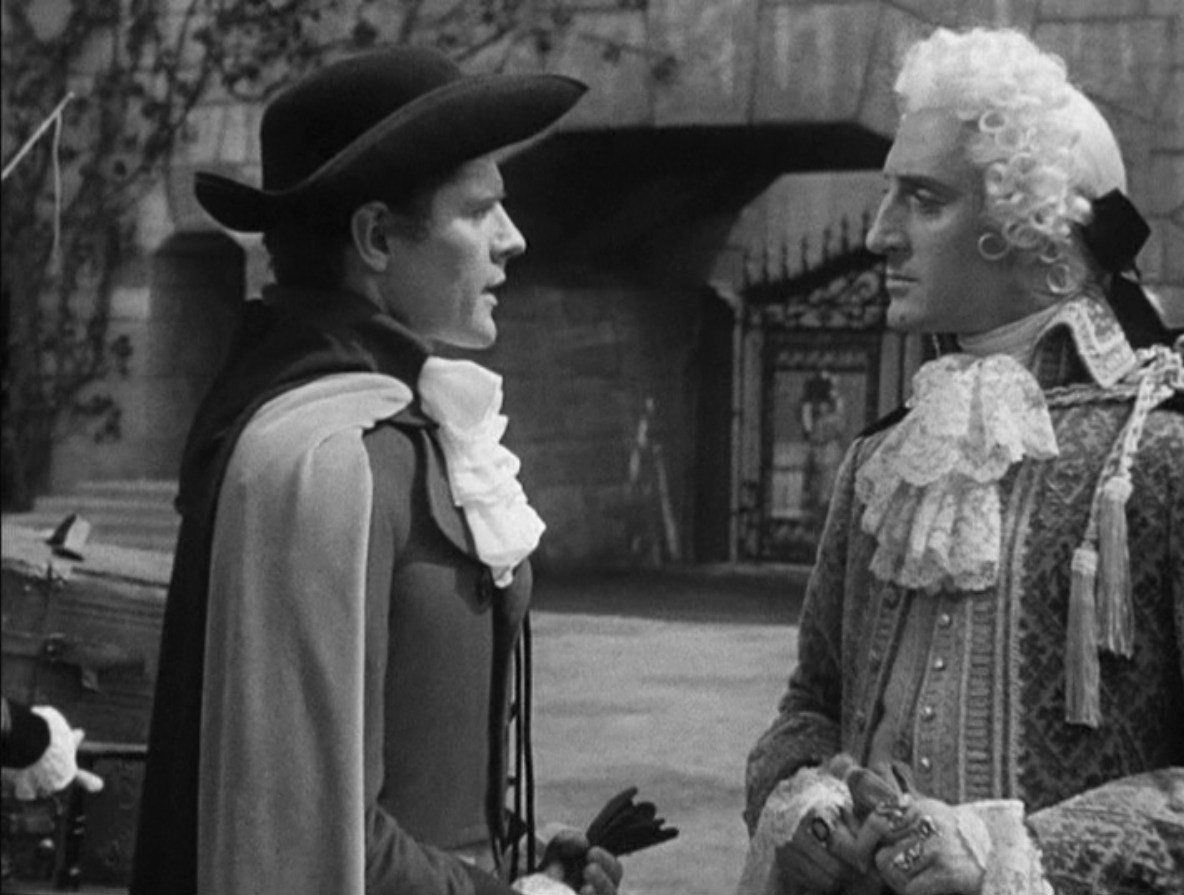 "You have made the name of Evremonde the most detested in all of France." |
Sixty-four sets were built on MGM studio locations. The huge cast included 112 speaking parts and thousands of extras. All the principal character actors and a large percentage of the supporting cast were English.
A Tale of Two Cities was the film debut for well-known stage actress Blanche Yurka (Madame Defarge). She wrote in her autobiography that sixty-seven actresses had tested for the role of Madame Defarge.
In addition to A Tale of Two Cities, David O. Selznick, the producer, worked with Basil Rathbone on three films: Anna Karenina, David Copperfield, and The Garden of Allah.
Basil Rathbone was awarded the BOXOFFICE Blue Ribbon Award for 1936 as the Marquis St. Evremonde. Rathbone's portrayal of the Marquis was perfect. In the novel the Marquis is described as having a handsome face, yet with a look of treachery and cruelty. The Marquis also appeared haughty, dignified, contemptuous, calm, and polished, yet ominous.
A Tale of Two Cities received two Academy Award nominations: Best Picture and Best Film Editing (Conrad Nervig).
A Tale of Two Cities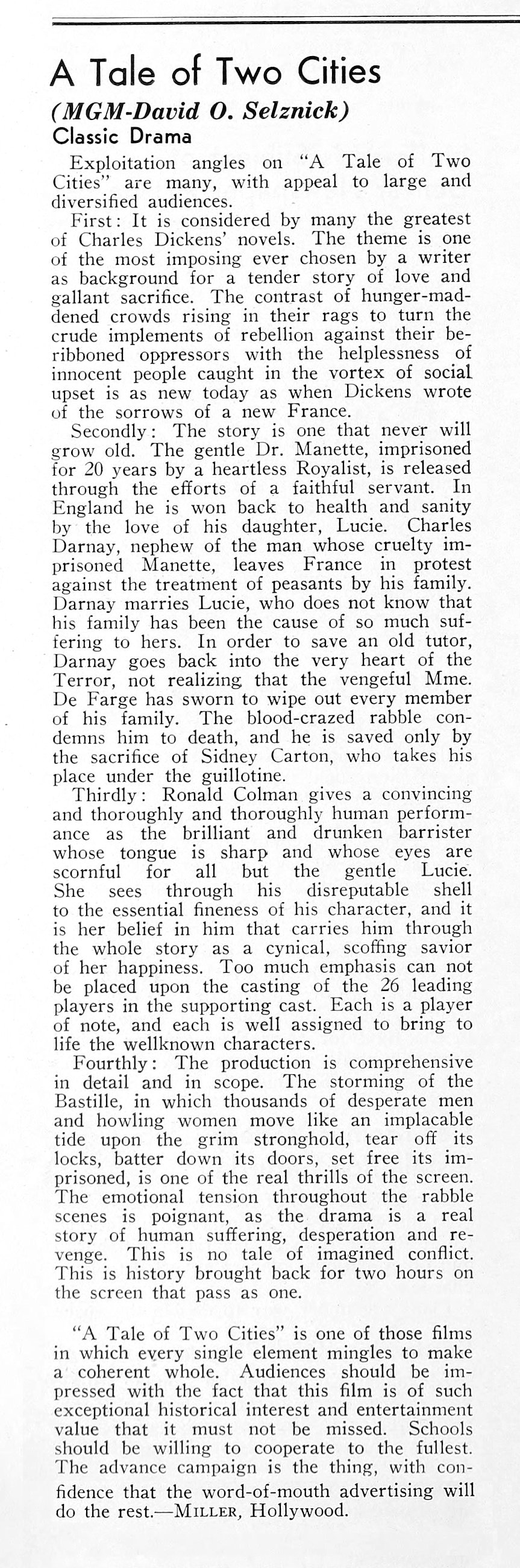 Exploitation angles on "A Tale of Two Cities" are many, with appeal to large and diversified audiences. First: It is considered by many the greatest of Charles Dickens' novels. The theme is one of the most imposing ever chosen by a writer as background for a tender story of love and gallant sacrifice. The contrast of hunger-maddened crowds rising in their rags to turn the crude implements of rebellion against their beribboned oppressors with the helplessness of innocent people caught in the vortex of social upset is as new today as when Dickens wrote of the sorrows of a new France. Secondly: The story is one that never will grow old. The gentle Dr. Manette, imprisoned for 20 years by a heartless Royalist, is released through the efforts of a faithful servant. In England he is won back to health and sanity by the love of his daughter, Lucie. Charles Darnay, nephew of the man whose cruelty imprisoned Manette, leaves France in protest against the treatment of peasants by his family. Darnay marries Lucie, who does not know that his family has been the cause of so much suffering to hers. In order to save an old tutor, Darnay goes back into the very heart of the Terror, not realizing that the vengeful Mme. De Farge has sworn to wipe out every member of his family. The blood-crazed rabble condemns him to death, and he is saved only by the sacrifice of Sidney Carton, who takes his place under the guillotine. Thirdly: Ronald Colman gives a convincing and thoroughly human performance as the brilliant and drunken barrister whose tongue is sharp and whose eyes are scornful for all but the gentle Lucie. She sees through his disreputable shell to the essential fineness of his character, and it is her belief in him that carries him through the whole story as a cynical, scoffing savior of her happiness. Too much emphasis can not be placed upon the casting of the 26 leading players in the supporting cast. Each is a player of note, and each is well assigned to bring to life the well-known characters. Fourthly: The production is comprehensive in detail and in scope. The storming of the Bastille, in which thousands of desperate men and howling women move like an implacable tide upon the grim stronghold, tear off its locks, batter down its doors, set free its imprisoned, is one of the real thrills of the screen. The emotional tension throughout the rabble scenes is poignant, as the drama is a real story of human suffering, desperation and revenge. This is no tale of imagined conflict. This is history brought back for two hours on the screen that pass as one. "A Tale of Two Cities" is one of those films in which every single element mingles to make a coherent whole. Audiences should be impressed with the fact that this film is of such exceptional historical interest and entertainment value that it must not be missed. Schools should be willing to cooperate to the fullest. The advance campaigning is the thing, with confidence that the word-of-mouth advertising will do the rest. —Miller, Hollywood. —Motion Picture Herald, December 7, 1935 |
"While other versions [of A Tale of Two Cities] have all been good films, none has achieved the stature of the 1935 version and its excellent combination of star power, technical brilliance and great storytelling." —Rovi, https://www.allmovie.com/movie/a-tale-of-two-cities-v48478
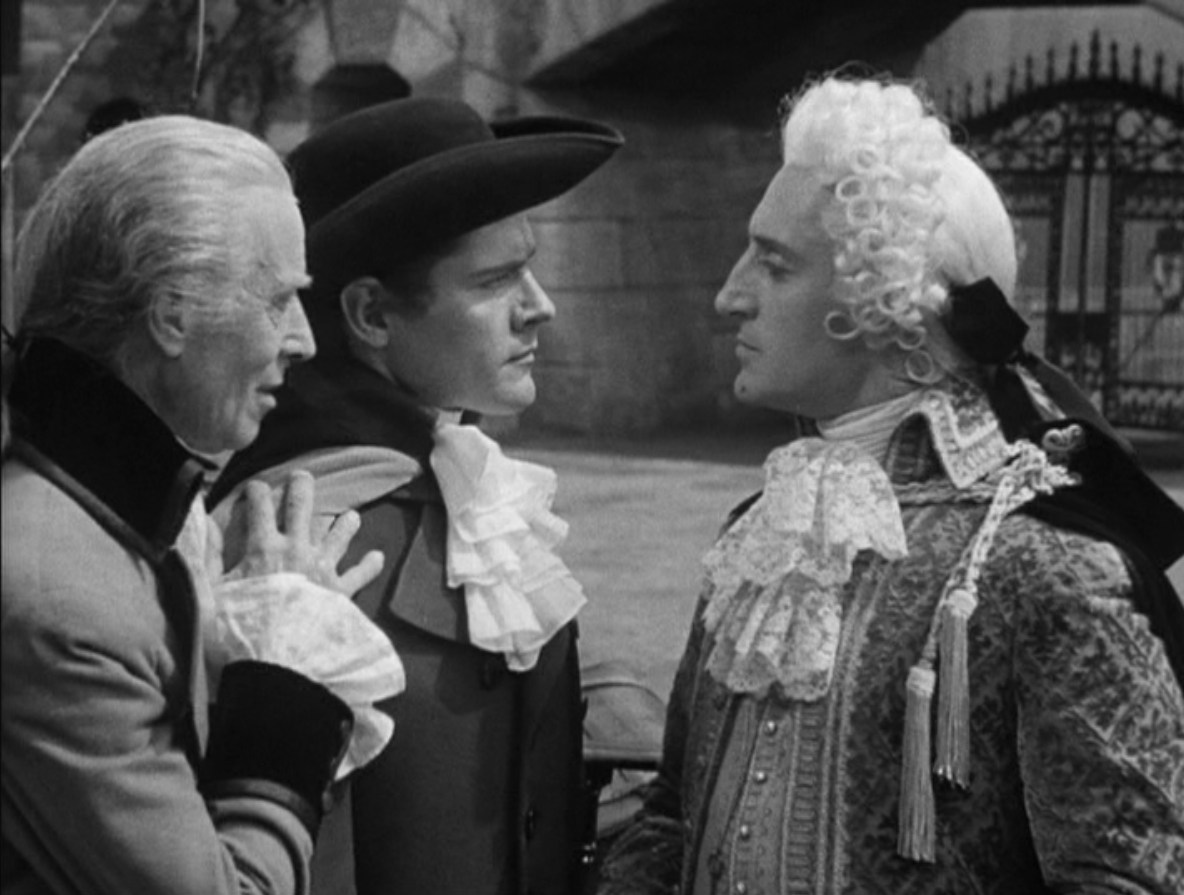 "Do you pity the swine whose flesh we eat?" |
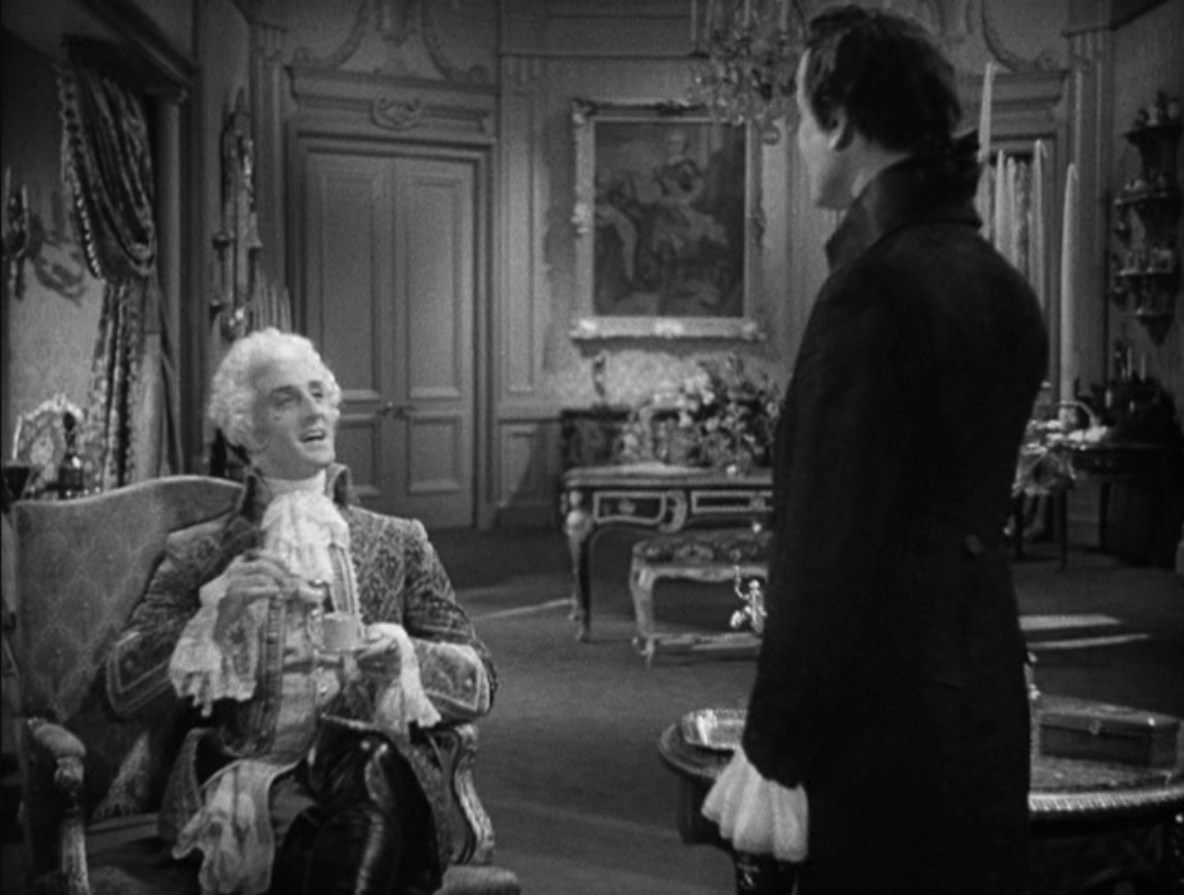 The Marquis plots to have Darnay arrested when he arrives in England. |
"No expense was spared to make 'A Tale of Two Cities' authentic in every detail. Over a year was spent in research alone. Costumes, scenery and properties were studied and collected from every available source. The largest set for this picture was that of the Bastille. Over 5000 extras were employed for this scene alone, which took several days to shoot. An interesting comparison between the mode of life in the French Revolution days with the elaborate and costly French palaces on one set and alongside was the set of the dreary, rotting hovels of the laborers and the famous gaol with its darkly stained floors and cobwebs swinging in the breeze. Those rats scuttling across the dirt floor were the real thing—at $5 a day." —Modern Screen, March 1936
|
A Tale of Two Cities For sheer scope and spectacle, here is the outstanding motion picture of the month. Charles Dickens' monumental story has received its perfect tribute in celluloid, and the result is required seeing. Seldom has any classic received such reverent treatment at the hand of Hollywood; in fact, if anything the picturization of "A Tale of Two Cities" is a trifle too painstaking. There's a heaviness that hangs over the audience even as the shadow of Mme. Guillotine hangs over the characters. But perhaps that's carping. Surely the story has been flawlessly cast, with Ronald Colman at last coming into his own as a dramatic actor as Sydney Carton, one of the truly heroic figures of all fiction. Mr. Colman has been an elegant Bulldog Drummond just a little too long for comfort; and he tackles his new assignment with fire and fervor—a superb performance. The bloodthirsty and bitter chapter in French history known as the Revolution is recorded in scenes of terrific power. The cast is perfect, with Elizabeth Allan a lovely Lucie Manette; and Henry B. Walthall, Edna May Oliver, Reginald Owen, Blanche Yurka, Isabel Jewell excellent, particularly Mr. Walthall and Miss Jewell. —Screenland, March 1936 |
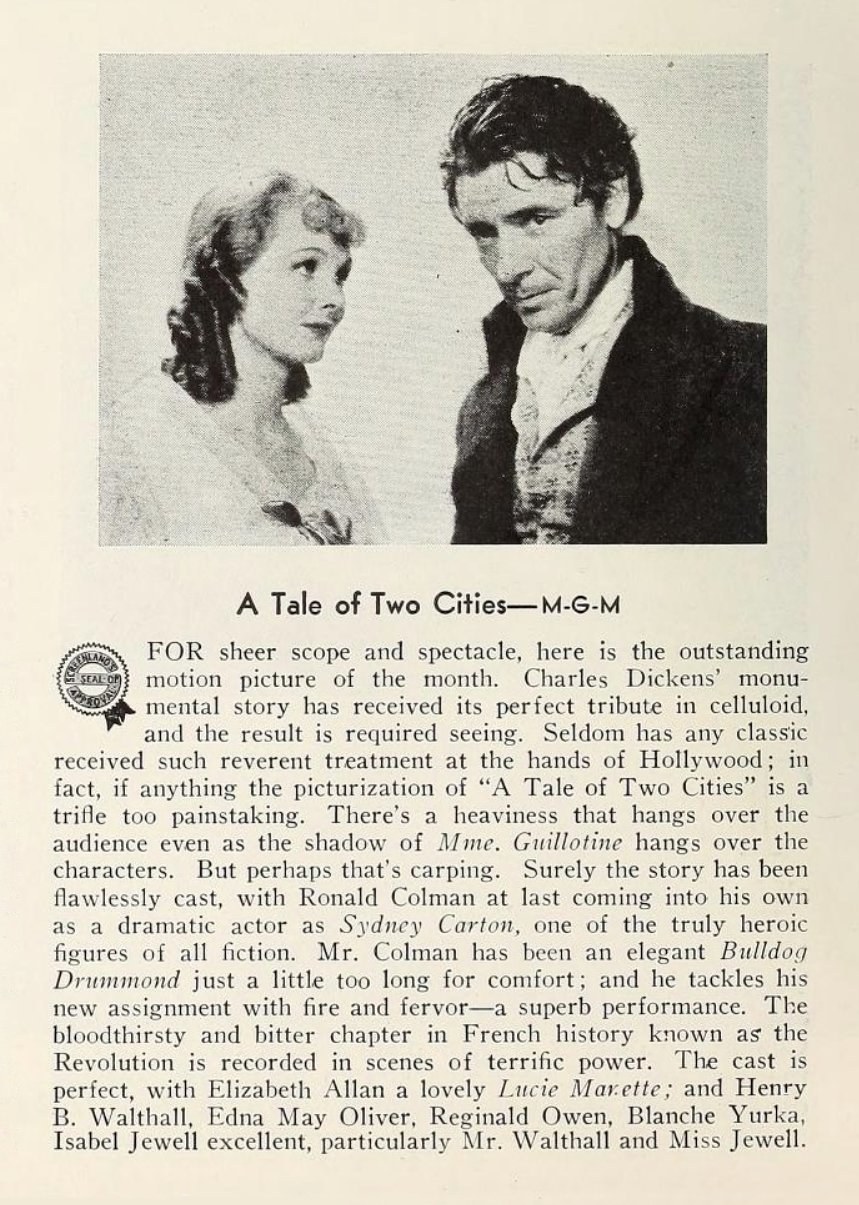
"One of the finest expressions of screen and profoundly emotional incitements yet offered. Ronald Colman gives a great performance. One of the finest of year's impersonations. Production magnitude gives it an epic sweep." —Daily Variety, December 1935
The trailer and some video clips from
A Tale of Two Cities can be found on the Turner Classic Movies website:
https://www.tcm.com/tcmdb/title/1614/a-tale-of-two-cities#photos-videos
A clip from A Tale of Two Cities: The Marquis St. Evremonde in his carriage
See Page Two for more reviews and photos. See Page Three for pictures of posters, lobby cards and promo photos.
.
|
|
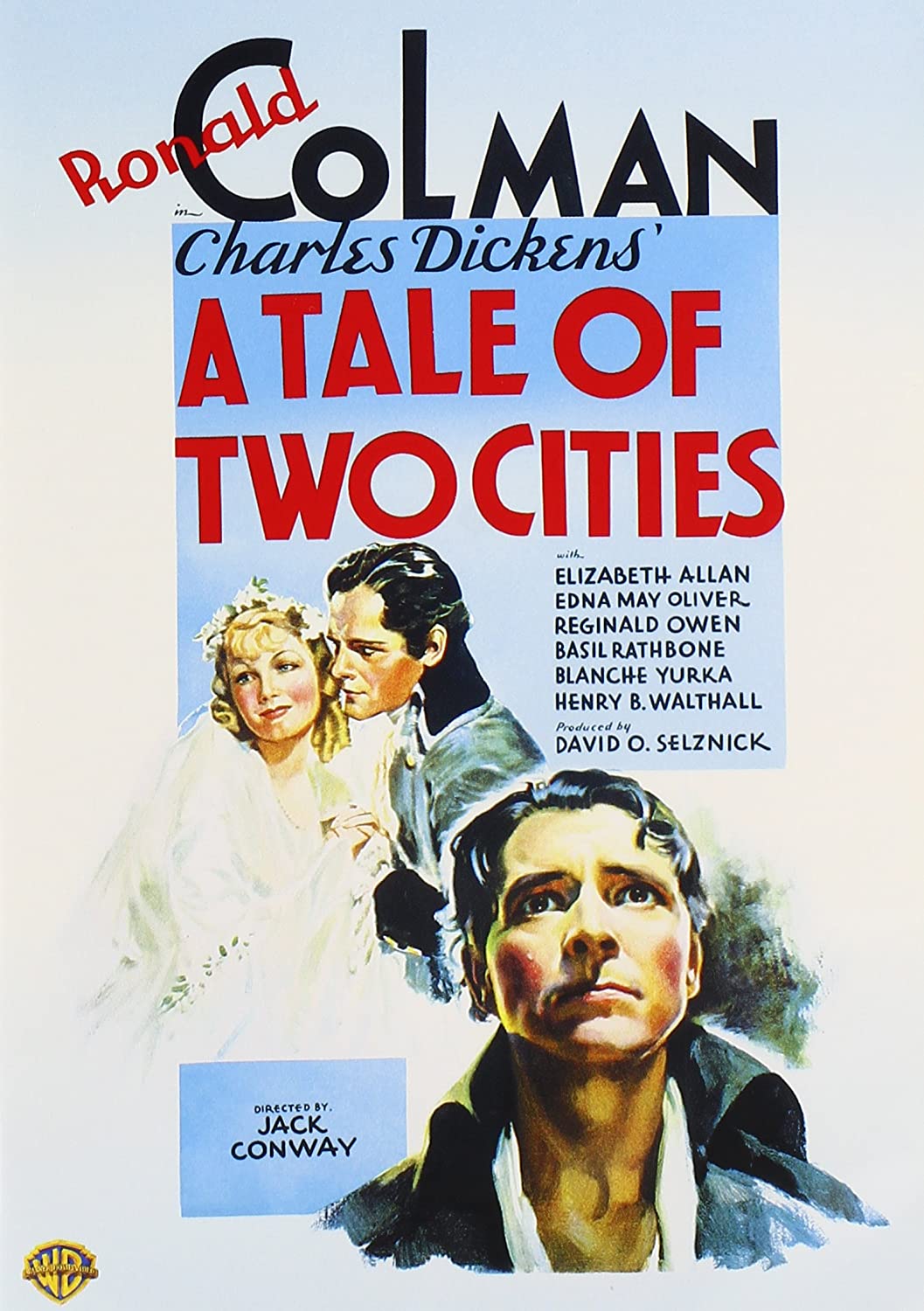
A Tale of Two Cities is available on DVD
|
Images on this page and pages two and three are from the film "A Tale of Two Cities," copyright MGM.
