|




















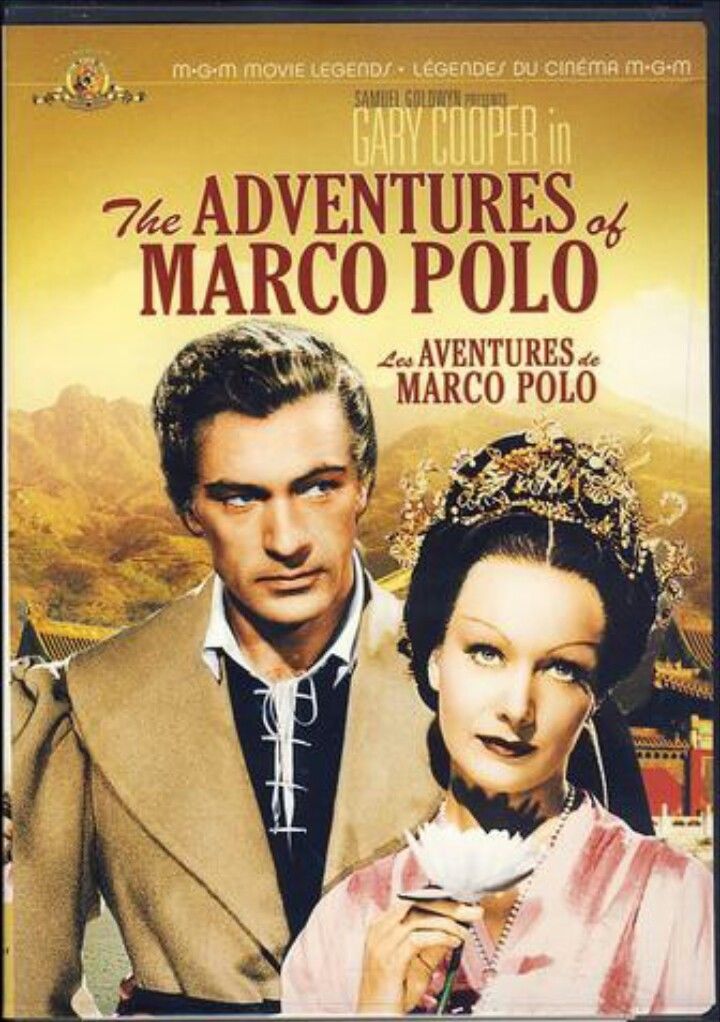
The Adventures of Marco Polo
|
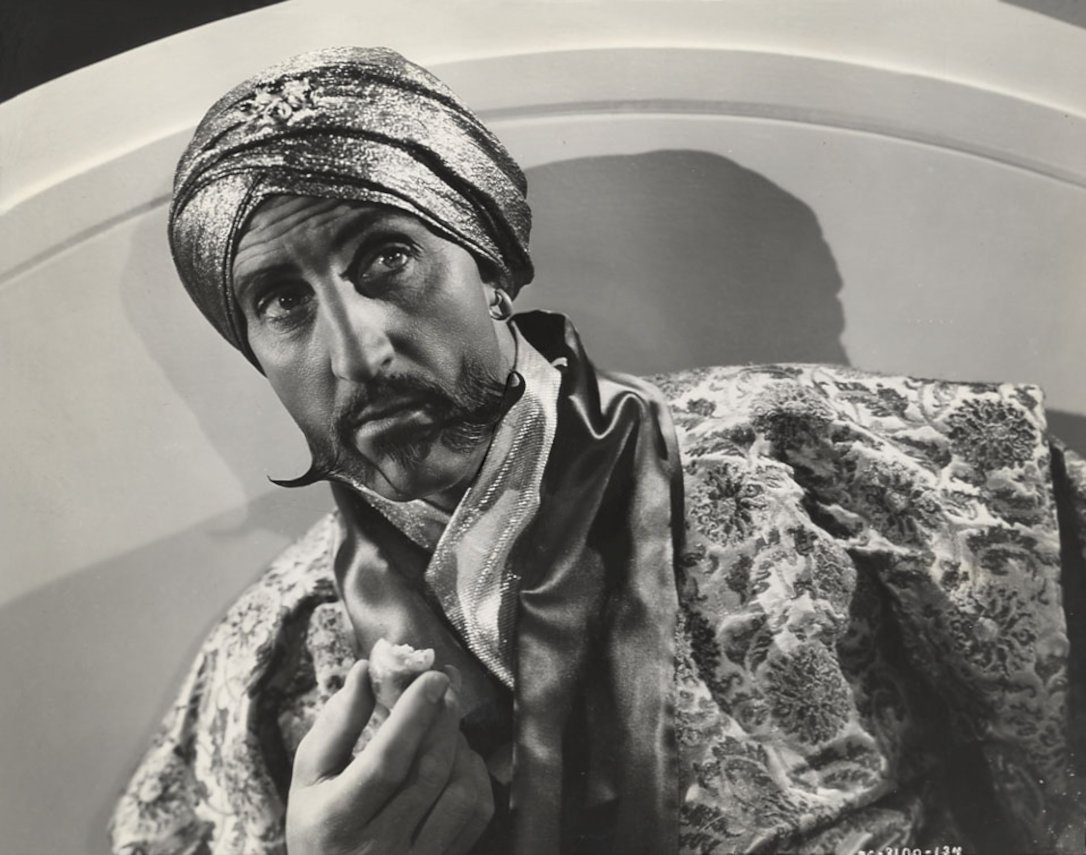
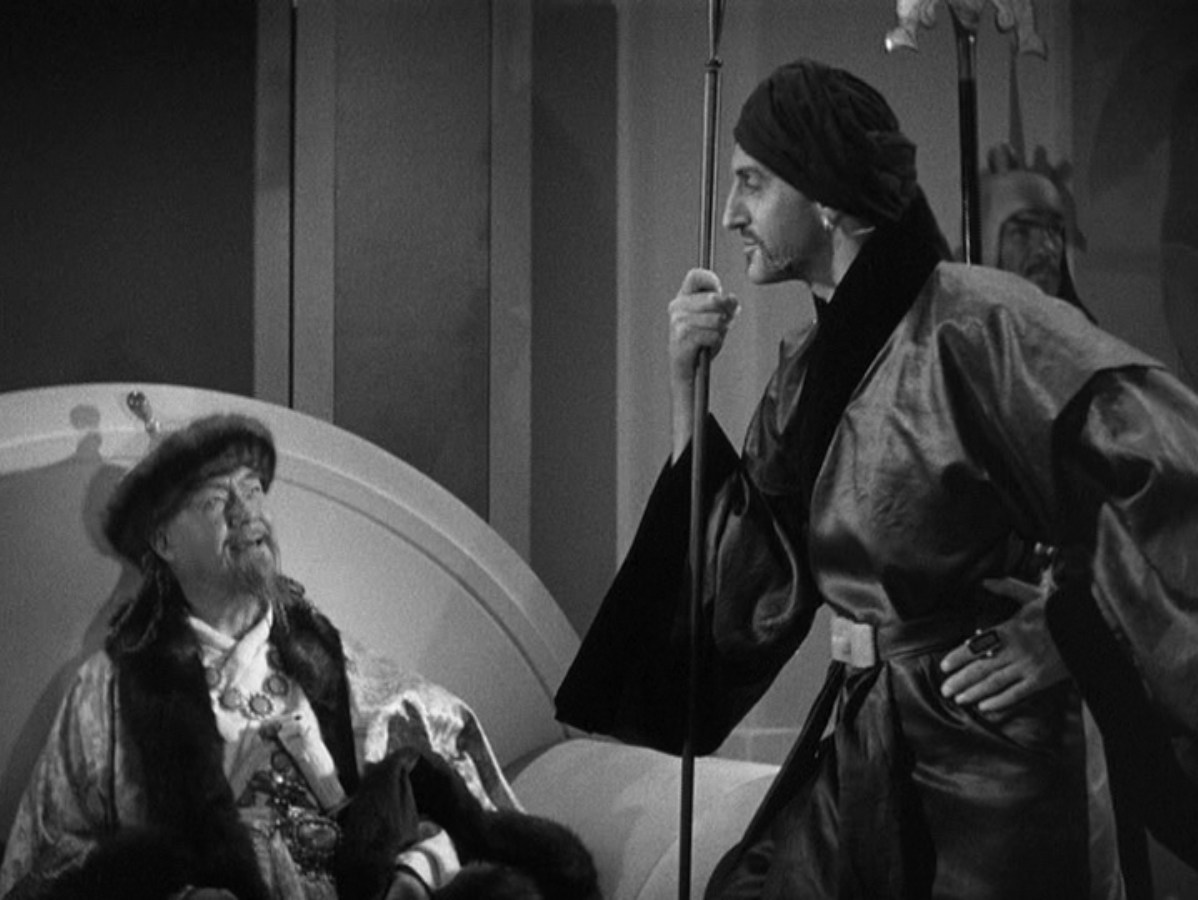 Kublai Khan and Ahmed |
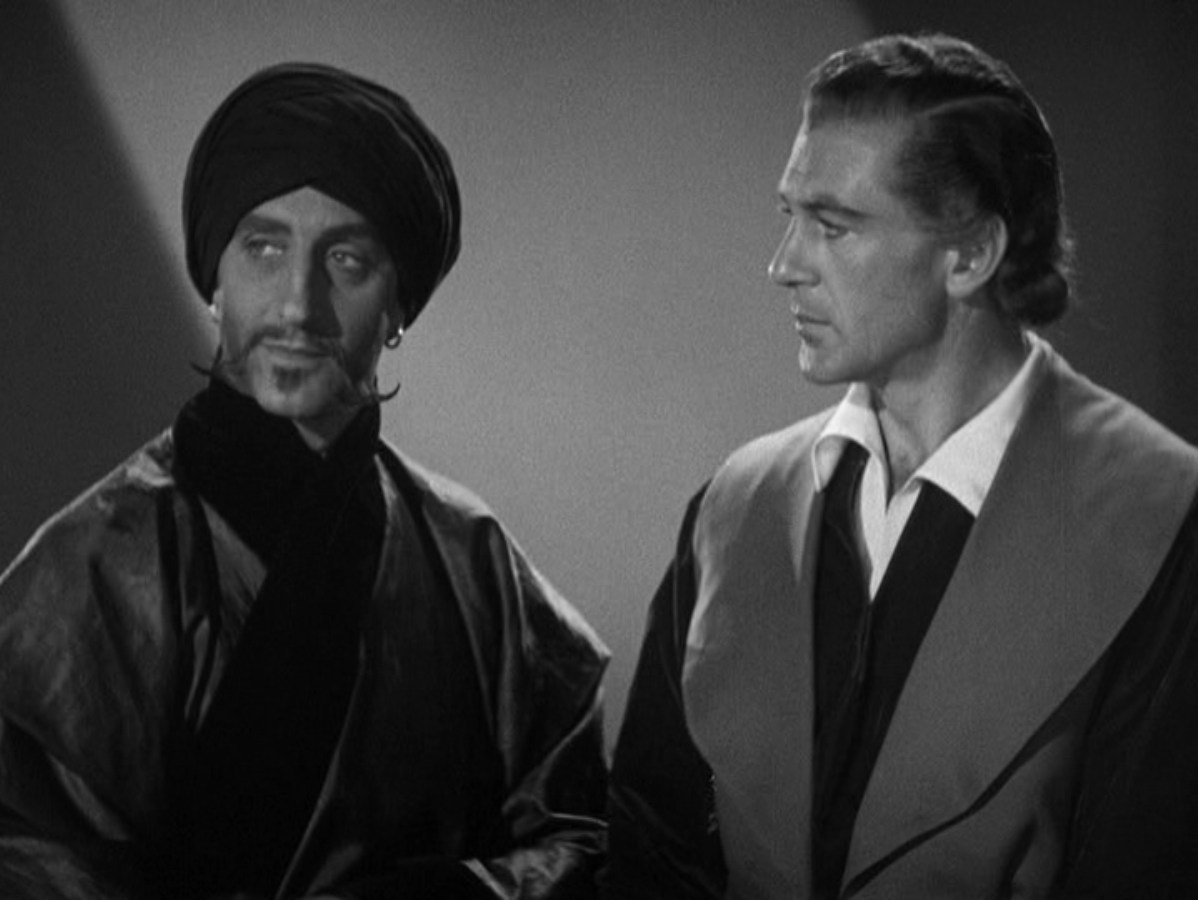 Ahmed and Marco Polo |
Ahmed takes the two Venetians on a tour of the palace, starting with his private quarters. He has a tower of his own, complete with vultures and a pit full of hungry lions. Ahmed executes a man while Marco Polo and Binguccio watch in horror.
When Marco Polo sees the princess again he asks her if she will be able to marry the man of her choice. He is smitten with her, and therefore sad that she is betrothed to the king of Persia. He asks her if he may kiss her before he leaves. "Kiss? What is that?" And Marco happily demonstrates this European custom, and the princess enjoys it.
Meanwhile Ahmed and his cohorts discuss the rebellion in Kaidu's province, and it becomes clear that the Tartar tribesmen are rebelling because Ahmed is stealing their tax money. Ahmed also has his eyes set on replacing Khan as Emperor. A guard reports what he saw Marco Polo and the princess doing in the garden. Ahmed is furious — he covets the princess for himself.
Khan asks Marco Polo to go to Kaidu's camp and spy on him. "If you do us this favor, it's possible that upon your return, you may be that much nearer to your own coveted trade agreements." Ahmed is fairly certain that Kaidu will kill Marco Polo and thereby rid him of this nuisance, but he assures Marco Polo that he will use every precaution to guarantee his safety.
There are, however, additional names of exploitation consequence to be made use of. It may be made known, advantageously as pertains to box office returns, that Basil Rathbone is present in a typical personification of evil, that Ernest Truex has a comedy assignment in his favorite pattern and that this is the introductory presentation of Sigrid Gurie, a newcomer about whom the newspapers have had much to say provocative of interest. Alan Hale, George Barbier, H.B. Warner, Henry Kolker and Ferdinand Gottschalk are other names to be displayed on the more spacious marquees. All this information, diligently purveyed, would seem to guarantee a substantial turnout for the picture in practically any city or town. (In the minority sectors where audience I.Q. of a high order is believed to prevail, it may be efficacious to emphasize the name of Robert E. Sherwood as author of the screen play and indicate, lightly that it is in the same general entertainment classification as his "Road to Rome" and other stage plays, although less broadly drawn.) It may be added, of course, although the name of Goldwyn says as much, that it is an expensive, elaborate and technically superb production. The multitude attracted by exploitation of this or any kind happens to be in for something of a surprise, pleasant or not as the case my turn out to be. They are to discover that the adventures of Marco Polo are not presented seriously, nor realistically, but grandly, beautifully, offhandly and with explicitly humorous intent. They are to be told, laughingly, that the hardy Venetian solicitor of trade agreements with China was less a salesman than a lover and more adventured against than adventuring. This may be a little disappointing to anyone approaching the picture with a view to finding out something about history and the customs of the period, although it may prove compensatingly diverting, a question only time and the public whim can answer. As the story goes, "Marco Polo" is sent off to remot Peking with instructions to consumate trade agreement with the fabulously wealthy "Kublai Khan" for his Venetian merchant sponsors. "Khan," doting parent of the fair "Princess Kukuchin" whom "Marco" promptly instructs in the Western art of osculation, turns the young man over to "Ahmed," his chief of state, who also likes the girl, and "Marco" is sent off to spy upon "Kaidu," monarch of a vassal province. "Kairdu," normally fond of executing spies, spares "Marco" on condition that he indulge the amorous spouse whose wifely attentions make it a little difficult for "Kaidu" to distribute his own romantic impulses among his subjects. "Khan" marches against Japan, disastrously, and returns to find that "Ahmed" has taken over his royal perogatives and is about to marry his daughter, forcibly. Then "Marco" gives "Kaidu" a successful sales talk and leads his army to the rescue of "Khan," the princess and the trade agreements, in a tremendous battle introducing the use of explosives. Although the subject matter is of a sort to suggest that maybe it would be nice to invite the kiddies to learn about history, the treatment of it is primarily and emphatically for the adult population, rather especially for the sophisticated sector thereof. This segment has liked some of Mr. Sherwood's pseudo-historical creations pretty well, others less so. Conjecture as to the fate of this one is, of course, conjecture. Previewed at Warner's Hollywood theatre to a large, distinguished, surprised profusely speculative and by no means unanimous audience. — William R. Weaver —Motion Picture Herald, February 19, 1938 |
When Marco Polo and Binguccio reach the Kaidu territory they are immediately captured by Kaidu's warriors, and taken to the camp. Kaidu is a vicious warrior who boils his enemies in oil, but he also likes to be with pretty young girls and his domineering wife prevents that. When Kaidu notices his wife flirting with Marco Polo, he realizes that Marco can divert the wife's attention, thus allowing Kaidu freedom to play around. So Marco and Binguccio are spared as long as Marco can keep Kaidu's wife occupied. Marco discovers yet another wonder unknown in Italy: coal.
While Kaidu dallies, Kublai Khan and his army go off to fight the Japanese. Power-hungry, Ahmed stays behind with plans to usurp the throne. The Persian ambassador reminds Ahmed that it is but one week until the seventh moon, when the princess is to be sent to the Persian king. Since Ahmed wants the princess for himself, he orders his guards to take the ambassador away, presumably to kill him. Ahmed visits the princess and tells her that he will not send her to Persia, but will keep her and marry her instead. She hates him, so she sends a message via carrier pigeon to Marco Polo.
Marco receives the message and asks Kaidu's permission to leave because the princess is in danger. Kaidu refuses. Marco talks to him about his revolt.
| Marco: | "Why are you rebelling against the Emperor?" |
| Kaidu: | "Because my people are taxed to the point of starvation. I don't mind paying proper tribute to Kublai Khan, but I refuse to pay Ahmed for his private treasury." |
Marco talks him into taking his warriors to Beijing. With the Emperor and his army away fighting the Japanese, now is the perfect time to attack Ahmed. Kaidu wonders how to get past the walls of Beijing and also the palace walls. Marco says he can get into the palace and will find a way to get Kaidu's army in. Marco Polo rides ahead to make arrangements.
The emperor's army was defeated by the Japanese; Kublai Khan and the other survivors return to Beijing. Khan discovers that Ahmed has usurped power, and now Ahmed threatens to release hungry vultures upon the captive princess unless Khan signs a document recognizing Ahmed as the rightful successor to the throne.
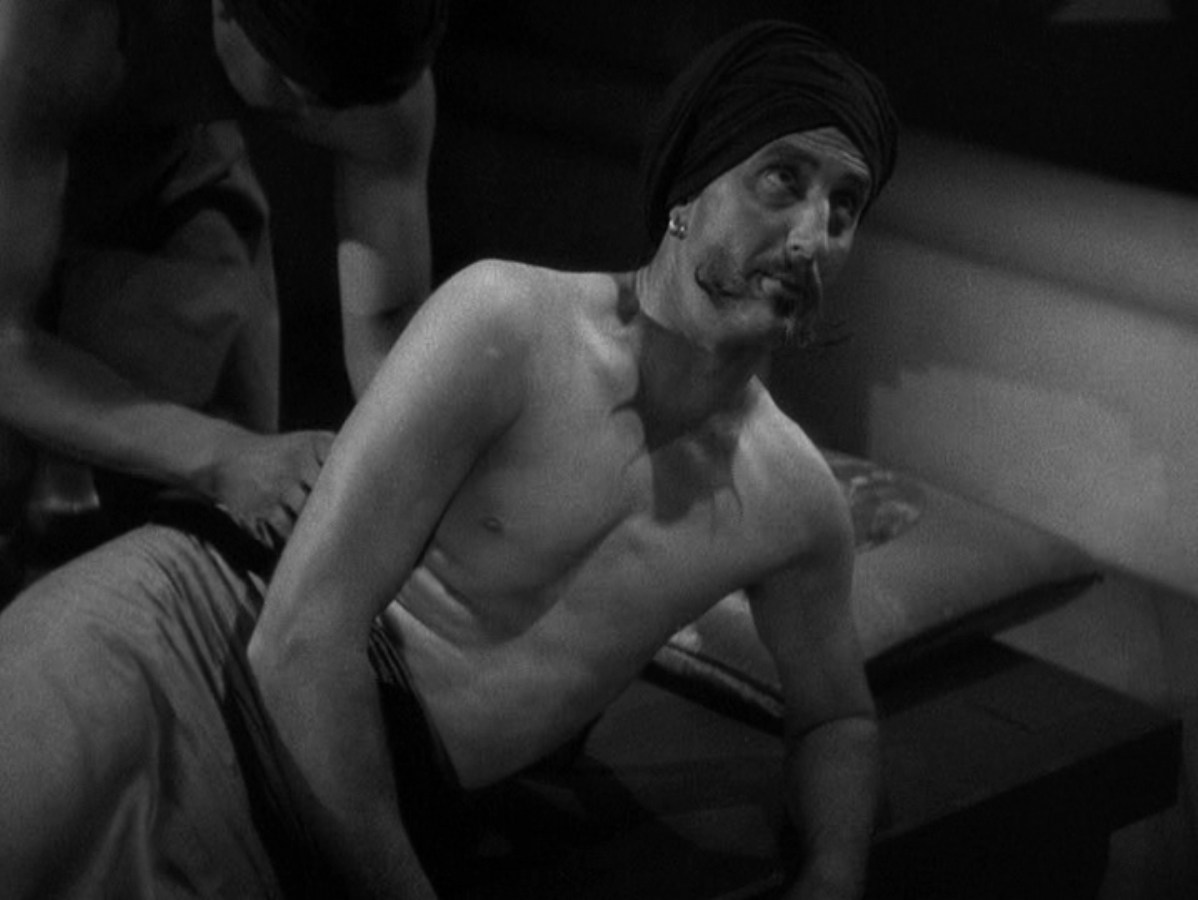 Ahmed gets a massage while listening to his guard. |
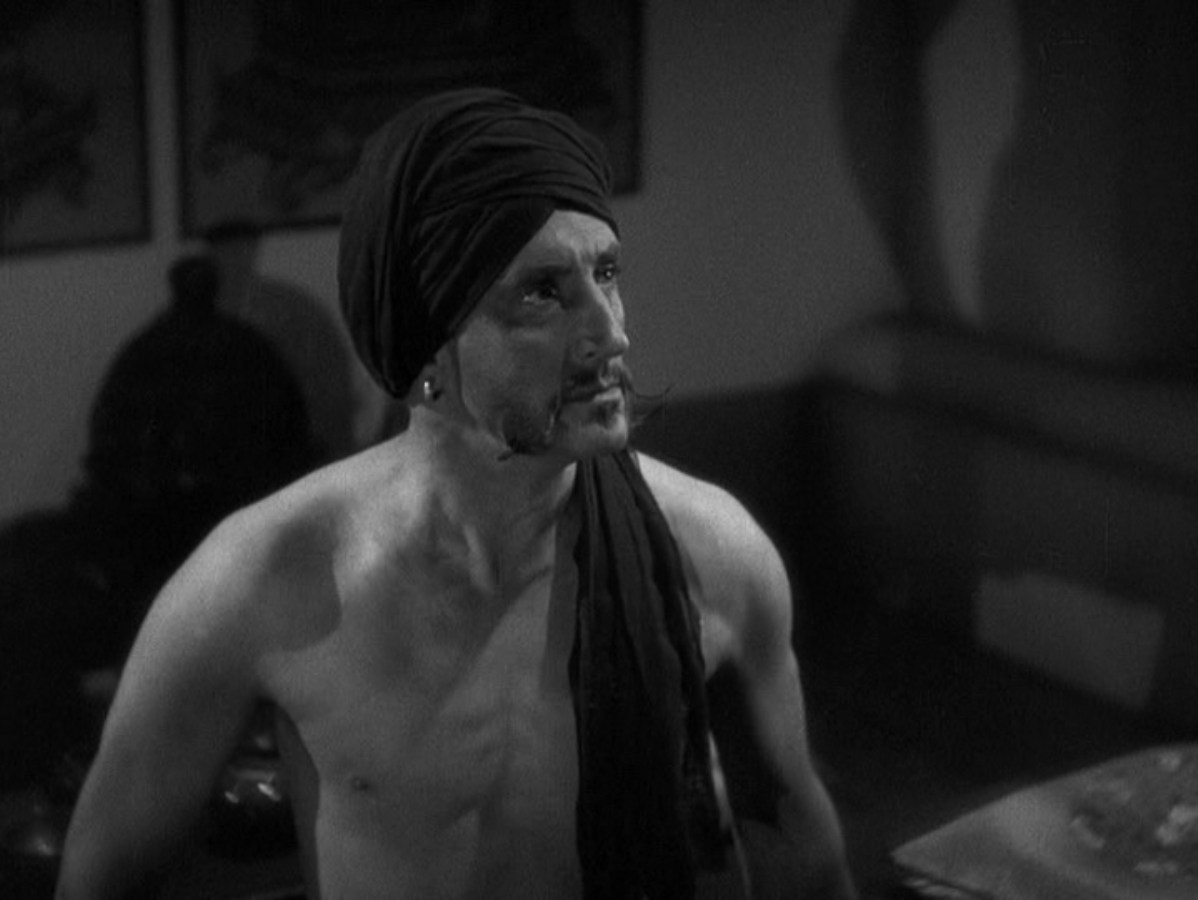 The guard explains that he saw Marco Polo and Princess Kukachin kissing. |
Marco Polo reaches Beijing and disguises himself as a local to gain secret entrance to the palace. While polishing the floor, he makes his way towards the princess' room. The princess is about to kill herself to avoid marriage to Ahmed, but Marco reaches her in time and stops her.
Kaidu's army is outside the city gate. Ahmed traps Kaidu and a few followers between the palace gate and city gate, and then he leaves for his wedding. Marco's friend Chen Tsu brings "fire powder" (gunpowder), with which Marco blows up the outside gate so the rest of Kaidu's army can ride through.
Princess Kukachin stalls the wedding as best she can until Marco Polo arrives and engages in a hand-to-hand battle with Ahmed. Ahmed opens the trap door to the lions, but Marco manages to throw Ahmed in.
With Ahmed out of the way, order is soon restored. Kublai Khan gives Kaidu a bevy of beautiful women, Binguccio draws up the trade agreements between Venice and China, and Marco Polo is given the task of escorting the princess to Persia.
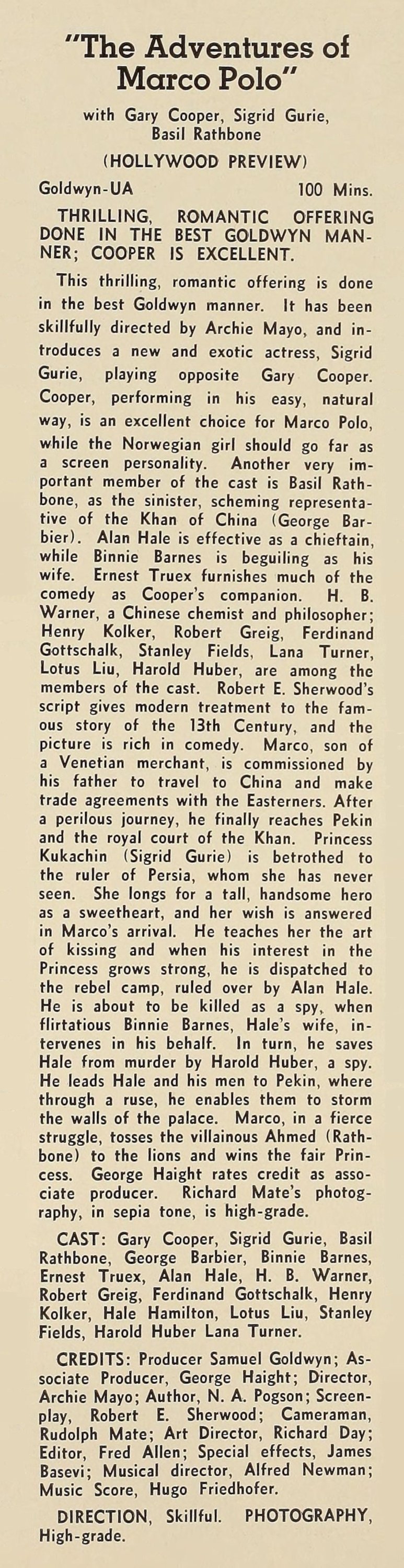 This thrilling, romantic offering is done in the
best Goldwyn manner. It has been skillfully directed by Archie Mayo,
and introduces a new and exotic actress, Sigrid Gurie, playing
opposite Gary Cooper. Cooper, performing in his easy, natural way,
is an excellent choice for Marco Polo, while the Norwegian girl
should go far as a screen personality. Another very important member
of the cast is basil Rathbone, as the sinister, scheming
representative of the Khan of China (George Barbier). Alan Hale is
effective as a chieftain, while Binnie Barnes is beguiling as his
wife. Ernest Truex furnishes much of the comedy as Cooper's
companion, H.B. Warner, a Chinese chemist and philosopher; Henry
Kolker, Robert Grieg, Ferdinand Gottschalk, Stanley Fields, Lana
Turner, Lotus Liu, Harold Huber, are among the members of the cast.
Robert E. Sherwood's script gives modern treatment to the famous
story of the 13th Century, and the picture is rich in comedy. Marco,
son of a Venetian merchant, is commissioned by his father to travel
to China and make trade agreements with the Easterners. After a
perilous journey, he finally reaches Pekin and the royal court of
the Khan. Princess Kukachin (Sigrid Gurie) is betrothed to the ruler
of Persia, whom she has never seen. She longs for a tall, handsome
hero as a sweetheart, and her wish is answered in Marco's arrival.
He teaches her the art of kissing and when his interest in the
Princess grows strong, he is dispatched to the rebel camp, ruled
over by Alan Hale. He is about to be killed as a spy, when
flirtatious Binnie Barnes, Hale's wife, intervenes in his behalf. In
turn, he saves Hale from murder by Harold Huber, a spy. He leads
Hale and his men to Pekin, where through a ruse, he enable them to
storm the walls of the palace. Marco, in a fierce struggle, tosses
the villainous Ahmed (Rathbone) to the lions and wins the fair
Princess. George Haight rates credit as associate producer. Richard
Mate's photography, in sepia tone, is high-grade. This thrilling, romantic offering is done in the
best Goldwyn manner. It has been skillfully directed by Archie Mayo,
and introduces a new and exotic actress, Sigrid Gurie, playing
opposite Gary Cooper. Cooper, performing in his easy, natural way,
is an excellent choice for Marco Polo, while the Norwegian girl
should go far as a screen personality. Another very important member
of the cast is basil Rathbone, as the sinister, scheming
representative of the Khan of China (George Barbier). Alan Hale is
effective as a chieftain, while Binnie Barnes is beguiling as his
wife. Ernest Truex furnishes much of the comedy as Cooper's
companion, H.B. Warner, a Chinese chemist and philosopher; Henry
Kolker, Robert Grieg, Ferdinand Gottschalk, Stanley Fields, Lana
Turner, Lotus Liu, Harold Huber, are among the members of the cast.
Robert E. Sherwood's script gives modern treatment to the famous
story of the 13th Century, and the picture is rich in comedy. Marco,
son of a Venetian merchant, is commissioned by his father to travel
to China and make trade agreements with the Easterners. After a
perilous journey, he finally reaches Pekin and the royal court of
the Khan. Princess Kukachin (Sigrid Gurie) is betrothed to the ruler
of Persia, whom she has never seen. She longs for a tall, handsome
hero as a sweetheart, and her wish is answered in Marco's arrival.
He teaches her the art of kissing and when his interest in the
Princess grows strong, he is dispatched to the rebel camp, ruled
over by Alan Hale. He is about to be killed as a spy, when
flirtatious Binnie Barnes, Hale's wife, intervenes in his behalf. In
turn, he saves Hale from murder by Harold Huber, a spy. He leads
Hale and his men to Pekin, where through a ruse, he enable them to
storm the walls of the palace. Marco, in a fierce struggle, tosses
the villainous Ahmed (Rathbone) to the lions and wins the fair
Princess. George Haight rates credit as associate producer. Richard
Mate's photography, in sepia tone, is high-grade.—The Film Daily, February 15, 1938 |
Don't expect historical accuracy from this film, but who cares? The film is utterly charming and entertaining. The Adventures of Marco Polo is only slightly based on the travels of the real Marco Polo. In the story of Marco Polo, producer Samuel Goldwyn apparently thought that Polo himself was more important to the world, more interesting to the public, than the period in which he lived, and the ancient politics in which he figured. In The Adventures of Marco Polo you will find a character to love, a romance to stir you. But you will also find the color, the atmosphere, the feeling of a world strange to you. You will have a fantastic adventure.
History records that a 21-year-old Marco Polo traveled to China with his father and uncle (not his bookkeeper) and lived there for 24 years. After his return to Venice, Marco Polo captained a ship, and was subsequently captured and imprisoned by the Genoese. While in prison he recounted his adventures in China. The published manuscript became very popular, but most of the incredible tales Marco told were not believed, and he was therefore dubbed "the man of a million lies." China had many wonders that were unknown to western culture in the 13th century: paper money, coal, gunpowder, for example. Yet, Marco Polo never mentioned the Great Wall of China, calligraphy, the binding of women's feet, and tea drinking. These omissions have led some people to believe that Marco Polo never actually visited China. Also supporting that theory is the fact that there is no mention of Marco Polo in Chinese historical records. The controversy is discussed in a 1995 book by Frances Wood called Did Marco Polo Go to China? and the 2001 book Marco Polo and the Discovery of the World by John Larner.
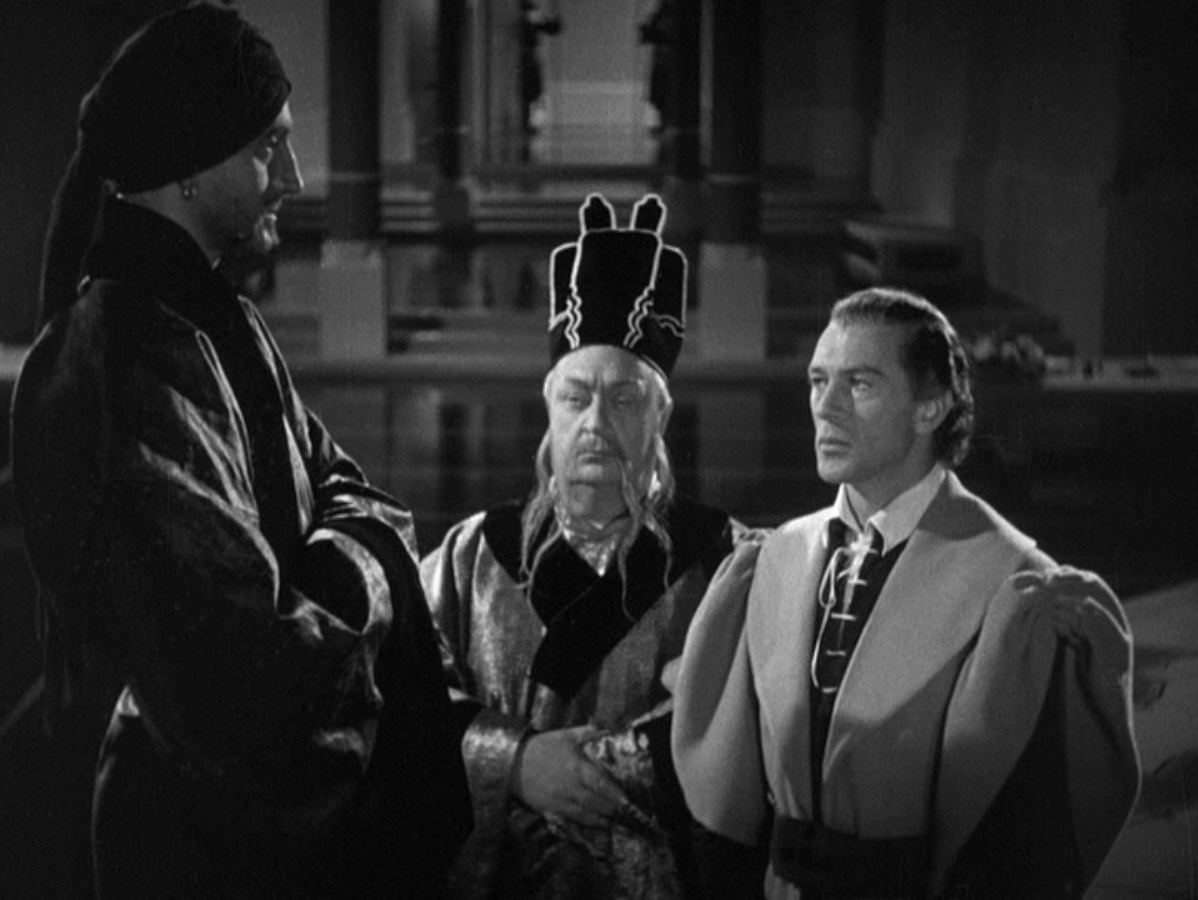 Ahmed sends Marco Polo to Kaidu Province. |
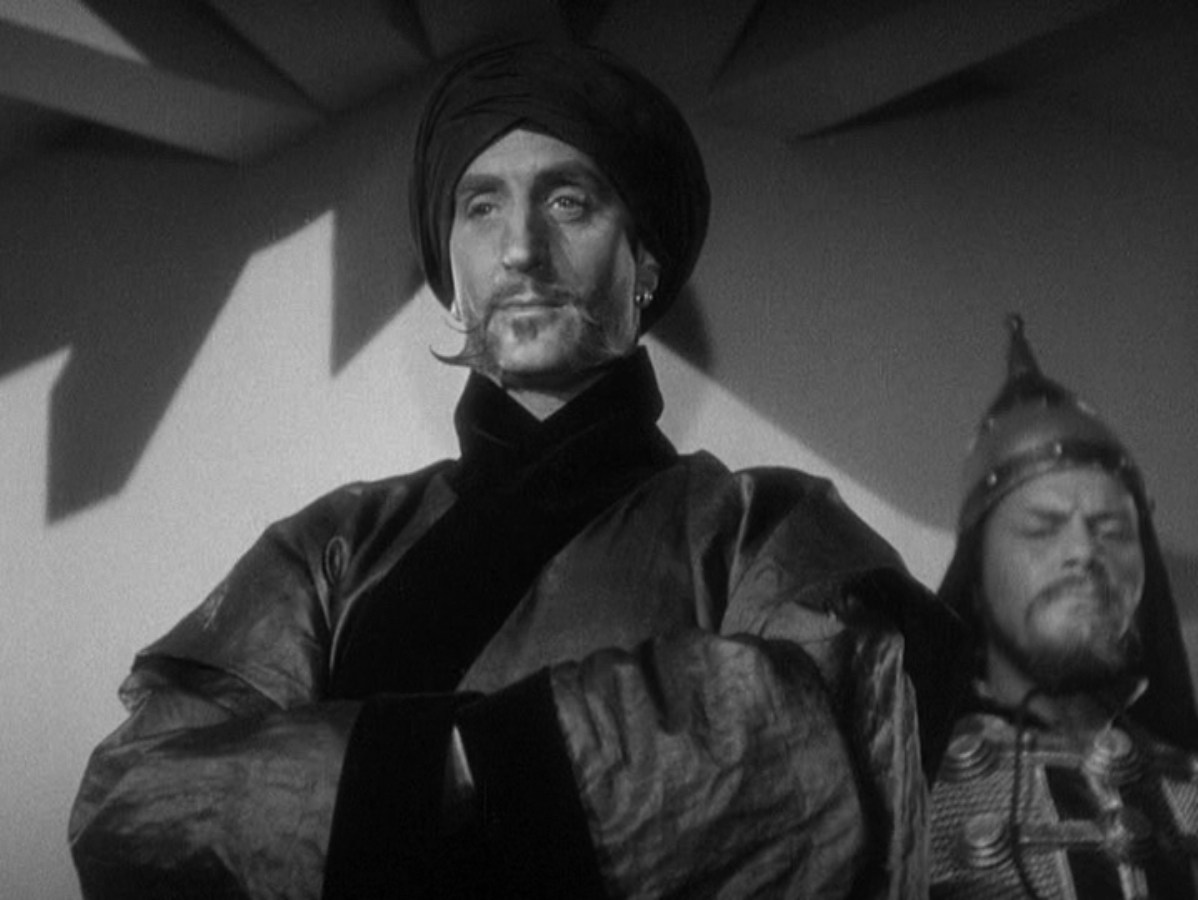 Ahmed watches as Marco Polo departs. |
Originally Douglas Fairbanks Sr. and Samuel Goldwyn planned to co-produce The Adventures of Marco Polo. On April 3, 1937, Fairbanks sold his interest in the film. He had, at one time, planned it as a starring vehicle for himself. Amid speculation behind his action, Fairbanks issued the following statement:
"Because of my desire to withdraw from the co-producership of 'The Adventures of Marco Polo,' in order to devote my time to individual productions of my own, Mr. Sam Goldwyn, my close friend and associate, has today purchased all of my rights to this forthcoming production." (Box Office magazine, April 10, 1937)
Goldwyn and those close to Fairbanks denied that any disagreement had caused a rift in their relationship.
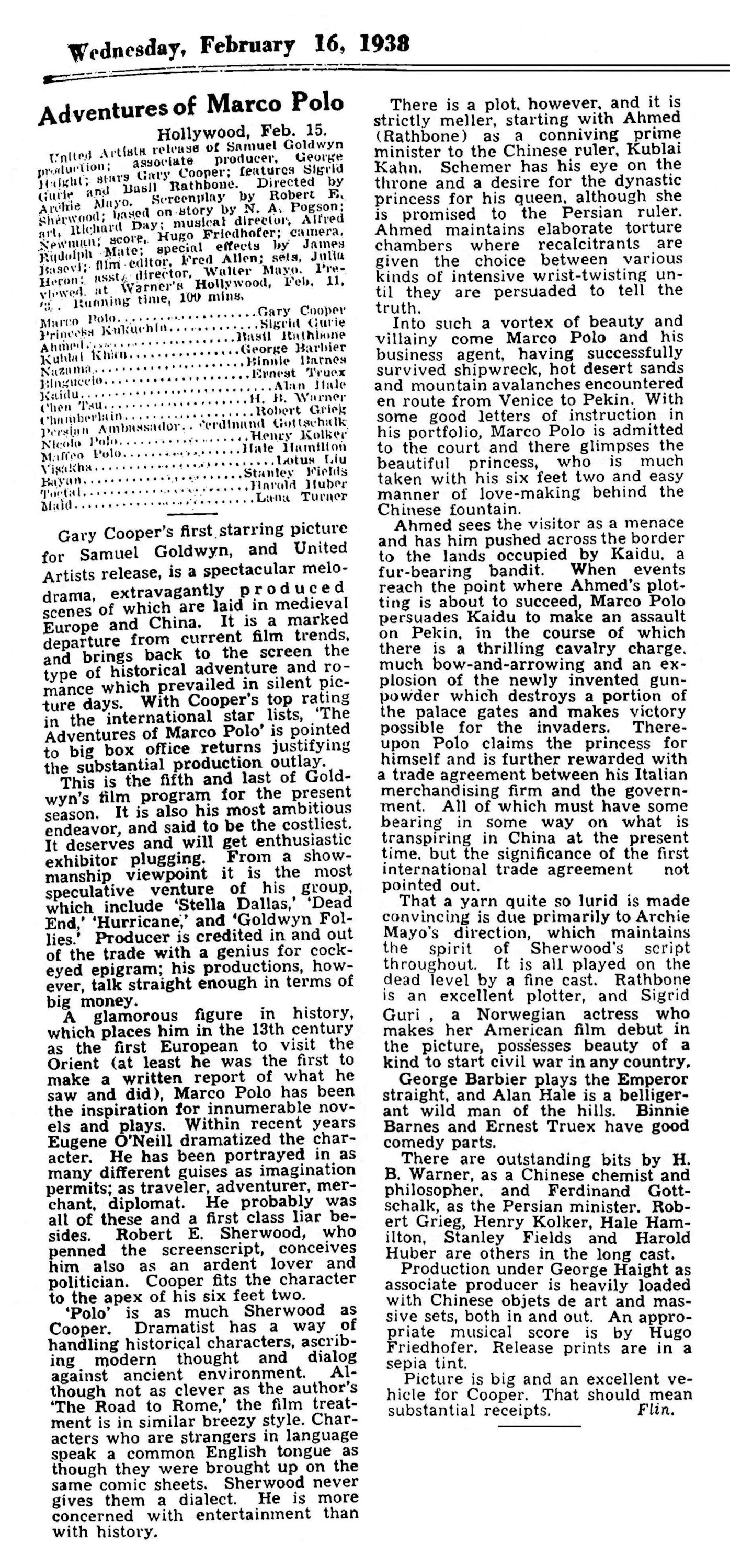
This is the fifth and last of Goldwyn's film program for the present season. It is also his most ambitious endeavor, and said to be the costliest. It deserves and will get enthusiastic exhibitor plugging. From a showmanship viewpoint it is the most speculative venture of his group, which include "Stella Dallas," "Dead End," "Hurricane," and "Goldwyn Follies." Producer is credited in and out of the trade with a genius for cock-eyed epigram; his productions, however, talk straight enough in terms of big money. A glamorous figure in history, which places him in the 13th century as the first European to visit the Orient (at least he was the first to make a written report of what he saw and did), Marco Polo has been the inspiration for innumerable novels and plays. Within recent years Eugene O'Neill dramatized the character. He has been portrayed in as many different guises as imagination permits: as traveler, adventurer, merchant, diplomat. He probably was all of these and a first class liar besides. Robert E. Sherwood, who penned the screenscript, conceives him also as an ardent lover and politician. Cooper fits the character to the apex of his six feet two. "Polo" is as much Sherwood as Cooper. Dramatist has a way of handling historical characters, ascribing modern thought and dialog against ancient environment. Although not as clever as the author's "The Road to Rome," the film treatment is in similar breezy style. Characters who are strangers in language speak a common English tongue as though they were brought up on the same comic sheets. Sherwood never gives them a dialect. He is more concerned with entertainment than with history. There is a plot, however, and it is strictly meller, starting with Ahmed (Rathbone) as a conniving prime minister to the Chinese ruler, Kublai Khan. Schemer has his eye on the throne and a desire for the dynastic princess for his queen, although she is promised to the Persian ruler. Ahmed maintains elaborate torture chambers where recalcitrants are given the choice between various kinds of intensive wrist-twisting until they are persuaded to tell the truth. Into such a vortex of beauty and villainy come Marco Polo and his business agent, having successfully survived shipwreck, hot desert sands and mountain avalanches encountered en route from Venice to Pekin. With some good letters of instruction in his portfolio, Marco Polo is admitted to the court and there glimpses the beautiful princess, who is much taken with his six feet two and easy manner of love-making behind the Chinese fountain. Ahmed sees the visitor as a menace and has him pushed across the border to the lands occupied by Kaidu, a fur-bearing bandit. When events reach the point where Ahmed's plotting is about to succeed, Marco Polo persuades Kaidu to make an assault on Pekin, in the course of which there is a thrilling cavalry charge, much bow-and-arrowing and an explosion of the newly invented gunpowder which destroys a portion of the palace gates and makes victory possible for the invaders. Thereupon Polo claims the princess for himself and is further rewarded with a trade agreement between his Italian merchandising firm and the government. All of which must have some bearing in some way on what is transpiring in China at the present time, but the significance of the first international trade agreement not pointed out. That a yarn quite so lurid is made convincing is due primarily to Archie Mayo's direction, which maintains the spirit of Sherwood's script throughout. It is all played on the dead level by a fine cast. Rathbone is an excellent plotter, and Sigrid Gurie, a Norwegian actress who makes her American film debut in the picture, possesses beauty of a kind to start civil war in any country. George Barbier plays the Emperor straight, and Alan Hale is a belligerent wild man of the hills. Binnie Barnes and Ernest Truex have good comedy parts. There are outstanding bits by H.B. Warner, as a Chinese chemist and philosopher, and Ferdinand Gottschalk, as the Persian minister. Robert Grieg, Henry Kolker, Hale Hamilton, Stanley Fields and Harold Huber are others in the long cast. Production under George Haight as associate producer is heavily loaded with Chinese objets de art and massive sets, both in and out. An appropriate musical score is by Hugo Friedhofer. Release prints are in a sepia tint. Picture is big and an excellent vehicle for Cooper. That should mean substantial receipts. Flin. —Variety, February 16, 1938 |
May 1937, Sam Goldwyn announced that AMP would be the last Goldwyn film done in black and white. Henceforth his pictures would be made only in Technicolor. As to why The Adventures of Marco Polo could not be made in Technicolor, Goldwyn explained, "Dr. Herbert T. Kalmus, of Technicolor, frankly advises me that they are yet unable to supply that much equipment." (Box Office, May 22, 1937)
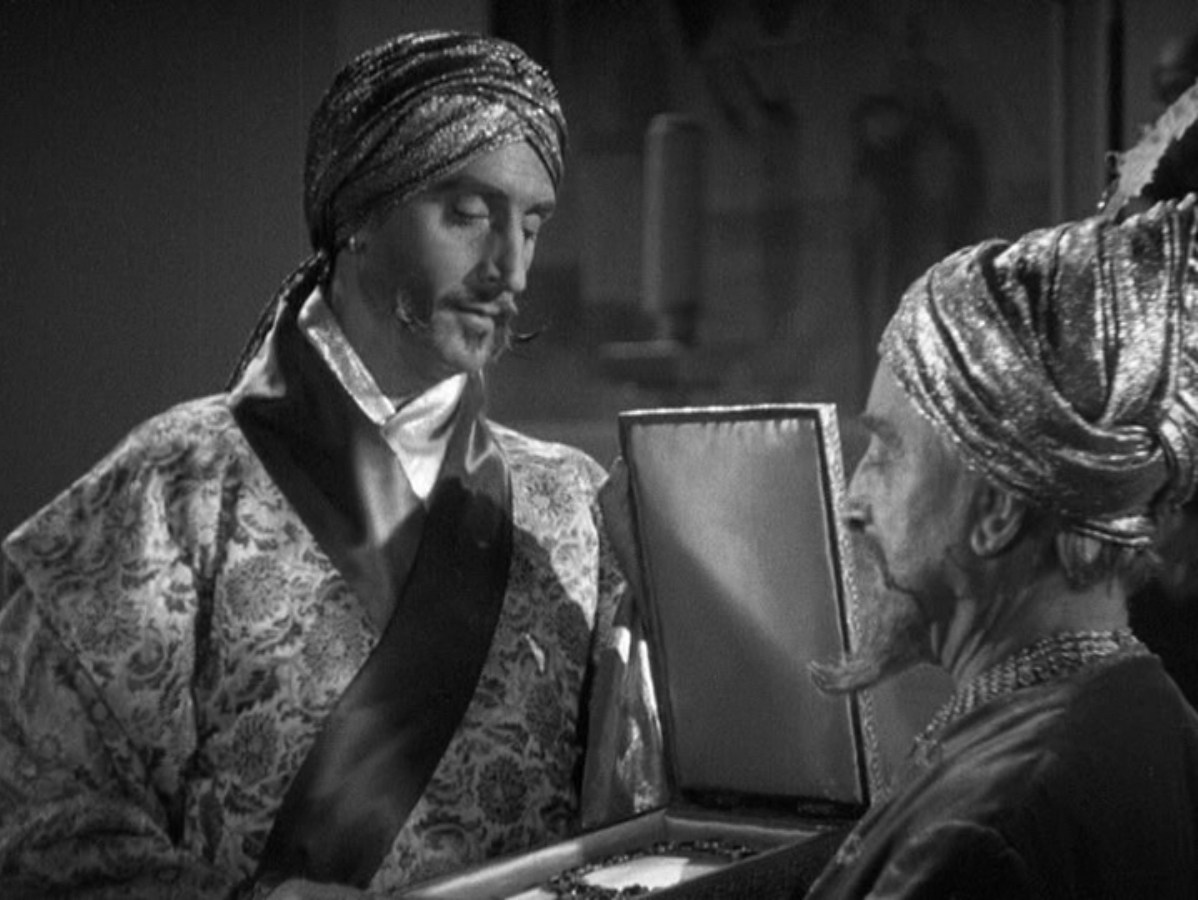 The Persian ambassador presents a beautiful necklace for the princess. |
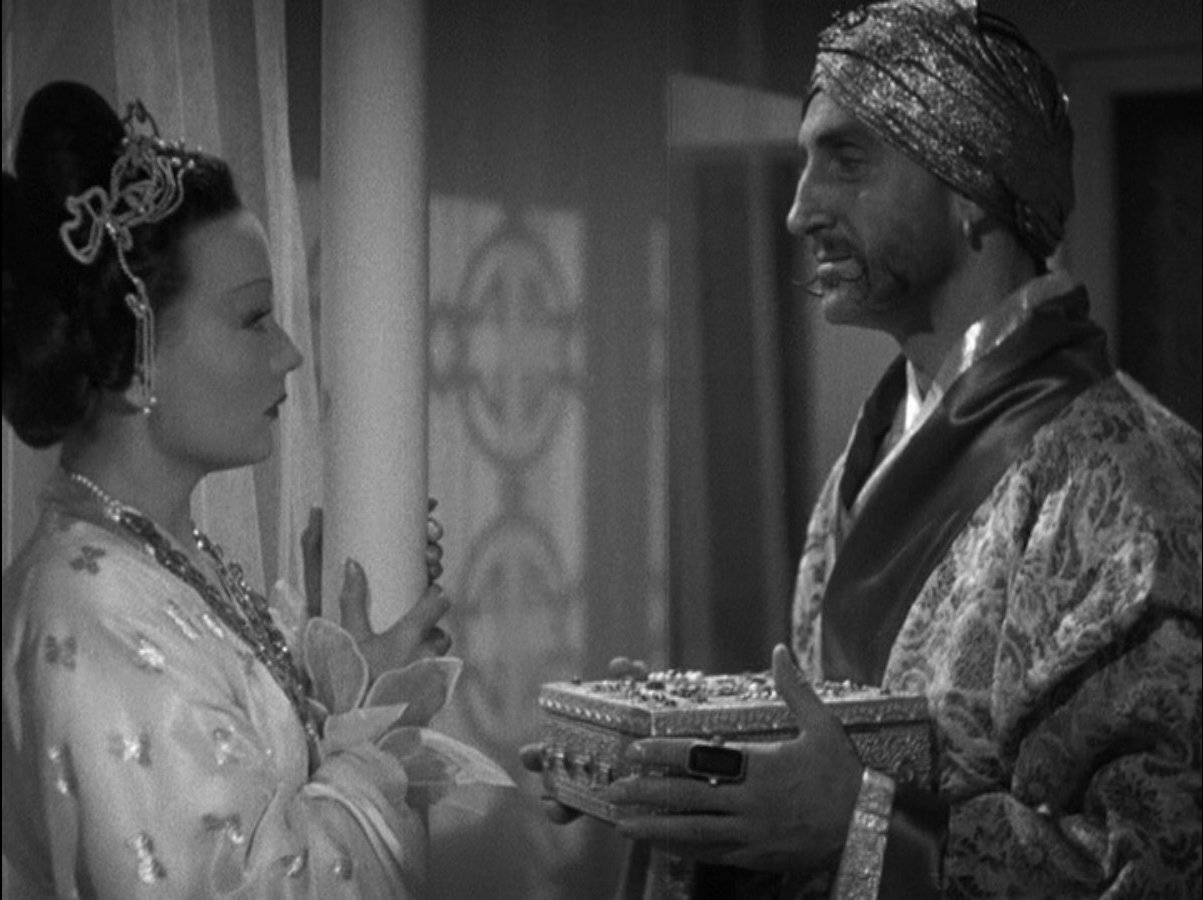 Ahmed presents the gift to the princess as if it's from him. |
Goldwyn began work on the film in June 1937. John Cromwell was hired as director, but after only four days, he abandoned the project. Cromwell's walkout is said to have occurred after a dispute with Samuel Goldwyn over characterizations in the picture. Cromwell differed with the producer's conception of Marco Polo's character as delineated in the script. Unable to effect a compromise, Cromwell backed away from the job.
Production was interrupted only temporarily, however, as Goldwyn assigned Archie Mayo to the film. Archie Mayo is being assisted by Walter Mayo. They are not related and this is the first time they have worked together.
Although it seemed an amicable parting of the ways, Cromwell later filed suit against Samuel Goldwyn, Walter Wanger and Selznick International for "breach of contract." Variety reported, "The action sets forth that Selznick participated in a deal with Goldwyn and Wanger whereby the three producers would share director's services and his $3,250 weekly salary. He claims dismissal by Goldwyn after working five weeks on The Adventures of Marco Polo and that he had been unpaid on his contract since then." (Variety, January 26, 1938) Goldwyn declared that Cromwell was not fired, but resigned.
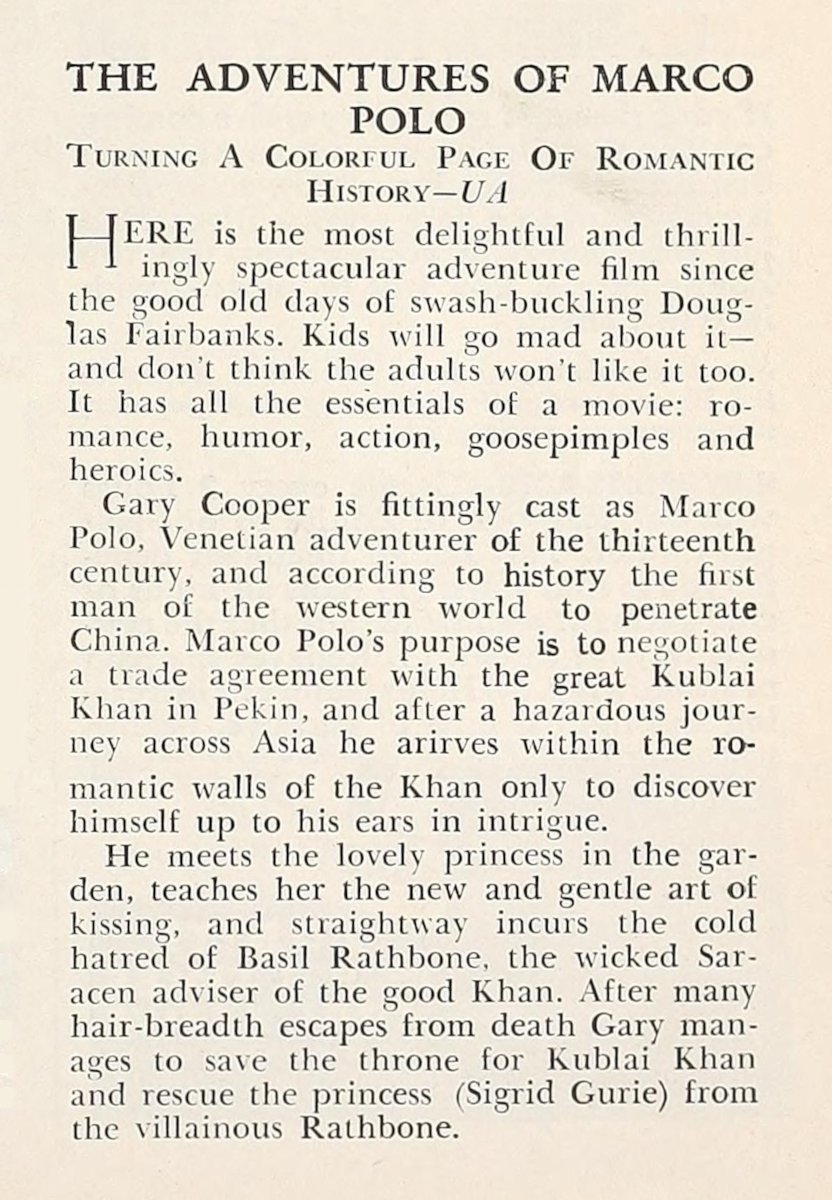
Gary Cooper is fittingly cast as Marco Polo, Venetian adventurer of the thirteenth century, and according to history the first man of the western world to penetrate China. Marco Polo's purpose is to negotiate a trade agreement with the great Kublai Khan in Pekin, and after a hazardous journey across Asia he arrives within the romantic walls of the Khan only to discover himself up to his ears in intrigue. He meets the lovely princess in the garden, teacher her the new and gentle art of kissing, and straightway incurs the cold hatred of Basil Rathbone, the wicked Saracen adviser of the good Khan. After many hair-breadth escapes from death Gary manages to save the throne for Kublai Khan and rescue the princess (Sigrid Gurie) from the villainous Rathbone. —Silver Screen, April 1938 |
.
Watch clips from The Adventures of Marco Polo on the Turner Classic Movies website:
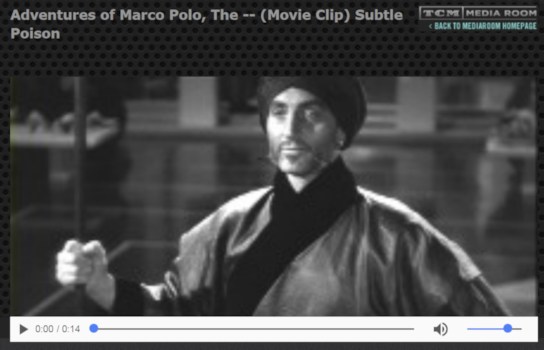
www.tcm.com/video/280116/adventures-of-marco-polo-the-subtle-poison
See Page Two for more reviews and pictures from the film. See Page Three for pictures of posters, lobby cards and promo photos.
.
|
|
The Adventures of Marco Polo is available on DVD
|