|













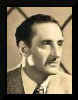







Judas
| A play in three acts by Walter Ferris and Basil Rathbone. Opened at the Longacre Theatre, New York City, January 24, 1929, and ran for 12 performances. Produced by William A. Brady, Jr. and Dwight Deere Wiman. Staged by Richard Boleslavsky. |
|
Cast of characters
| Simon Ish Kerioth | William Courtleigh |
| Rebekah | Jennie Eustace |
| Naomi | Dorothy Cumming |
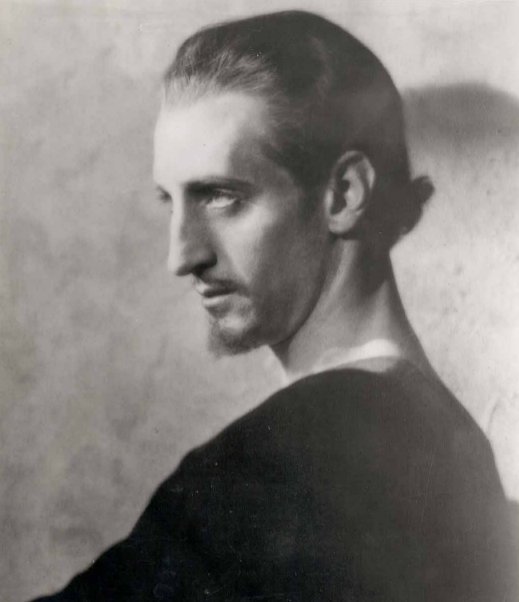
| Judas | Basil Rathbone |
| Flavius | Charles Henderson |
| Marcus | Doan Borup |
| Thomas | Lyons Wickland |
| Andrew | Harold Moffet |
| James | William D. Post |
| Matthew | Charles Halton |
| John | William Challee |
| Peter | Doan Borup |
| First Priest | John O'Meara |
| Second Priest | Tom Hayes |
| Third Priest | A. Lymmborn |
| Fourth Priest | Ralph Thomas |
| Caiphas | William Courtleigh |
| A Priest of the Guard | Joseph Redalieu |
| Akiba | Charles Halton |
| Joseph of Arimathea | Robert Barrat |
| Act I — The courtyard of the
House of Simon ish Kerioth, in Judea Act II — A House in Bethany, near Jerusalem Act III — The Temple, Jerusalem |
|
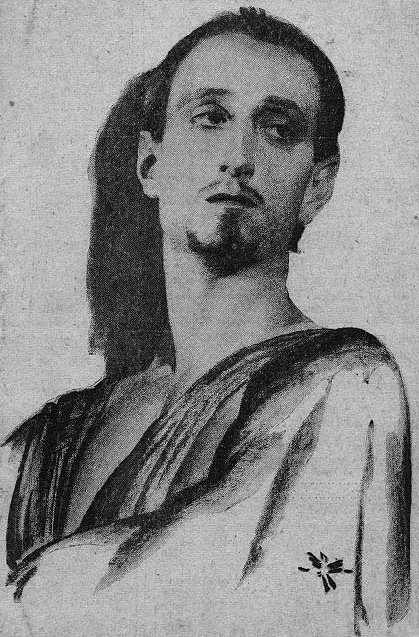
"A defense of the betrayer in which Judas is shown as the most devoted of
Jesus' disciples but determined to arouse the Savior as a militant rather than
as a spiritual redeemer of the Jewish people. The betrayal is a part of Judas'
plan to inspire Jesus' rebellion."
[from The Best Plays of 1928-29, ed. by Burns Mantle (Dodd, Mead and
Co., 1929), 461-462.]
The relationship between Jesus and Judas had troubled Rathbone since he was in his teens, and over the years he became obsessed with it. Why did Jesus choose a despicable betrayer to become one of his disciples? Rathbone discussed the subject with friends, and also with Walter Ferris, a teacher with a gift for writing. Ferris was intrigued by Rathbone's idea of a play exploring the association between Jesus and Judas. Their collaboration was perfect. Basil had the play in his mind, and Walter put it on paper. "Act by act, and scene by scene I passionately released the still waters of my imagination, which poured from me like a broken dam, while Walter sat quietly making voluminous notes, questioning me, analyzing my answers, objecting, agreeing, reserving his judgment. . . . Walter and I were in such complete rapport that he finished writing the play in one month. It was exactly what I had hoped for, a most sensitive and intelligent transposal into dialogue of all we had talked about" (In and Out of Character, by Basil Rathbone, 4th Limelight Edition, New York, 1997. p. 111),
| In the play Judas was seeking a leader who could successfully head a revolt against the Romans. When he saw Jesus he felt instinctively drawn to Jesus, and he followed him. "To Jesus he expounded his hopes and plans for an uprising that would release his beloved homeland from Roman domination. And though Jesus had turned sadly away from him, Judas' mind was made up. This was his leader and Judas would be to him, as it were, his chief of staff. Miracles there must be to attain his purpose, and miracles there were, but not of the kind that Judas sought after. He was contemptuous of his fellow disciples and was deeply troubled by the Master's choice of such simple, ignorant fellows. But he would bide his time, and he could well afford to since there was much to encourage him. People loved his leader; great crowds were drawn to see and hear Him. Much of what the Master said and did was highly provocative and Jewish religious leaders in Jerusalem were much concerned by His teachings and His success with the people" (p. 114). |
|
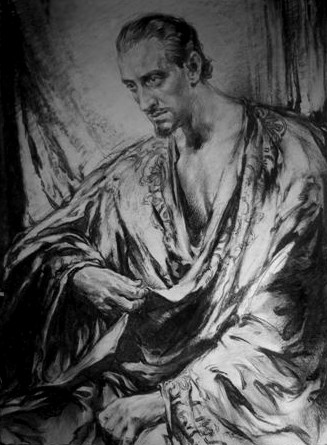
By the time Jesus and his disciples came to Jerusalem to celebrate the Passover Judas had grown impatient with the lack of progress with the "revolution." As a last, desperate move, Judas chose to betray Jesus in order to force a situation, and spark rebellion against the Romans. When that didn't happen, Judas was overcome with guilt, and hanged himself.
The play received mixed reviews and closed after three weeks on Broadway. While it was considered a failure in terms of box office receipts, many Catholics, Protestants and Jews wrote letters to Rathbone and came backstage to see him. The play certainly generated controversy.
Rathbone wrote that when he asked a Catholic priest, a good friend of his, why he and Ferris had met with such opposition from virtually all denominations of the Christian Church, the priest replied, "My dear Basil, it is all right for you and Mr. Ferris to have made this journey because it seems perfectly evident that you know the road back home. But to many others such questionings can be deeply disturbing. These people entering upon such a journey might be unable to find their way home again and their peace of mind could be permanently affected. It is our duty to see that they are not exposed to such a possibility" (p. 116).
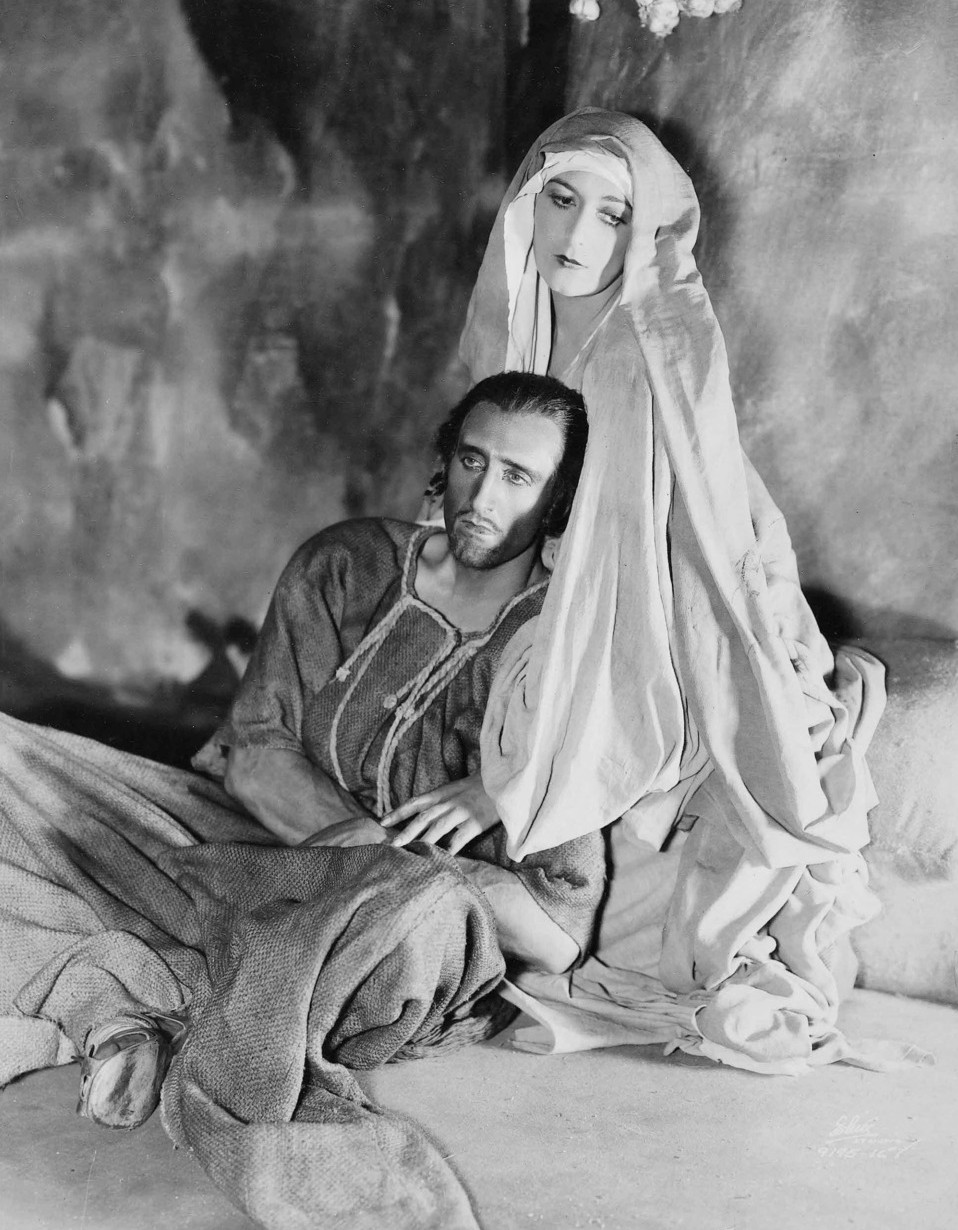 BR and Dorothy Cumming |
play was originally called "Render unto Caesar"
* * * * * * * * * * * * * * * * * * *
"Judas," by Walter Ferris and Basil Rathbone, at the Longacre Theatre, is a kind of play about which I am exceedingly ill-equipped to give an opinion. It is a sincere and sympathetic study of Judas Iscariot as a materialist who, half maddened by Christ's spirituality, which he entirely fails to understand, betrays Him in order to force Him into resistance of Rome. This is not a new or startling contribution to religious thought, but is here embodied in a workmanlike and sometimes moving play which is occasionally splashed with horrid bits of near-poetry. I happen to have a phobia against all solemn plays set "in Palestine about the year 33 A.D." They are like tantalizing marginal notes on a great drama which takes place just off stage, and of whose progress they keep one informed by means of long expository speeches. "Judas" is more interesting than such plays usually are.
In settings and costumes it has the superb beauty one has come to expect of Brady & Wiman productions.
Basil Rathbone himself plays Judas in the old-fashioned, theatrical way which seems inseparable from such plays. It is undoubtedly effective. Among the ragged, tatterdemalion company of Christ's followers, he strides magnificent in purple and magenta. If the play is ever though to need a subtitle, I suggest "Judas (Or the Well-dressed Disciple)."
Dorothy Cumming plays Naomi, Judas' betrothed, with lovely grace and a voice very like Margalo Gillmore's.
written by Charles Brackett
The New Yorker, February 2, 1929, p. 28
* * * * * * * * * * * * * * * * * * * *
The Stage, 14 February 1929 (p. 24)
Judas
Walter Ferris (author of "The First Stone," presented by the Civic Repertory last season) and Basil Rathbone collaborated on this dignified and occasionally impressive Biblical drama presented by Brady and Wiman at the Longacre on January 24. It closes tonight, after only twelve performances—a brief run indeed. Possibly contemporary audiences, now that Lent approaches, are not prepared to accept the unconventional—nay, radical—portrait of Judas that Messrs. Rathbone and Ferris present. As these authors see Iscariot, he is not the arch villain and fiend incarnate of ordinary clerical teaching, but a sturdy patriotic Judean who omitted the Passover pilgrimage to Jerusalem and neglected his own betrothal feast to join Jesus, under whose spiritual and moral leadership he sees a chance for Palestine to throw off the Roman yoke. But after the entry into Jerusalem and Jesus's failure to announce the setting up of a temporal kingdom of the Jews, Judas proclaims hi intention of saving the Master for himself, and betrays Jesus to the High Priest for a nominal price to seal the bargain. Messrs. Ferris and Rathbone admittedly follow Klopstock's poem "The Messias" for motivation. "Here," writes Mr. Ferris, "Judas ... expected Jesus to found a temporal kingdom, and betrayed Him at last in a desperate attempt to force His hand, thinking He would choose temporal power if death stood before Him as an alternative." Afterwards Judas "knew remorse and went out and hanged himself," though the remorse is increased by a sudden realisation of the greatness of the spiritual leader. The betrayal scene, in which William Courtleigh appeared as Caiaphas the High Priest, is impressive in its dignified simplicity; and, indeed, the authors appear to have aimed at simplicity throughout, particularly in conversation, where a colloquial effect seems to be sought. Unfortunately, the piece, under Richard Boleslavsky's direction, is overacted; and even Mr. Rathbone's Judas was not free from exaggerated emphasis. It was clear and intelligent and thoroughly thought-out, but altogether too declamatory and excitable, though the last-named trait was intentionally stressed. Played in a lower key, it would have been a fine piece of acting.
* * * * *
From California and the Californians, page 491 (online at http://babel.hathitrust.org/cgi/pt?id=uc1.32106005424343;view=1up;seq=647;q1=Basil;start=1;size=10;page=search;num=491 ):
"The play was of unconventional order and based on the relations of Jesus and his betrayer, Judas, the version of their friendship and of the final great tragedy differing much from the usual orthodox theory, and this innovation having led to severe arraignment of the play by virtually all religious denominations, with the result that the production failed to register success. The play presented Jesus as an impractical dreamer with unlimited vision, and Judas, as an idealist, was limited to his profound desire for the upbuilding of the empire of Israel.
* * * * * * * *
from the NEW YORK TIMES, January 25, 1929
The Play
By J. Brooks Atkinson
The Man of Thirty Silver Pieces
JUDAS, a play in three acts, by Walter Ferris and Basil Rathbone. Settings by Jo Mielziner: staged and costumes designed by Richard Boleslavsky; produced by William A. Brady Jr. and Dwight Deere Winan. At the Longacre Theatre.
[cast list]
Such a play as actors love and skeptics deplore is "Judas," which was mounted at the Longacre last evening. For the actor it is an opportunity to cast off the shackles of realistic drama and to revel in attitudinizing and posturing under the protection of a sacred theme. To the skeptic, however, it commits the fatal error of representing as men those who have been enshrined in the literature of heroes.
This character study of Judas, which is the joint labor of Walter Ferris, author of "The First Stone," and Basil Rathbone, who plays the chief part uncritically, represents the betrayer as an intellectual reformer. When he first hears of Jesus he reads into the wisdom of the Nazarene all the hopes he has of freedom. Being an intellectual, however, Judas understands all the facts and misses the idea completely; he is an idealist in his head alone. And in a world governed by Caesar's centurions, who are drunk as usual, he thinks only in terms of conquest by the sword. To his practical mind, humility is weakness. He cannot grasp the stupendousness of victory by so soft a weapon as love. In betraying Jesus to the Romans, Judas hopes to force Him into violent action, immediately. For he is nervous and impatient; he is an agitator. He loves the Master at once so well and so impertinently that he hopes to save Him from Himself.
That interpretation of a strong, sincere Judas may not recommend itself to most people, especially since it requires making the other disciples not so much rude men as dull men. Nor was it Leonardo's conception of a man so evil, that, while painting "The Last Supper," he lost many months in finding a face sufficiently malevolent. But it serves as the credible theme of a play that lies close to the grand Christian drama in Jerusalem.
What one objects to chiefly is the vanity of such stage enterprises. Great themes are to be treated by great artists. And instead of taking on a reflected grandeur from such themes, mediocre plays seem more egregious than usual, and the roar and rant of the acting sound particularly hollow. The shriek of the wind machine, the whirr of the electric fan, the glare of electric light that symbolizes the radiant Master, the singing and harp accompaniment off-stage reduce the theatre to a bag of tinker's tricks. And the unnatural vocal tones that are designed to conjure up a hushed solemnity, become more properly painful.
To write with so much asperity about the current play may seem like making Mr. Rathbone the scapegoat for all the theatre's petty sins against sacred wisdom and religious themes. Nevertheless, both the play "Judas" and Mr. Rathbone's acting of the part are, to this chronicler, presumptuous. Perhaps the meek shall inherit, not only the earth, but the theatre.
*********************
Notes from BU Archives:
Correspondence related to “Judas”: 10 ALS, 4 TLS, 1 CTLS, 1 Telegram
Frederick W. Corning (mining engineer) TLS, Jan 24, 1929
“Your presentation of the much troubled, historic Judas was on a high plane of intellectual understanding and forcefulness. Indeed you were time and again at great heights; and the tender passages with your beautiful biblical sweetheart were heartmoving—and purifying, no doubt, to some of the more earthly love notions of your enthusiastic audience, exponents presumably of the more worldly standards of the day!! You have imparted to the great work, as author and actor, the best that is in you—which is saying much.”
Benjamin DeCasseres (author), ALS, April 10, 1929
Jennie Eustace, ALS, undated (“Friday night”)
Charles Fleischer (publisher), ALS, Jan 26, 1929; CTLS to Brooks Atkinson, Jan 25, 1929
“I am with you, heart and soul and mind. – Perhaps—if you will take these letters with you—they will give you a bit of satisfaction in the midst of the mass of ignorant unsympathy and persecution which you seem to be doomed to suffer, along with the traditional Judas.
However, you will bear bravely and beautifully what must somehow be borne.”
Frances Hellman (mother of George Sidney Hellman, author), 2 ALS, Jan 24 (positive letter, but unreadable) and Jan 31, 1929:
“There are in life frustrations which mean victories. Such, to my mind, is the failure of your dream “Judas” a noble work that has failed to satisfy a bigoted Church and a press which—to its shame be it said—has submitted to its tyrannical dictates. Your play impresses me as an attempt, and a logical one, to explain the arch-traitor of Biblical superstition, as a man who, despite fanaticism and misguided passion, is yet not incapable of the possible idealism latent in every human soul. As such it is a noble attempt, and your portrayal of Judas is a great histrionic presentation at touching and convincing as any I have ever witnessed.”
Victor Wittgenstein, ALS, “Tues morning at 1 a.m.”
Nicea R. Osborne (Feb 2, 1929):
“Please accept my congratualtions on your very fine, sympathetic performance in the role of “Judas.” Also for your sincere, earnest effort as co-author of the play in giving to the theatre something worthwhile. It seems such a shame that an apathetic public should allow such a play to die for lack of patronage when so many inane, stupid ones continue to thrive. It would indeed seem to be a discouraging outlook to the artist with ideals … So you young artists must keep your ideals with the assurance that some day your patience and efforts will be rewarded.”
Judas got bad reviews in the papers, but the letters are very positive. On one negative review (newspaper clipping) BR wrote the word “BALLS!”
