|




















The
Hound of the Baskervilles
|
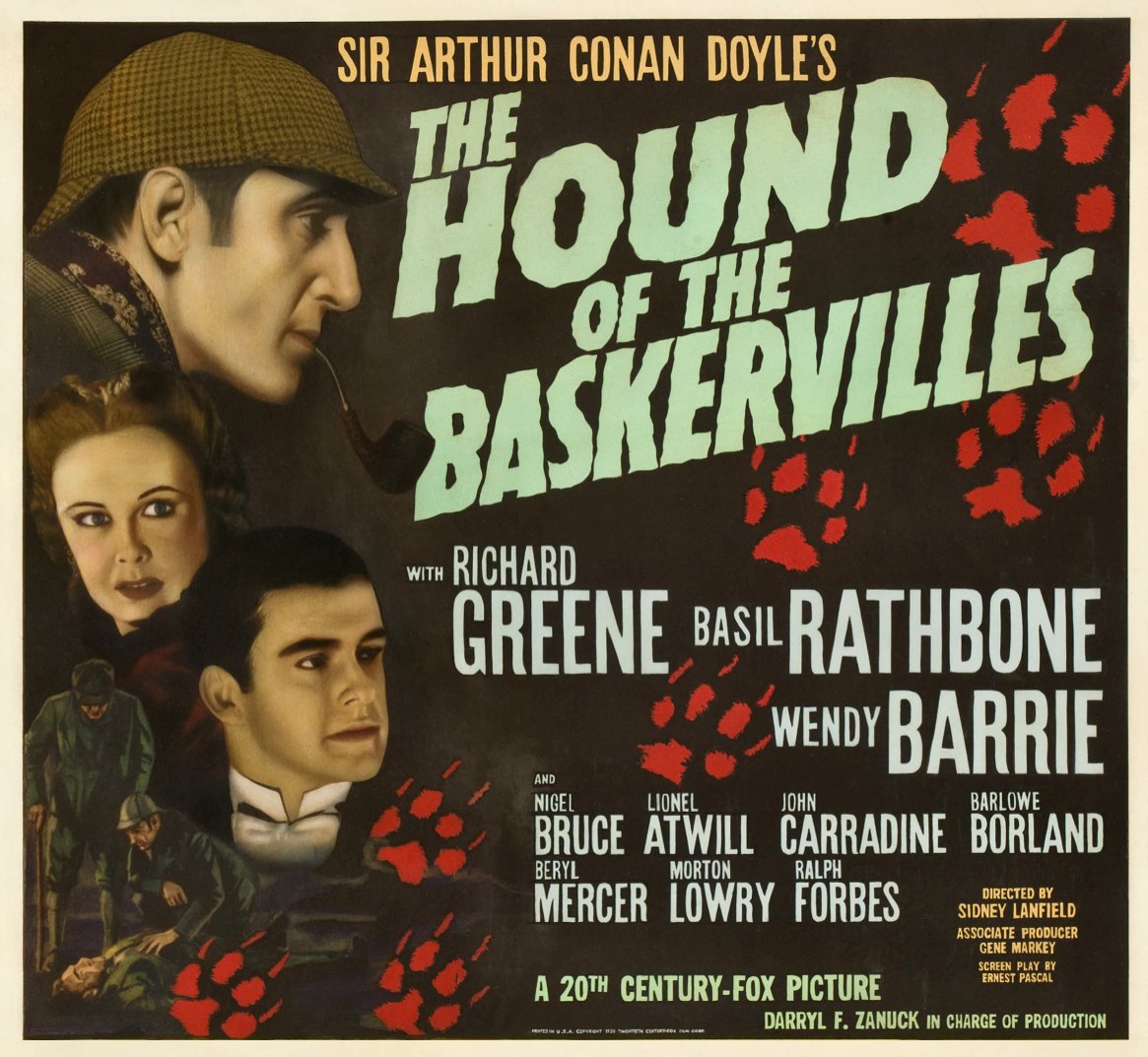
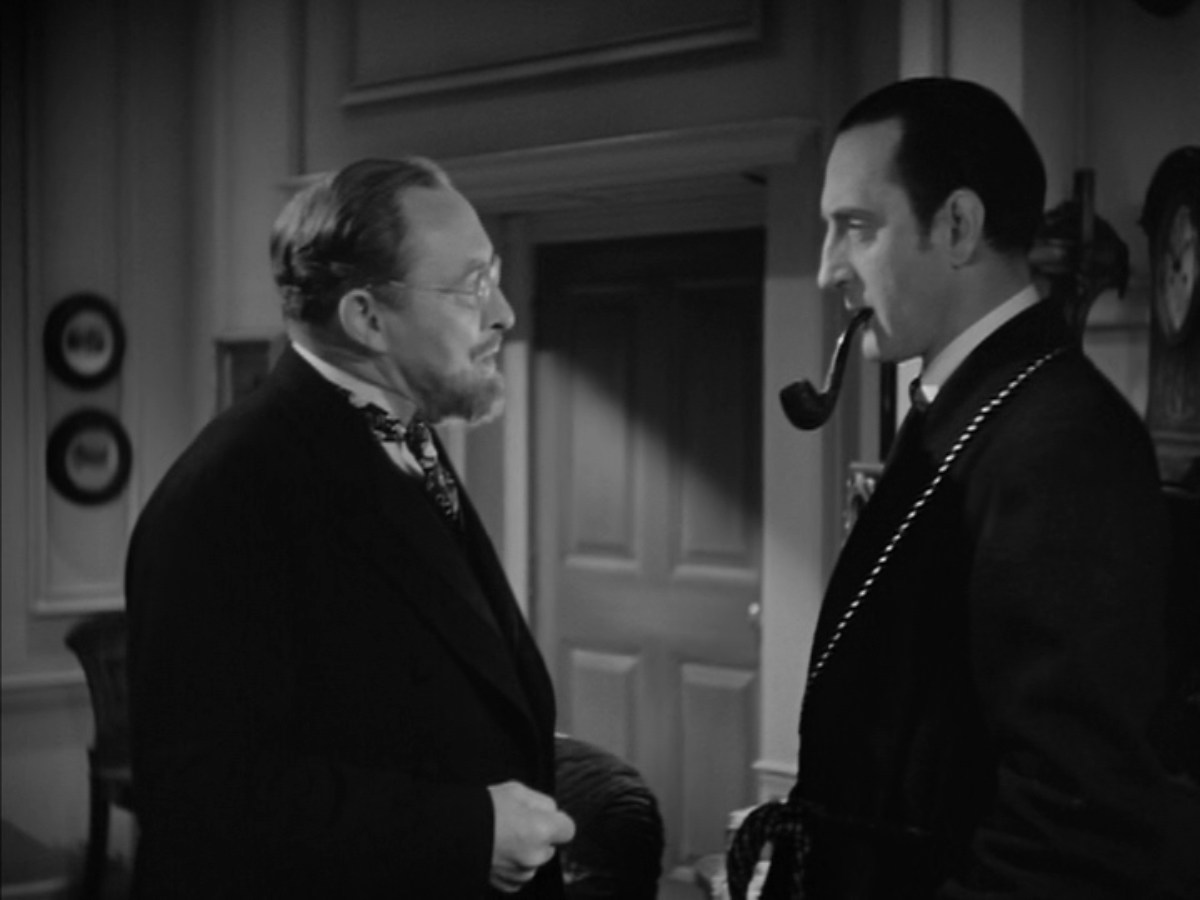 Dr. Mortimer and Holmes |
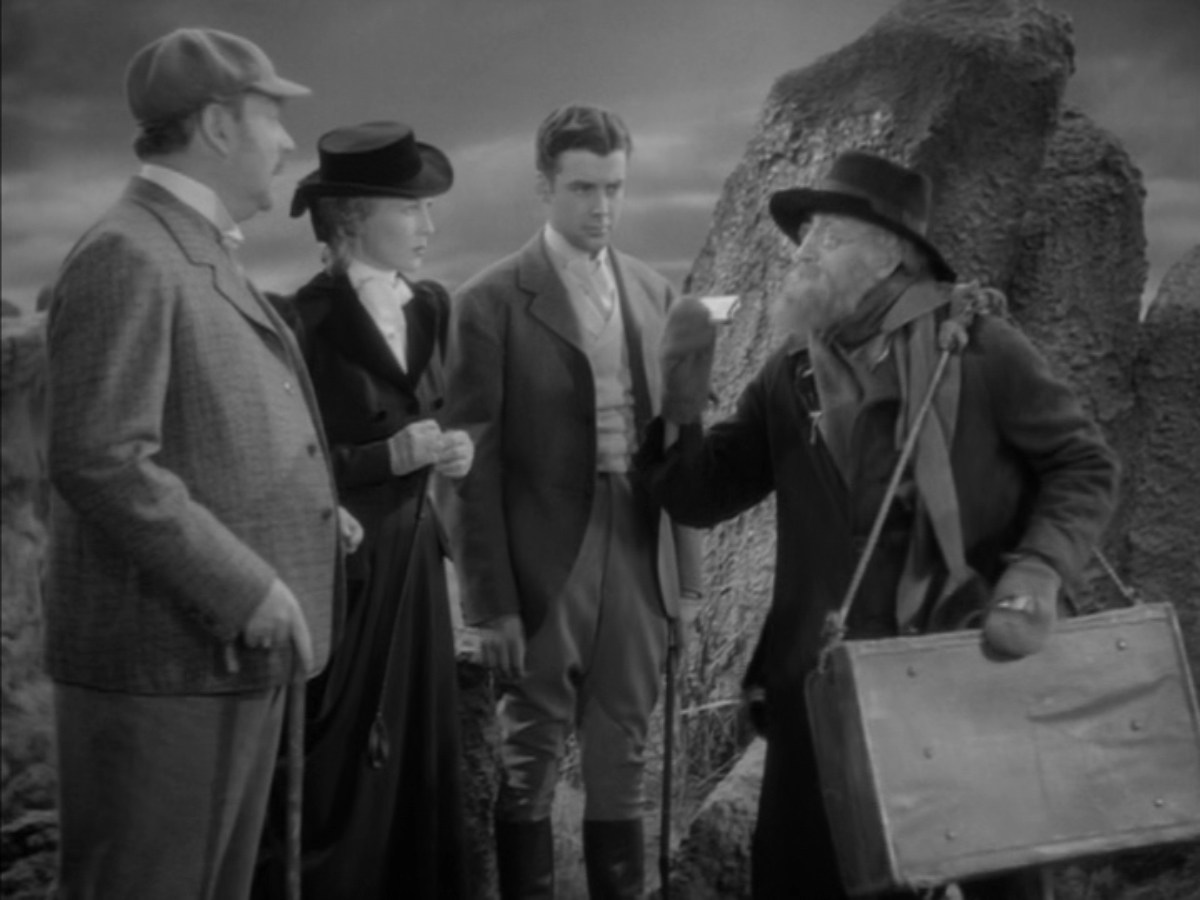 Watson, Miss Stapleton, Sir Henry, and Holmes (disguised as a peddler) |
Holmes appears as a peddler before Watson, Sir Henry and Miss Stapleton, and completely fools them. When Holmes has almost figured out the mystery, he removes his disguise, revealing himself to Watson. Watson is indignant when he realizes that Holmes has been there all the time, and didn't trust him enough to tell him! (Of course Watson has made a fool of himself by claiming to be the great detective Sherlock Holmes!) Holmes returns with Watson to Baskerville Hall to fill in some missing pieces to the puzzle. Even when Holmes has figured out who the murderer is, he cannot arrest him without evidence. Holmes says, "The only way is to catch him red-handed, to catch him in such a way that there's no escape, no alibi. And that means gambling with Sir Henry's life." Once again Holmes tells Sir Henry that he has nothing to fear, his troubles are over, and Holmes and Watson board a train headed for London. At the next stop, they disembark, take a train back and arrive at the moor just in the nick of time to save Sir Henry from being killed by the Hound. Holmes and Watson shoot the Hound dead. In the final scene, with nearly everyone present, Holmes explains how he figured out who the murderer and hound owner was. Feeling trapped, Stapleton pulls a gun on everyone, and then runs out of the house. Holmes does not give chase, explaining that the police are out in force on the roads, and the only other means of escape is across the deadly Grimpen Mire.
THE HOUND OF THE BASKERVILLES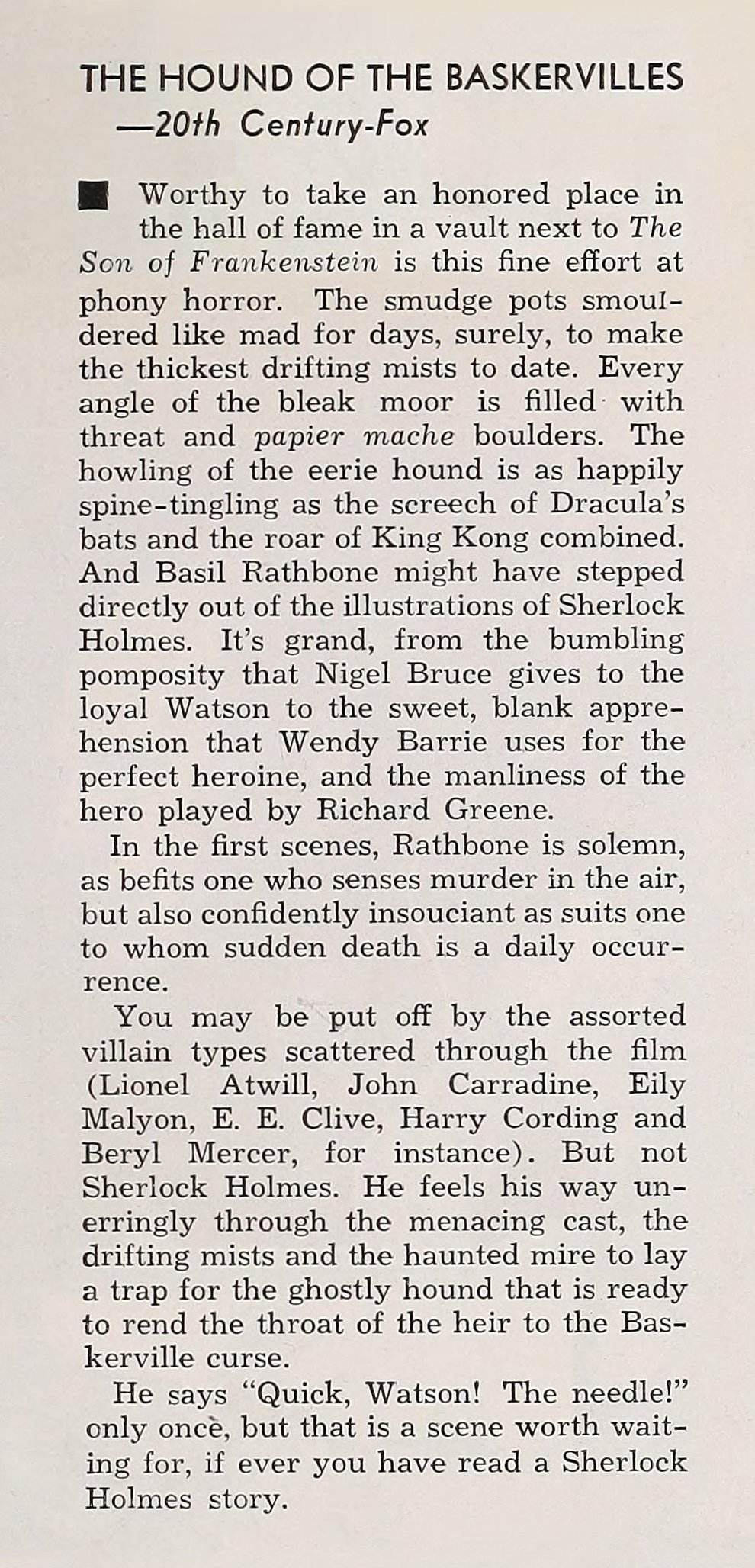 Worth to take an honored place in the hall of fame in a vault next to The Son of Frankenstein is this fine effort at phony horror. The smudge pots smouldered like mad for days, surely, to make the thickest drifting mists to date. Every angle of the bleak moor is filled with threat and papier mache boulders. The howling of the eerie hound is an happily spine-tingling as the screech of Dracula's bats and the roar of King Kong combined. And Basil Rathbone might have stepped directly out of the illustrations of Sherlock Holmes. It's grand, from the bumbling pomposity the Nigel Bruce gives to the loyal Watson to the sweet, blank apprehension that Wendy Barrie uses for the perfect heroine, and the manliness of the hero played by Richard Greene. In the first scenes, Rathbone is solemn, as befits one who senses murder in the air, but also confidently insouciant as suits one to whom sudden death is a daily occurrence. You may be put off by the assorted villain types scattered through the film (Lionel Atwill, John Carradine, Eily Malyon, E.E. Clive, Harry Cording and Beryl Mercer, for instance). But not Sherlock Holmes. He feels his way unerringly through the menacing cast, the drifting mists and the haunted mire to lay a trap for the ghostly hound that is ready to rend the throat of the heir to the Baskerville curse. He says "Quick, Watson! The needle!" only once, but that is a scene worth waiting for, if every you have read a Sherlock Holmes story. —Hollywood, June 1939 |
The Hound of the Baskervilles follows the original story by Sir Arthur Conan Doyle pretty closely. There are, however, some differences:
- The novel opens at 221B Baker Street with Holmes and Watson examining the walking stick left by Dr. Mortimer (Lionel Atwill), whom they haven't met yet. The film opens with the death of Sir Charles Baskerville and the neighbors discussing the circumstances of Sir Charles' death.
- In the novel, Mrs. Laura Lyons (Frankland's daughter) is a fairly important character, having arranged to meet Sir Charles on the night of his death. She is not mentioned in the film.
- In the novel Beryl Stapleton turns out to be married to Mr. Stapleton and only pretending to be his sister. There is no talk of an engagement to Sir Henry Baskerville. In the film Miss Stapleton (Wendy Barrie) really is the sister—step-sister, in fact, so there is a happy ending for Sir Henry (Richard Greene) and Beryl Stapleton.
- The seance scene with Mrs. Mortimer does not occur in the novel. In fact, Mrs. Mortimer does not appear as a character in the novel.
- Mrs. Hudson isn't mentioned in the novel.
- The trap that Holmes lays to catch the Hound is also different in the novel and film. In the novel Holmes, Watson and Lestrade are on the moor, waiting for Sir Henry to leave the Stapleton's house and walk home. They are ready and shoot the Hound before it has even scratched Sir Henry. In the film Holmes and Watson (minus Lestrade) are late getting to the moor because the carriage broke down and they don't reach Sir Henry and shoot the Hound before Sir Henry has been horribly mauled, almost to death. This is typical Hollywood: try to build up the suspense—"Will he get there in time to save Sir Henry?" It is out of character for Holmes to not have all the details worked out.
- In the film (and not in the novel) Holmes allows himself to get locked in the pit where the hound had been kept. How could Holmes be so stupid when he's supposed to be so brilliant?
- At the end of the film Holmes says, "Oh, Watson—the needle!" This line is not in the novel, but Holmes' use of morphine is documented in other stories. This line added nothing to the story—it's amazing that the censors allowed it.
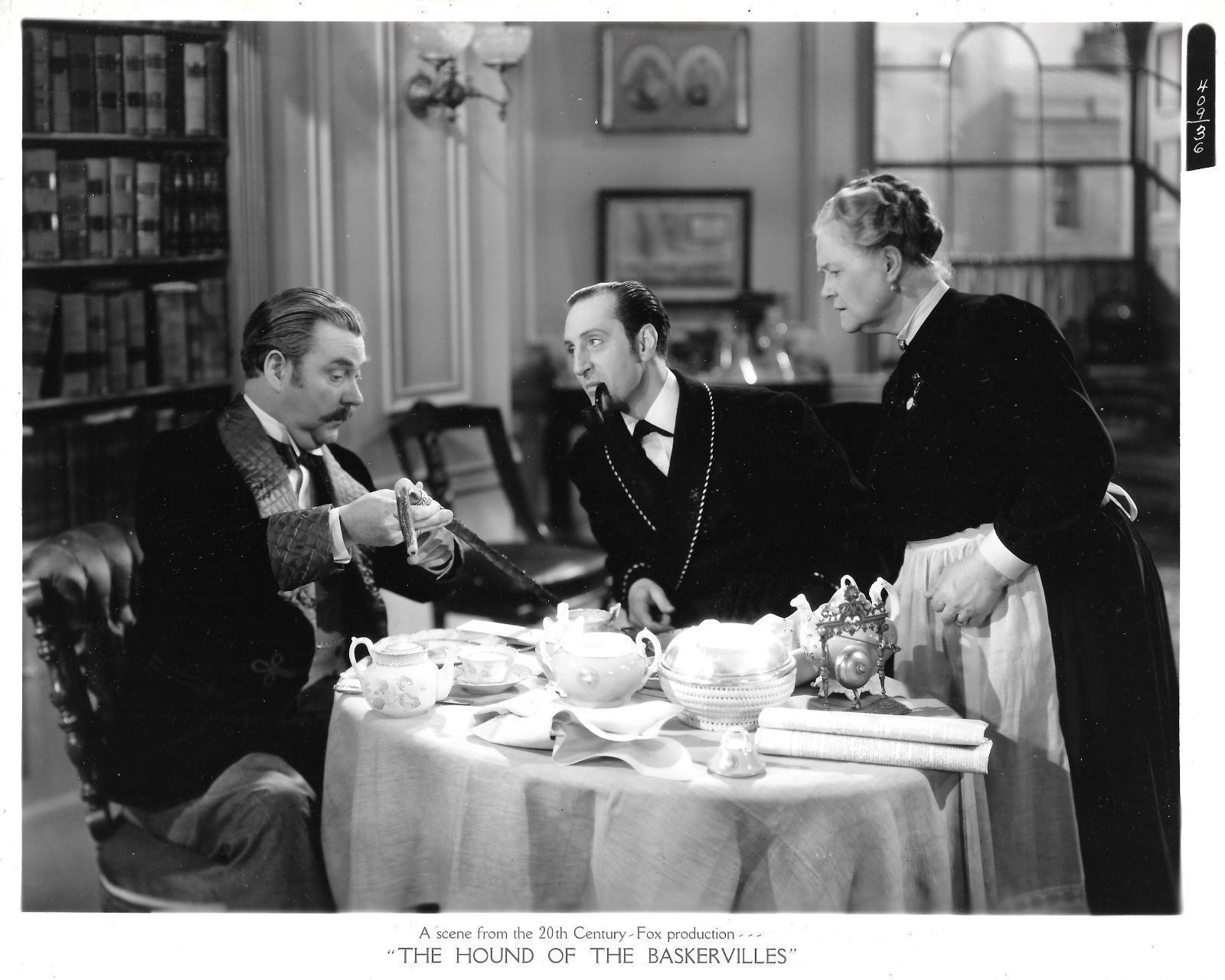 Mrs. Hudson tells Holmes he had a visitor. |
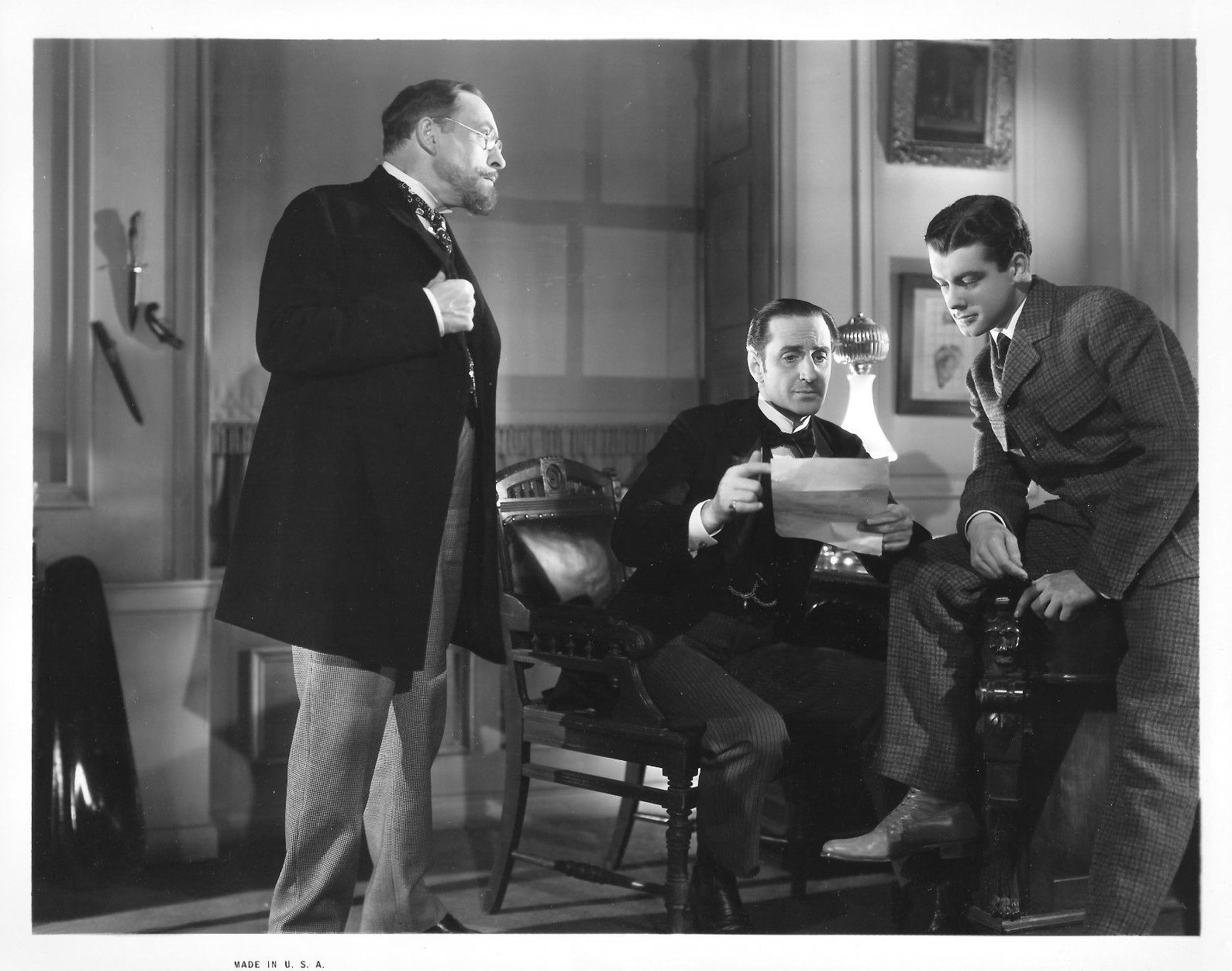 Dr. Mortimer tells Holmes and Sir Henry about the legend. |
In spite of some of the differences mentioned above, The Hound of the Baskervilles remains one of my favorite Sherlock Holmes films, and it of course established Basil Rathbone as the definitive Sherlock Holmes. I especially like the first scene with Holmes and Watson in Baker Street. The dialogue is almost word for word the same as in the novel, and the chemistry between Rathbone and Nigel Bruce is perfect. the later Universal films often feature Nigel Bruce's interpretation of Watson as a bumbling idiot, which is so different from the character appearing in Conan Doyle's stories. But in this film Bruce is much less bumbling, and actually appears to be a capable friend and physician.
Newspaper critic Rose Pelswick wrote, "Smoking the traditional pipe and playing the violin, but otherwise making the character credible rather than eccentric, Mr. Rathbone is vastly superior to the previous screen impersonators of the Baker Street genius." (quoted in Chris Steinbrunner and Norman Michaels, The Films of Sherlock Holmes)
Concerning the studio, Steinbrunner and Michaels noted that "Twentieth-Century Fox had an enormous, well-designed back lot with winding European streets ideally suited for London and the British villages detailed in the story." The liberal use of dry ice on the set created the eerie and ominous foggy atmosphere of the English moor and the ruins of a burial ground.
"The moor was an indoor set, built on a large soundstage spanning 300 by 200 feet and in such a way that different camera angles and slight redressing could trick the eye and create the impression of a vast expanse. Very helpful in this regard was a huge amount of fake fog pumped into the set; according to the studio publicity department, $93,000 of the production budget was spent on fog machines." —John M. Miller, Turner Classic Movies, http://www.tcm.com/this-month/article/247035%7C0/The-Hound-of-the-Baskervilles.html
 A pretty good Sherlock Holmes melodrama. Produced
twice before, once in 1922 and again in 1932, it still offers
entertainment for followers of murder mysteries. The production
values are, of course, superior to those of the other two pictures.
The background (that of the lonely British moors), creates an eerie
atmosphere, so that each time a character wanders out of the house
for a walk, one is held in suspense, not knowing what to expects.
Although one suspects the murderer's identity, this does not lesson
one's interest, for along with him there are several other
suspicious characters. It is in the ending, however, that the action
causes tense excitement. The scenes that show the vicious dog
running across the moors in an attempt to overtake and attack the
hero, are thrilling as well as frightening. The romance is pleasant. A pretty good Sherlock Holmes melodrama. Produced
twice before, once in 1922 and again in 1932, it still offers
entertainment for followers of murder mysteries. The production
values are, of course, superior to those of the other two pictures.
The background (that of the lonely British moors), creates an eerie
atmosphere, so that each time a character wanders out of the house
for a walk, one is held in suspense, not knowing what to expects.
Although one suspects the murderer's identity, this does not lesson
one's interest, for along with him there are several other
suspicious characters. It is in the ending, however, that the action
causes tense excitement. The scenes that show the vicious dog
running across the moors in an attempt to overtake and attack the
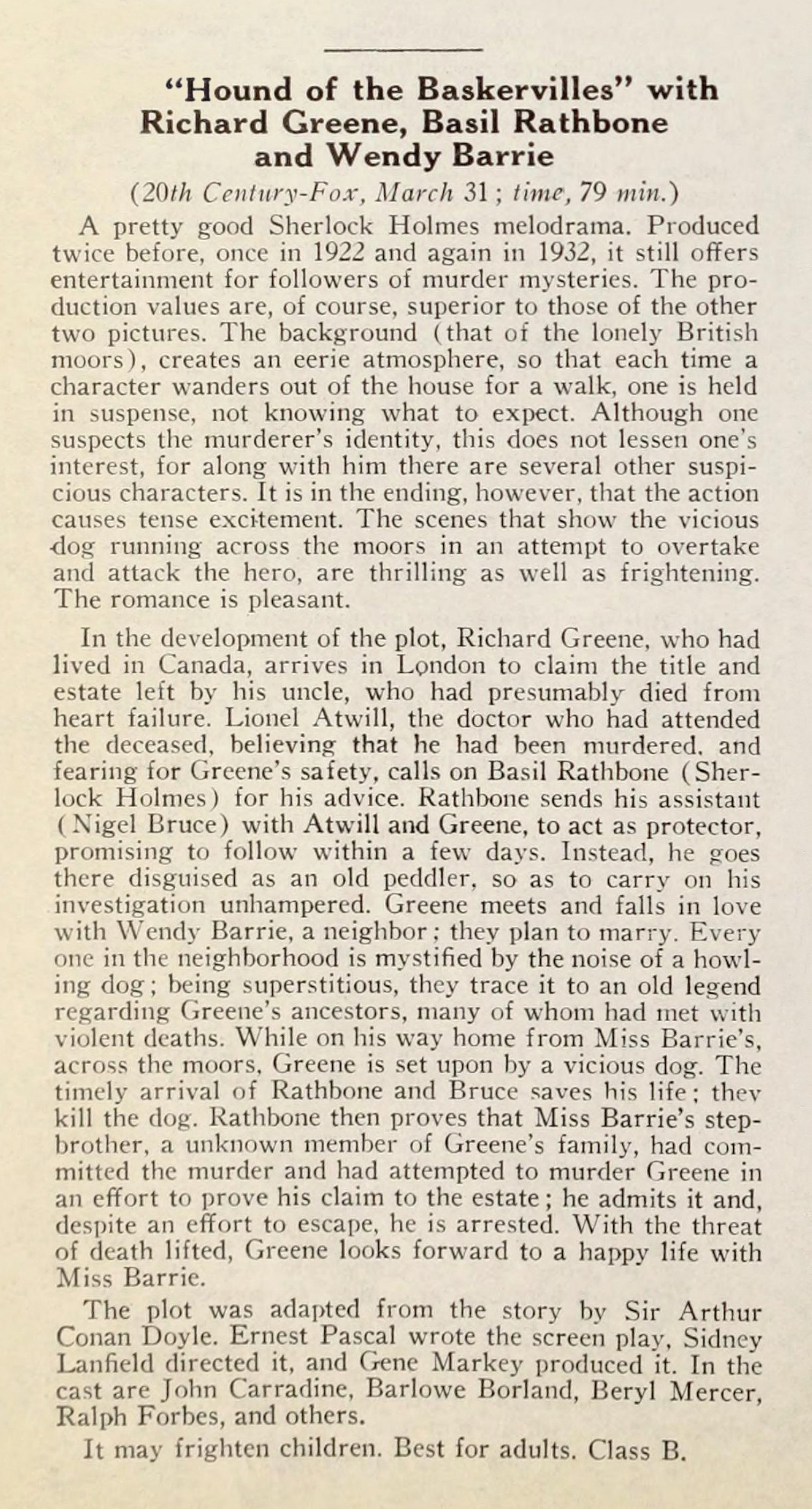
hero, are thrilling as well as frightening. The romance is pleasant.In the development of the plots, Richard Greene, who had lived in Canada, arrives in London to claim the title and estate left by his uncle, who had presumably died from heart failure. Lionel Atwill, the doctor who had attended the deceased, believing that he had been murdered, and fearing for Greene's safety, calls on Basil Rathbone (Sherlock Holmes) for his advice. Rathbone sends his assistant (Nigel Bruce) with Atwill and Greene, to act as protector, promising to follow within a few days. Instead, he goes there disguised as an old peddler, so as to carry on his investigation unhampered. Greene meets and falls in love with Wendy Barrie, a neighbor; they plan to marry. Every one in the neighborhood is mystified by the noise of a howling dog; being superstitious, they trace it to an old legend regarding Greene's ancestors, many of whom had met with violent deaths. While on his way home from Miss Barrie's, across the moors, Greene is set upon by a vicious dog. The timely arrival of Rathbone and Bruce saves his life; they kill the dog. Rathbone then proves that Miss Barrie's stepbrother, an unknown member of Greene's family, had committed the murder and had attempted to murder Greene in an effort to prove his claim to the estate; he admits it and, despite an effort to escape, he is arrested. With the threat of death lifted, Greene looks forward to a happy life with Miss Barrie. The plot was adapted from the story by Sir Arthur Conan Doyle. Ernest Pascal wrote the screen play, Sidney Lanfield directed it, and Gene Markey produced it. In the cast are John Carradine, Barlowe Borland, Beryl Mercer, Ralph Forbes, and others. It may frighten children. Best for adults. Class B. —Harrison's Reports, April 1, 1939 |
Nigel Bruce wrote the following in his memoirs (posted on the Scarlet Street forums):
| "The Hound of the Baskervilles, which is perhaps
Conan Doyle's most exciting adventure of Sherlock Holmes, was
selected as the first vehicle for Basil and myself. Much of the
picture was made in a huge stage on the 20th-Century back lot. The
entire stage was surrounded by a circular screen of canvas on which
was painted a very lifelike picture of Dartmoor. The centre of the
stage was filled with large boulders made of plaster of paris. Here
and there a bridge was seen and several caves were visible. Running
through the boggy marsh-like ground were several small streams. For
eight weeks we worked in this set, and the atmosphere was most
unpleasant as the fog which was necessary to the story was made by
artificial methods and freshly pumped into the stage after every
shot. The effect reached, however, was eerie and foreboding and the
picture turned out to be an excellent one. Basil Rathbone looked exactly like every picture that one has ever seen of Sherlock Holmes; and the cast, which was a good one, included Wendy Barrie, Lionel Atwill, John Carradine and an attractive young newcomer from England by the name of Richard Greene. Our director was Sidney Lanfield. Lanfield had the reputation of being a tartar, but after a few outbursts during the first few days, Basil and I got on splendidly with him. Each morning we greeted him with great affection and both of us would plant a kiss on his furrowed brow. After each take we would shake hands and solemnly congratulate one another on our 'excellent performance.' We took the whole film in a mood of light-hearted enjoyment which left Sidney, who was accustomed to arguments and scenes, in a state of complete bafflement, and he gave up losing his temper in sheer self-defense. The result of this was that we all worked happily together and enjoyed every moment on the picture. I never worked with a nicer man than Basil, and I never acted with a more unselfish or more cooperative actor. The Baskervilles took from December 29th, 1938, to the 8th of March, 1939, and in the picture I earned nearly $10,000. The Hound of the Baskervilles was released....and its reception both in America and in England, where we felt they would be more critical, was beyond our wildest hopes. Basil was hailed as a splendid Sherlock Holmes and the critics not only gave him high praise but remarked that his resemblance to the general idea of the great detective was amazing. As Doctor Watson, I seemed to amuse and satisfy the many devoted admirers of the Conan Doyle characters. The London Sunday Pictorial said this of the film: 'In my excitement I dropped my hat, cigarettes, gloves and matches, and I let them stay on the floor until the lights went up.'" |
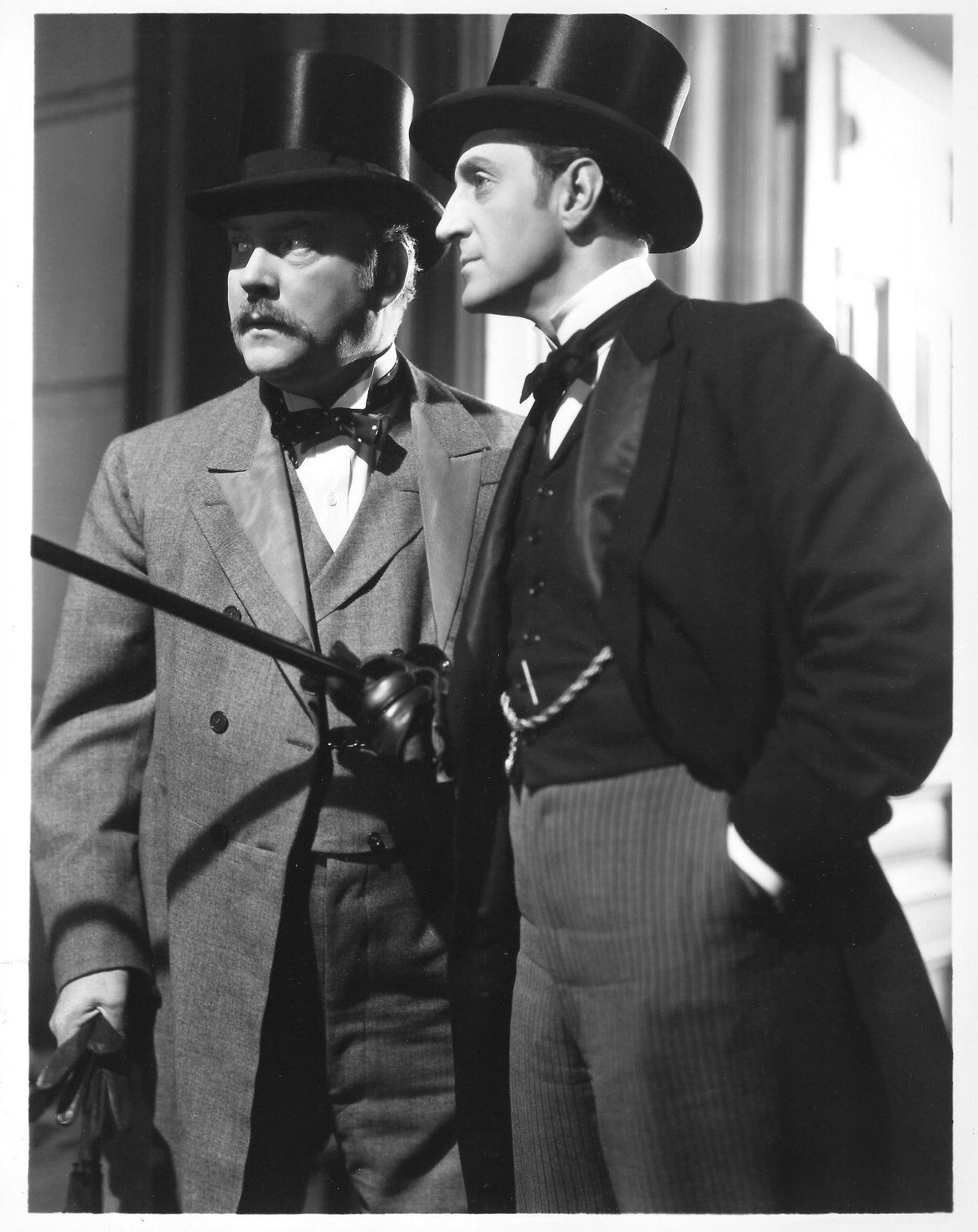 Holmes observes a cab following Sir Henry. |
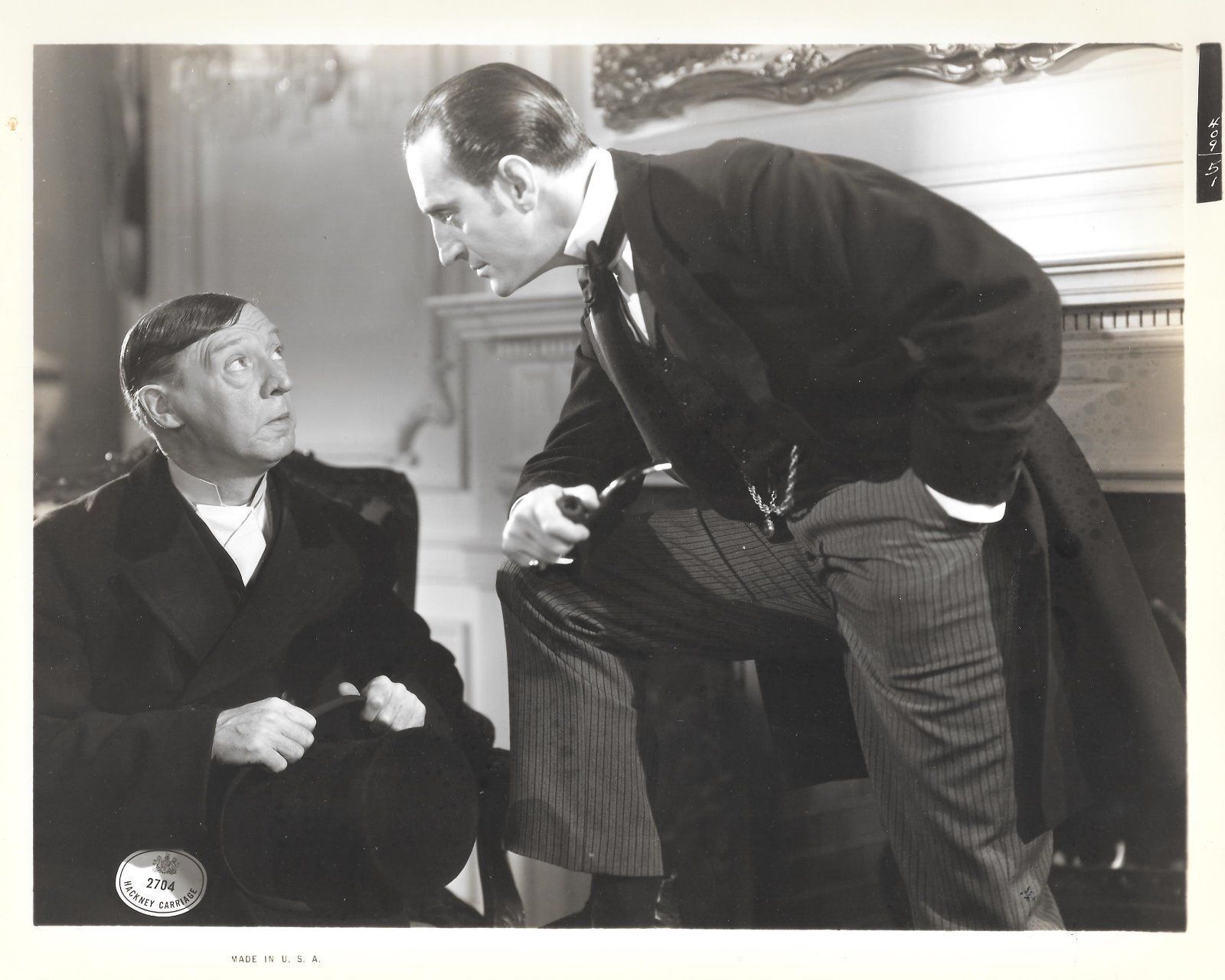 Holmes questions the cabby. |
This was the only film that Richard Greene and Basil Rathbone made together.
Wendy Barrie had previously acted with Basil Rathbone in 1935's A Feather in Her Hat.
Morton Lowry (Stapleton) had previously appeared with Rathbone in The Dawn Patrol, and later appeared in Pursuit to Algiers.
Lionel Atwill (Dr. Mortimer) would later play Moriarty in Sherlock Holmes and the Secret Weapon. He also appeared with Rathbone in Son of Frankenstein and The Sun Never Sets.
John Carradine (Barryman) acted with Basil Rathbone many years later in The Last Hurrah (1958), Hillbillys in a Haunted House (1967), and Autopsy of a Ghost (1967).
The Hound was played by a 140-pound Great Dane named Chief. He appeared suitably ferocious to frighten audiences even though no "glow-in-the-dark" phosphorus was used on him (as was on the hound in the novel).
THE HOUND OF THE BASKERVILLES Examination of "The Hound of the Baskervilles" bares several matters of exploitation importance. Its author, Sir Arthur Conan Doyle, undoubtedly did more than any other writer to precipitate the flood of detective stories in fiction, in stage plays and on the screen. Certainly his hero, Sherlock Holmes, is the direct ancestor of all modern slick sleuths, just as Doctor Watson is the sire of comedy stooges. The book itself is a time proved thriller. Millions have read it. This is the third time, but first since 1922, that the story comes to screen realism, now through the photoplay writing talents of Ernest Pascal, whose recent credits include "Kidnapped," "Love Under Fire" and "Wee Willie Winkie," "Sing, Baby, Sing," "One in a Million," "Thin Ice" and "Wake Up and Live" are numbered among director Sidney Lanfield's accomplishments. The English aspect and character of the pet thriller is continued further in cast assignments. Richard Greene ... will play the role of "Sir Henry Baskerville." Basil Rathbone, outstanding in "If I Were King," "Son of Frankenstein" and "Adventures of Robin Hood," will be "Sherlock Holmes"; Nigel Bruce is "Doctor Watson." The girl whose romance with "Baskerville" looses terror on the bleak moors is Wendy Barrie. Among others having important parts are Lionel Atwill, John Carradine, Barlowe Borland, Beryl Mercer, Morton Lowry, Ralph [Forbes], E.E. Clive and Eily Malyon. While there is an element of weird horror in the story, the yarn is not an out and out bloodcurdler. The elements of love interest, comedy and mystery are just as important. The importance which Darryl Zanuck has attached to production detail is seen in his selection of Richard Day as art director. He designed the settings for many Samuel Goldwyn pictures as well as those which will be seen in "The Little Princess." The battery of camera men is headed by Peverll Marley, who has photographed many of Hollywood's biggest pictures such as "In Old Chicago," "Alexander's Ragtime Band" and "Suez." The plot and character of "The Hound of the Baskervilles" is familiar. The locale is a fog-drenched, terror-legended moor in England's Devonshire country. Everybody knows about the fierce hound that is the principal instrument of horror. To this eerie background comes a young Canadian to claim his inheritance and find love, but to be made a victim of fear-breeding superstition. —Motion Picture Herald, March 4, 1939 |
"Had I made but the one Holmes picture, my first, The Hound of the Baskervilles, I should probably not be as well known as I am today. But within myself, as an artist, I should have been well content. Of all the 'adventures' The Hound is my favorite story, and it was in this picture that I had the stimulating experience of creating, within my own limited framework, a character that has intrigued me as much as any I have ever played." —Basil Rathbone, In and Out of Character
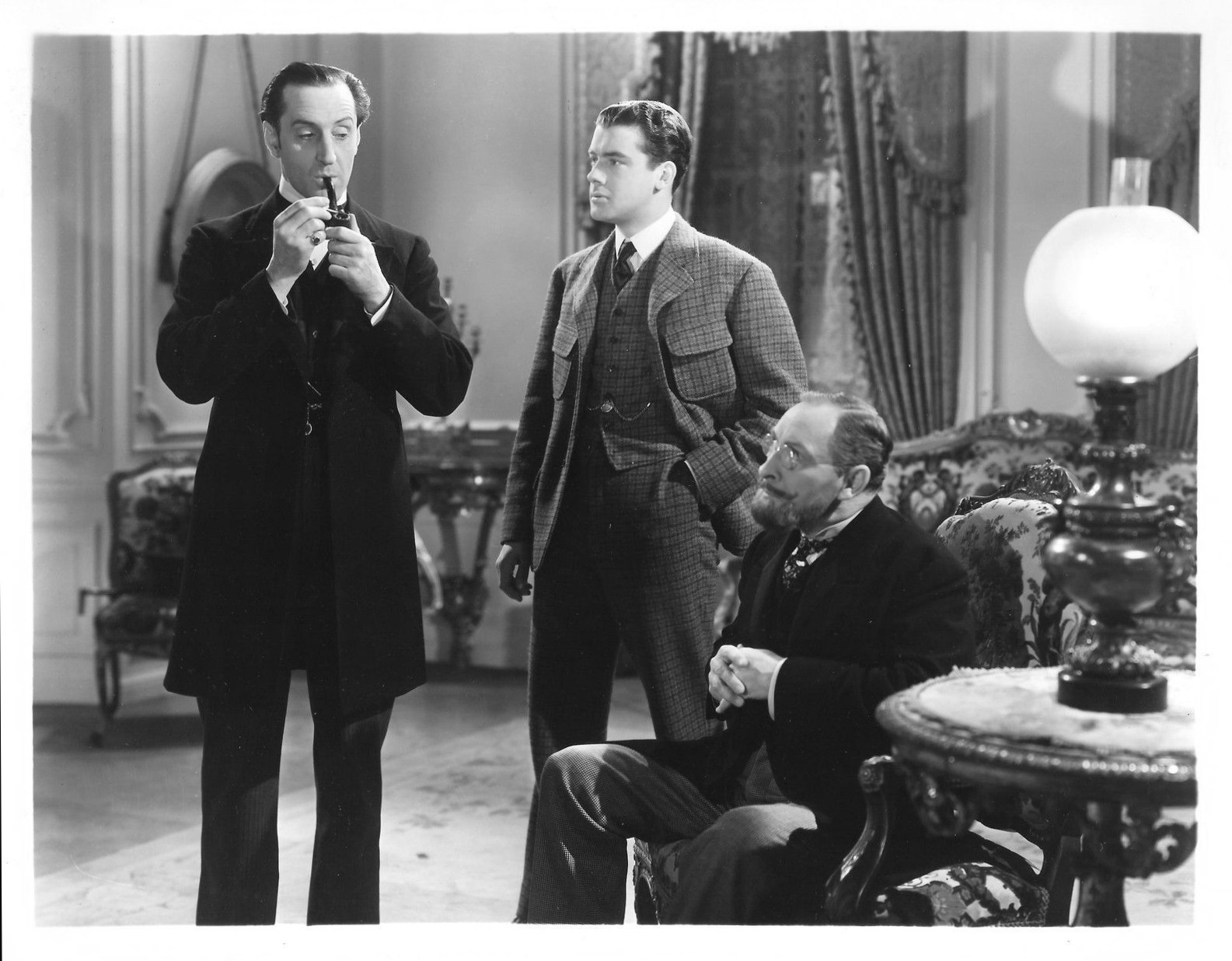 Holmes assures Sir Henry that he's not in danger. |
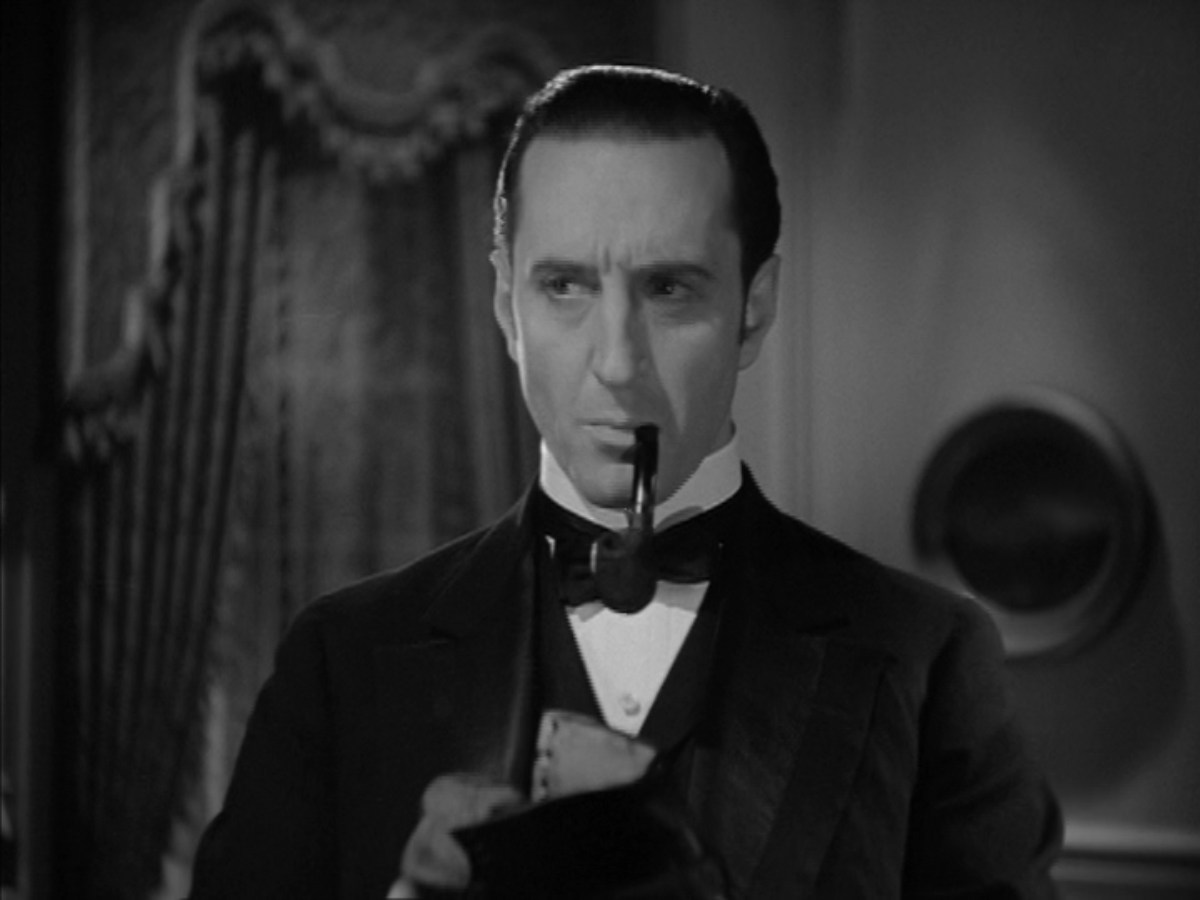 But Holmes knows that Sir Henry really is in danger. |
"One of the best screen versions of this oft-told tale. ... A big hit in a year of big hits, The Hound of the Baskervilles firmly established Basil Rathbone and Nigel Bruce as moviedom's definitive Sherlock Holmes and Dr. Watson." —Hal Erickson, Rovi
Hound of the Baskervilles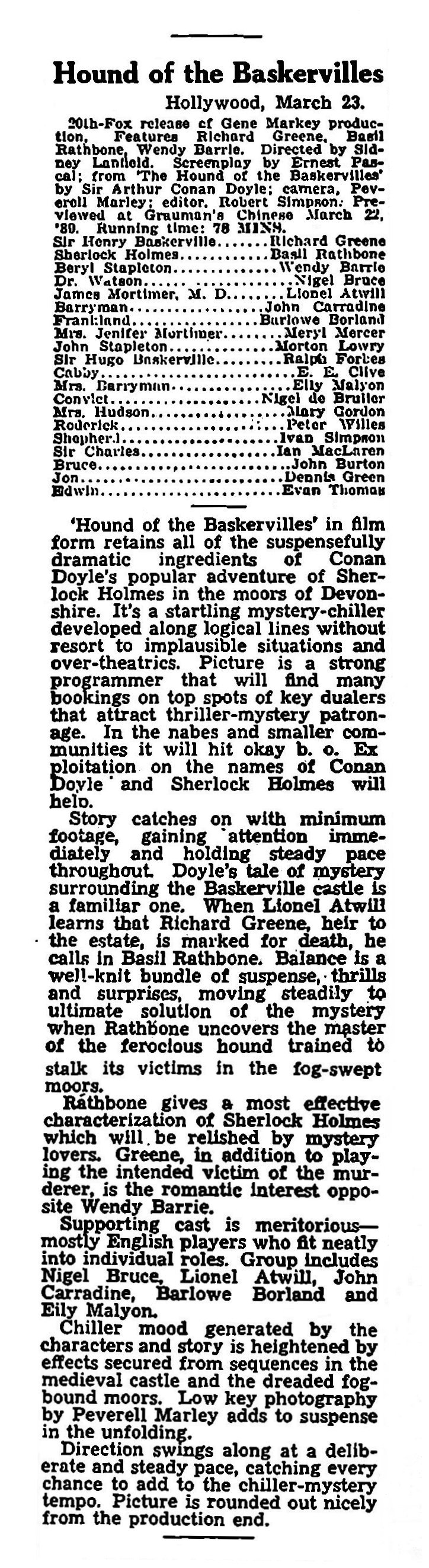 'Hound of the Baskervilles' in film form retains all of the suspensefully dramatic ingredients of Conan Doyle's popular adventure of Sherlock Holmes in the moors of Devonshire. It's a startling mystery-chiller developed along logical lines without resort to implausible situations and over-theatrics. Picture is a strong programmer that will find many bookings on top spots of key dualers that attract thriller-mystery patronage. In the nabes and smaller communities it will hit okay b.o. Exploitation on the names of Conan Doyle and Sherlock Holmes will help. Story catches on with minimum footage, gaining attention immediately and holding steady pace throughout. Doyle's tale of mystery surrounding the Baskerville castle is a familiar one. When Lionel Atwill learns that Richard Green, heir to the estate, is marked for death, he calls in Basil Rathbone. Balance is a well-knit bundle of suspense, thrills and surprises, moving steadily to ultimate solution of the mystery when Rathbone uncovers the master of the ferocious hound trained to stalk its victims in the fog-swept moors. Rathbone gives a most effective characterization of Sherlock Holmes which will be relished by mystery lovers. Greene, in addition to playing the intended victim of the murderer, is the romantic interest opposite Wendy Barrie. Supporting cast is meritorious—mostly English players who fit neatly into individual roles. Group includes Nigel Bruce, Lionel Atwill, John Carradine, Barlowe Borland and Eily Malyon. Chiller mood generated by the characters and story is heightened by effects secured from sequences in the medieval castle and the dreaded fog-bound moors. Low key photography by Peverell Marley adds to suspense in the unfolding. Direction swings along at a deliberate and steady pace, catching every chance to add to the chiller-mystery tempo. Picture is rounded out nicely from the production end. —Variety, March 29, 1939 |
"Putting its straightest face upon the matter and being as weird as all get-out, the film succeeds rather well in reproducing Sir Arthur's macabre detective story along forthright cinema lines. The technicians have whipped up a moor at least twice as desolate as any ghost-story moor has need to be, the mist swirls steadily, the savage howl of the Baskerville hound is heard at all the melodramatically appropriate intervals and Mr. Holmes himself, with hunting cap, calabash and omniscience, whispers from time to time, 'It's murder, Watson, murder!'" —Frank Nugent, The New York Times, March 25, 1939
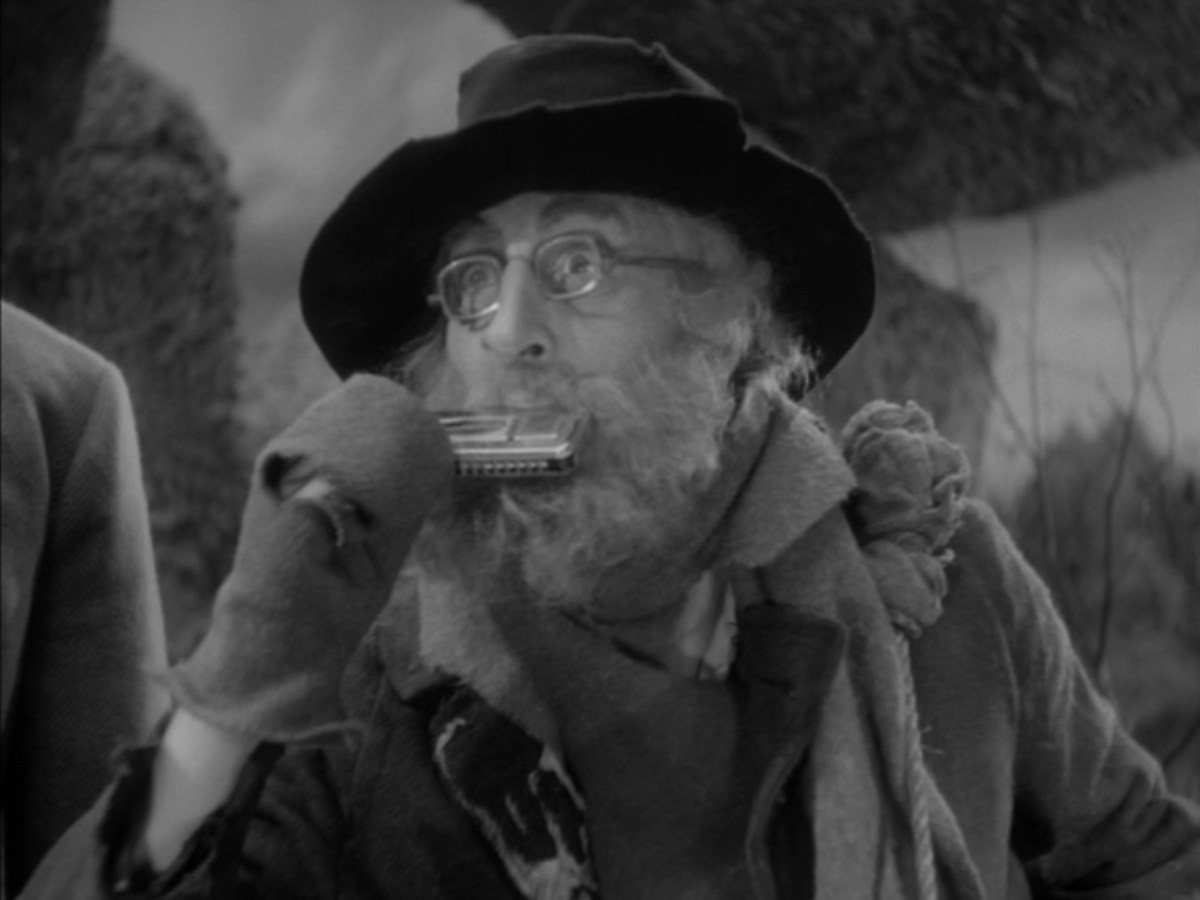 Holmes, disguised as a peddler. |
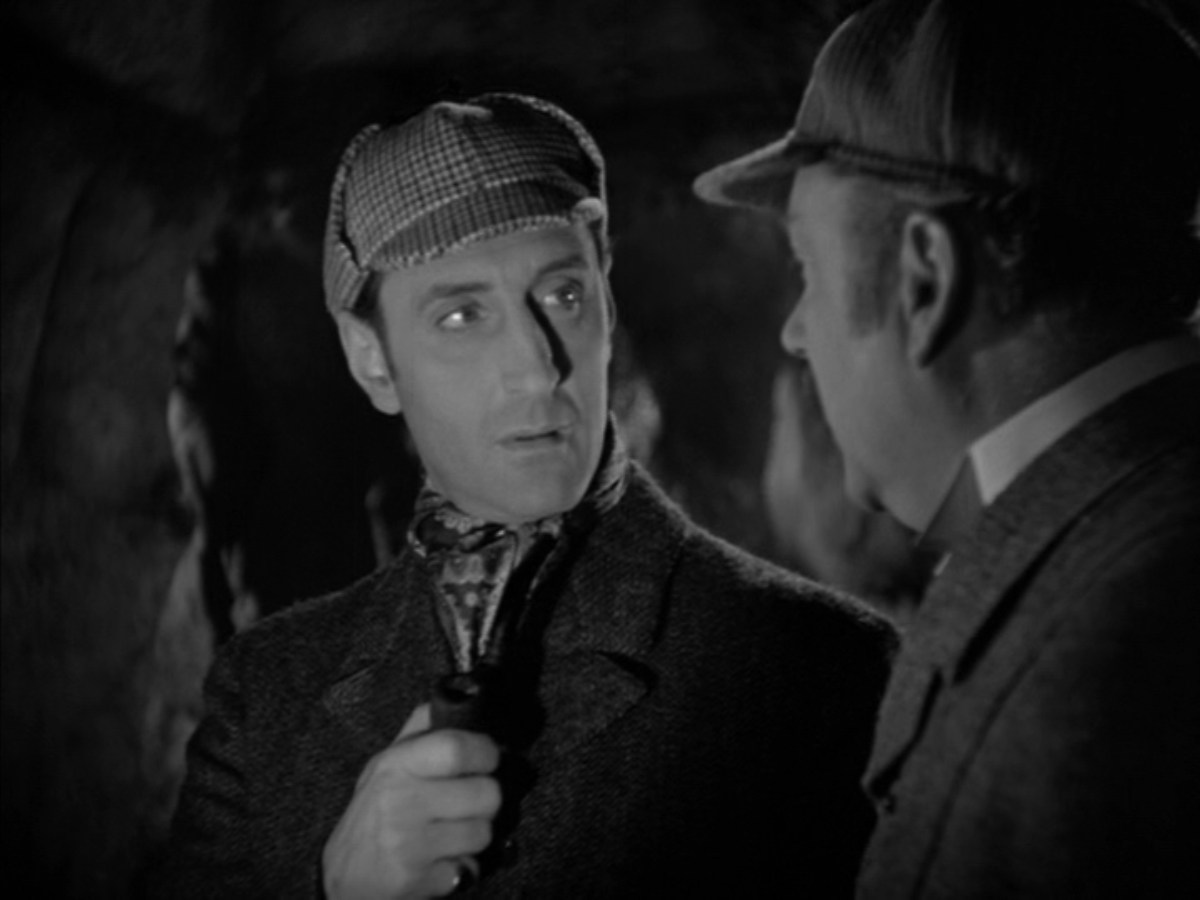 Holmes explains why he needed to be in disguise. |
"This mystery will have you holding on to your seats— It is indeed a pleasure to find Sherlock Holmes back on the screen this month. Especially when he is played by that grand actor Basil Rathbone, who is simply Mr. Holmes to a T." —Silver Screen, June 1939
"The Hound of the Baskervilles"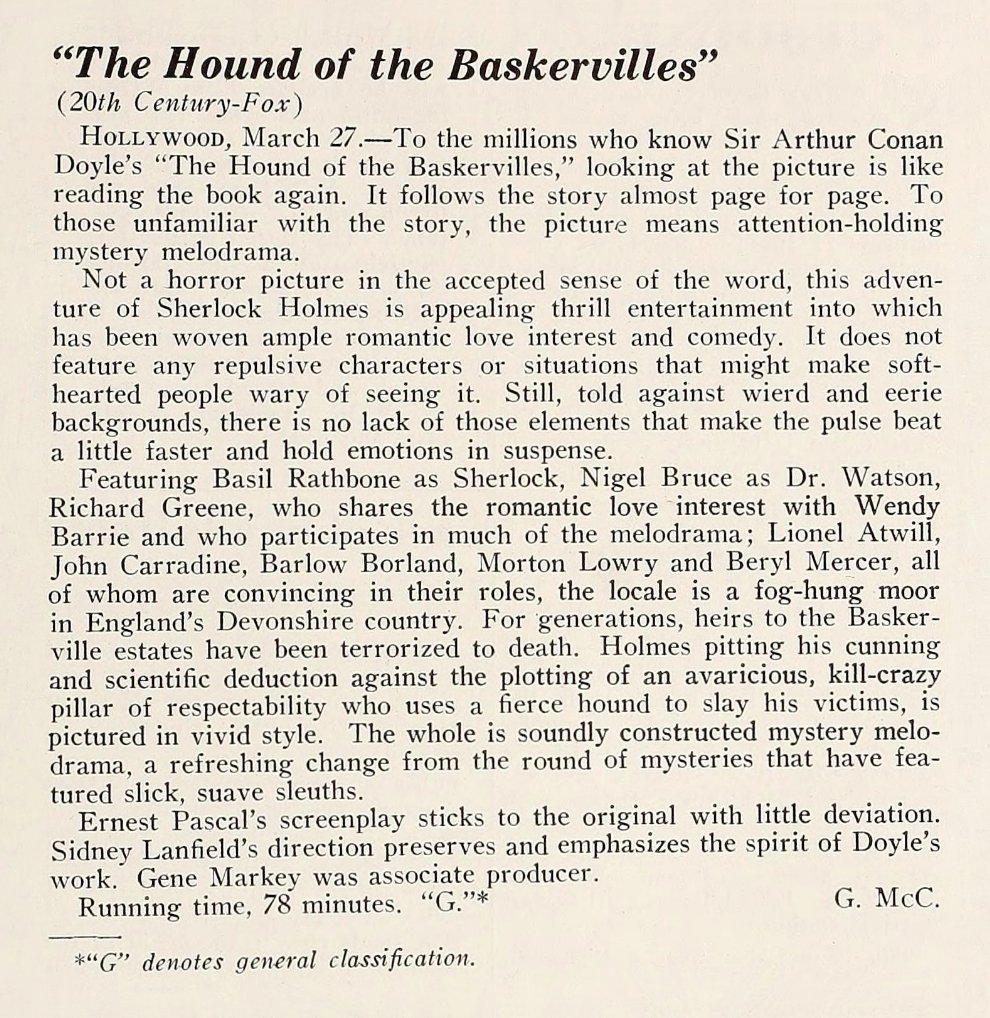 To the millions who know Sir Arthur Conan Doyle's "The Hound of the Baskervilles," looking at the picture is like reading the book again. It follows the story almost page for page. To those unfamiliar with the story, the picture means attention-holding mystery melodrama. Not a horror picture in the accepted sense of the word, this adventure of Sherlock Holmes is appealing thrill entertainment into which has been woven ample romantic love interest and comedy. It does not feature any repulsive characters or situations that might make soft-hearted people wary of seeing it. Still, told against weird and eerie backgrounds, there is no lack of those elements that make the pulse beat a little faster and hold emotions in suspense. Featuring Basil Rathbone as Sherlock, Nigel Bruce as Dr. Watson, Richard Greene, who shares the romantic love interest with Wendy Barrie and who participates in much of the melodrama; Lionel Atwill, John Carradine, Barlow Borland, Morton Lowry and Beryl Mercer, all of whom are convincing in their roles, the locale is a fog-hung moor in England's Devonshire country. For generations, heirs to the Baskerville estates have been terrorized to death. Holmes pitting his cunning and scientific deduction against the plotting of an avaricious, kill-crazy pillar of respectability who uses a fierce hound to slay his victims, is pictured in vivid style. The whole is soundly constructed mystery melodrama, a refreshing change from the round of mysteries that have featured slick, suave sleuths. Ernest Pascal's screenplay sticks to the original with little deviation. Sidney Lanfield's direction preserves and emphasizes the spirit of Doyle's work. Gene Markey was associate producer. G. McC. —Motion Picture Daily, March 28, 1939 |
"Basil Rathbone manages a Sherlock which should satisfy the exigent, and Nigel Bruce's Watson blunders through the mess of crime in fine spirits. The story may have been written thirty-seven years ago, but it still stands up." —John Mosher, The New Yorker, April 1, 1939
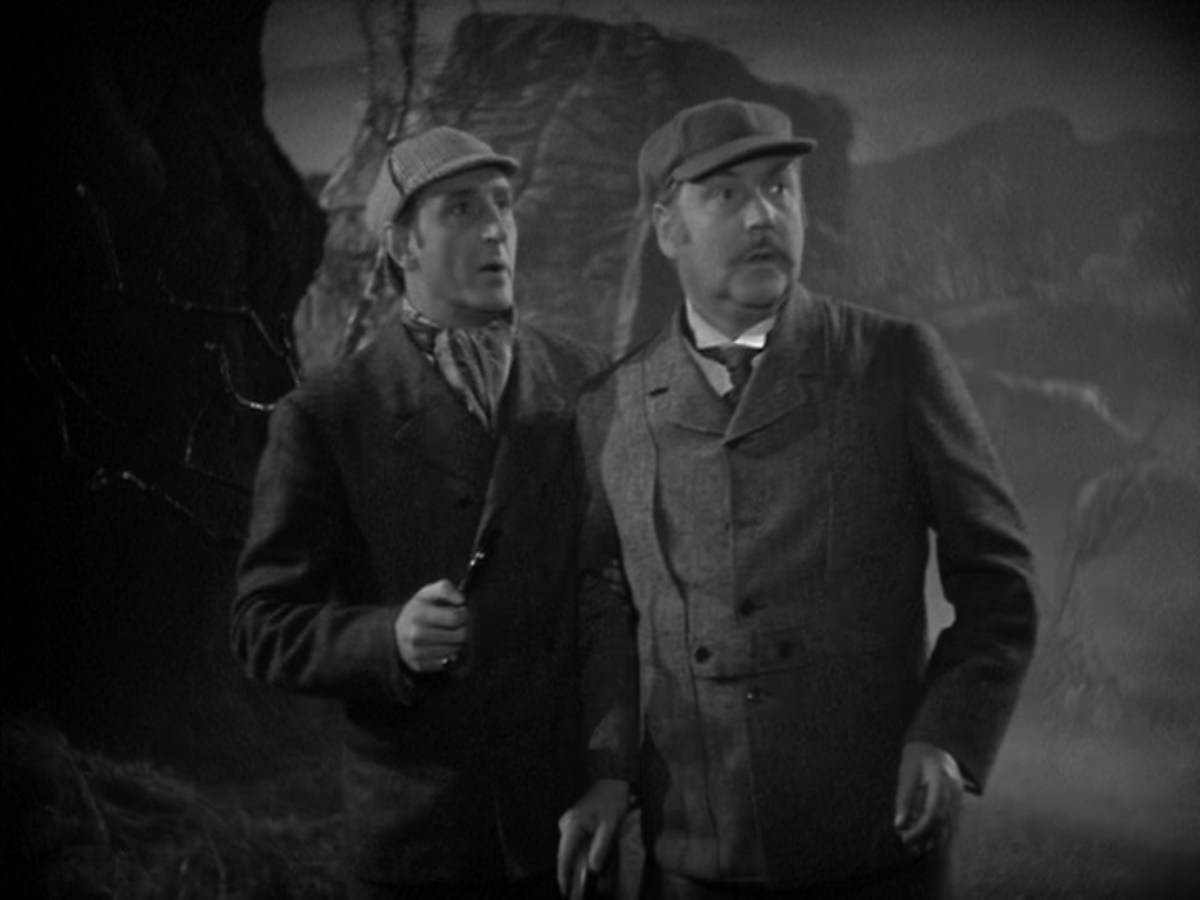 Holmes and Watson hear the howl of the hound. |
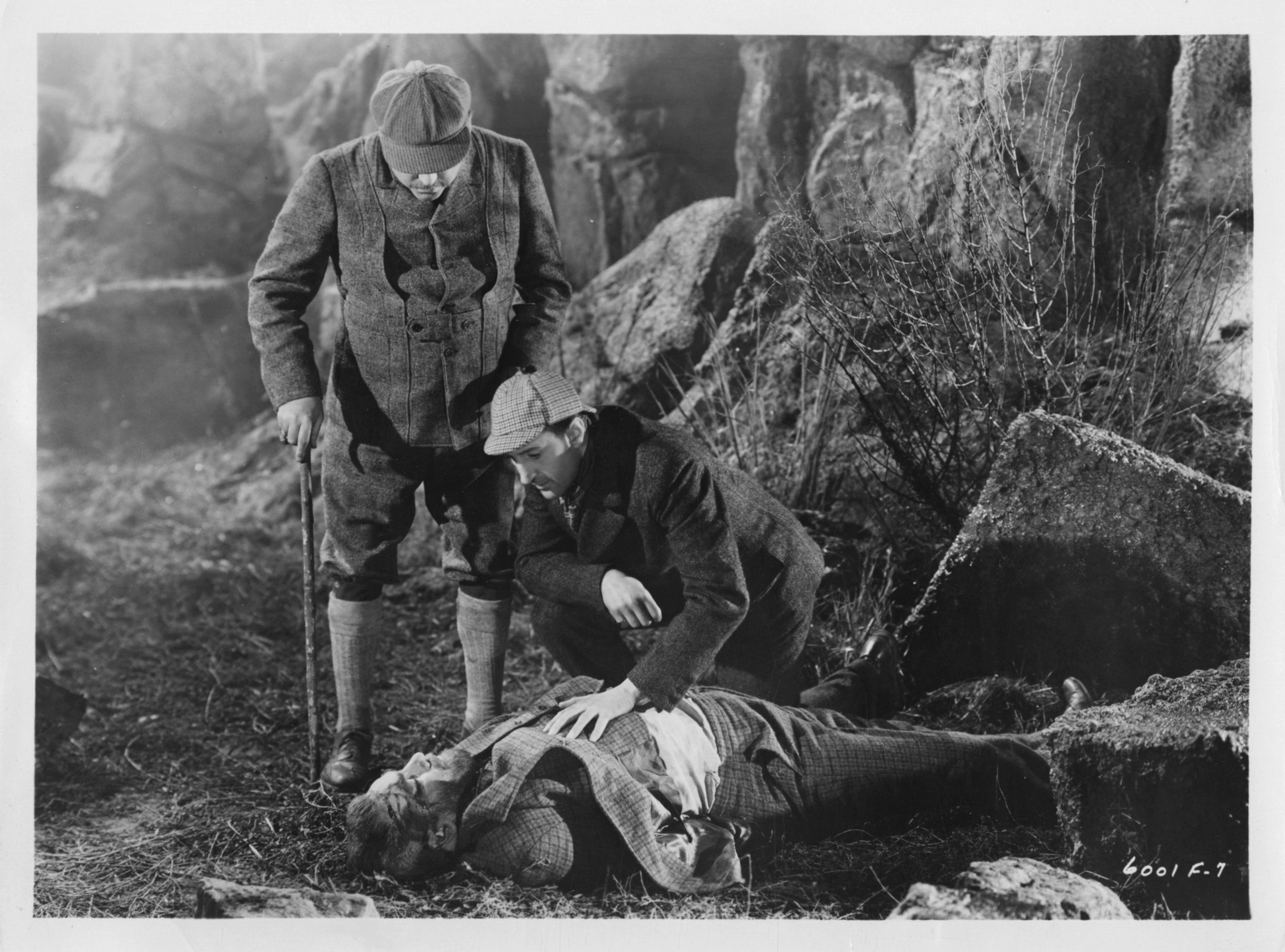 Holmes and Watson find the body of the convict. |
"The Hound of the Baskervilles makes few compromises in establishing itself as an unblushing 'chiller.' It hews straight to the line and spares no bone-rattling in striking out to the end. What few compromises it makes are expressly in the interests of artful performances and somewhat impressionistic scenic embellishments. It thus attaches to itself a Class A feeling throughout, while exerting a sustained appeal to 'horror picture' addicts." —The Reporter, March 27, 1939
See more photos and reviews of The Hound of the Baskervilles on page 2.
See Posters, Lobby Cards and Promo Photos on page 3.
.
|
|
The Hound of the Baskervilles is available on DVD
|
Images on this page and pages two and three are from the film The Hound of the Baskervilles, copyright 20th Century Fox.
